Obsiva: Voice + Photos — AI-Generated Inspection Reports on Mobile

Obsiva uses phone photos, annotations, and voice input to have AI automatically generate structured PDF inspection reports.
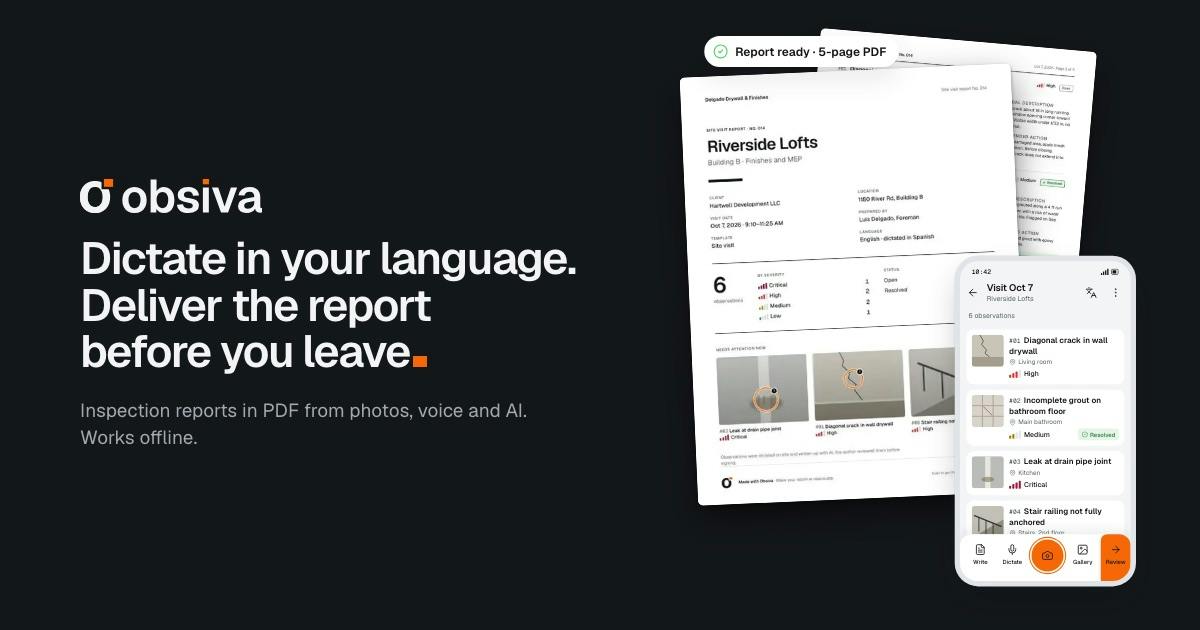
Obsiva is a vertical AI tool on Product Hunt targeting construction site inspections in industries like construction and property management. On-site personnel photograph, annotate problem locations, and dictate findings; AI then generates a description, severity, responsible party, and corrective action for each finding and compiles them into a structured PDF report, so users have results before leaving the site. It supports offline work and English-Spanish bilingual reports, and follow-up inspections can track unresolved issues via before-and-after photos. A free Android version is available, with Pro adding unlimited reports, cloud backup, and custom logo. The product received 66 upvotes and ranked 17th; community discussion is not yet active, and real-world reliability remains to be validated.
Writing construction site inspection reports is often time-consuming and laborious, and Obsiva, a new product on Product Hunt, aims to change that process. It lets on-site personnel take photos, annotate issues, and dictate findings via voice on their phones, with AI automatically generating a structured PDF inspection report.
Core Features: From Field Data to Professional Reports
Obsiva's workflow is straightforward: users photograph the site, mark problem locations on the photos, and then dictate their findings. The AI generates a description, severity level, responsible party, and corrective action for each finding based on these inputs, then compiles them into an executive summary. The entire process happens on the phone, so users can have the report in hand before leaving the site.
This design targets inspection scenarios in industries such as construction and property management. Traditionally, inspectors need to take handwritten notes, archive photos, and then organize everything into documents after returning to the office — time-consuming and prone to missing details. Obsiva moves the report generation step to the field, reducing information loss during handoffs.
Structured reports refer to document formats that organize content according to fixed fields (such as issue description, severity, responsible party, corrective action, photographic evidence, etc.). Compared with free-form text, structured reports are easier to search, tally, and compare across projects, and are more readily adopted by downstream management systems or client review workflows. Obsiva fills preset templates with AI-generated content precisely to make inspection results reusable and standardized.
Offline Capability and Bilingual Reports
According to the product page, Obsiva supports offline operation, which is especially important for construction site environments with poor network coverage. In addition, it generates bilingual reports (English and Spanish), making it convenient for multilingual teams or cross-border projects.
In follow-up inspections, users can track unresolved issues through "before-and-after comparison photos," forming a closed-loop management process. This feature helps teams continuously follow up on corrective actions rather than starting from scratch each inspection.
So-called "offline operation" typically means the app can still complete core tasks without a network connection — for example, local photo capture, annotation, voice input, and preliminary report generation — and then sync data to the cloud once connectivity is restored. For construction sites, underground spaces, or remote property scenarios, unstable network coverage is the norm, so offline capability determines whether a tool can truly be deployed.
Pricing and Platform
Obsiva is currently available free on Android, while the Pro version adds unlimited reports, cloud backup, and custom logo features. For individual inspectors or small teams, the free version is enough to experience the core workflow; the Pro version is better suited to enterprise users who need branded output and cloud collaboration.
The product was developed by Joseph A M León Lau and received 66 upvotes on Product Hunt, ranking 17th. Judging by the number of comments, community discussion is not yet active, and the product's real-world experience and reliability await validation from more users.
Lessons for Deploying AI Tools
Obsiva represents a trend among vertical AI tools: rather than building general-purpose large models, they embed AI capabilities into specific workflows to solve a clear pain point. This "small but polished" approach lowers the learning curve for users and makes it easier to build reputation within a specific industry.
However, the quality of inspection reports depends heavily on the AI's accuracy in recognizing speech and images, as well as whether it understands industry terminology. Whether Obsiva can consistently produce usable reports in real construction site environments will be key to retaining users. For construction industry professionals, this type of tool is worth watching and trying out.
Vertical AI tools refer to AI applications customized for a specific industry or workflow, rather than general-purpose chat or generative models. Their advantages lie in: fixed input/output formats, industry terminology and judgment criteria that can be constrained in advance, and users not needing to learn prompt engineering tricks. But the challenges are equally obvious — data for vertical scenarios is often scarce, and the depth of AI understanding of professional terminology and on-site context directly determines output quality, so these tools typically require industry experts to participate in rule design and result validation.
Related articles
Watching Movies in the Terminal: Building an SSH Streaming Service with Codex Multi-Agent Workflow
A creator uses Codex multi-agent workflow to build an SSH-accessible streaming service in the terminal, with planning, cloud async dev, AI-drawn scenes, and synced live channels.

AI Face Licensing: A New Micro-Drama Trend or a Hollywood Trap?
Actors are licensing their faces to micro-drama startups for AI digital doubles to perform. Popular in China, the model raises concerns in Hollywood over lost control and diluted bargaining power.

Amazon's First Digital Photo Frame Is 50% Off for Black Friday: Is the Alexa Frame Worth Buying?
Amazon's first digital photo frame, the Alexa Photo Frame, is nearly 50% off for Black Friday, with prices starting at $114. We analyze why this new product dropped in price just one month after launch, its positioning, who it's for, and buying advice.