OCRia-1 Goes Open Source: Flagship OCR Model Runs Locally on a Mac mini
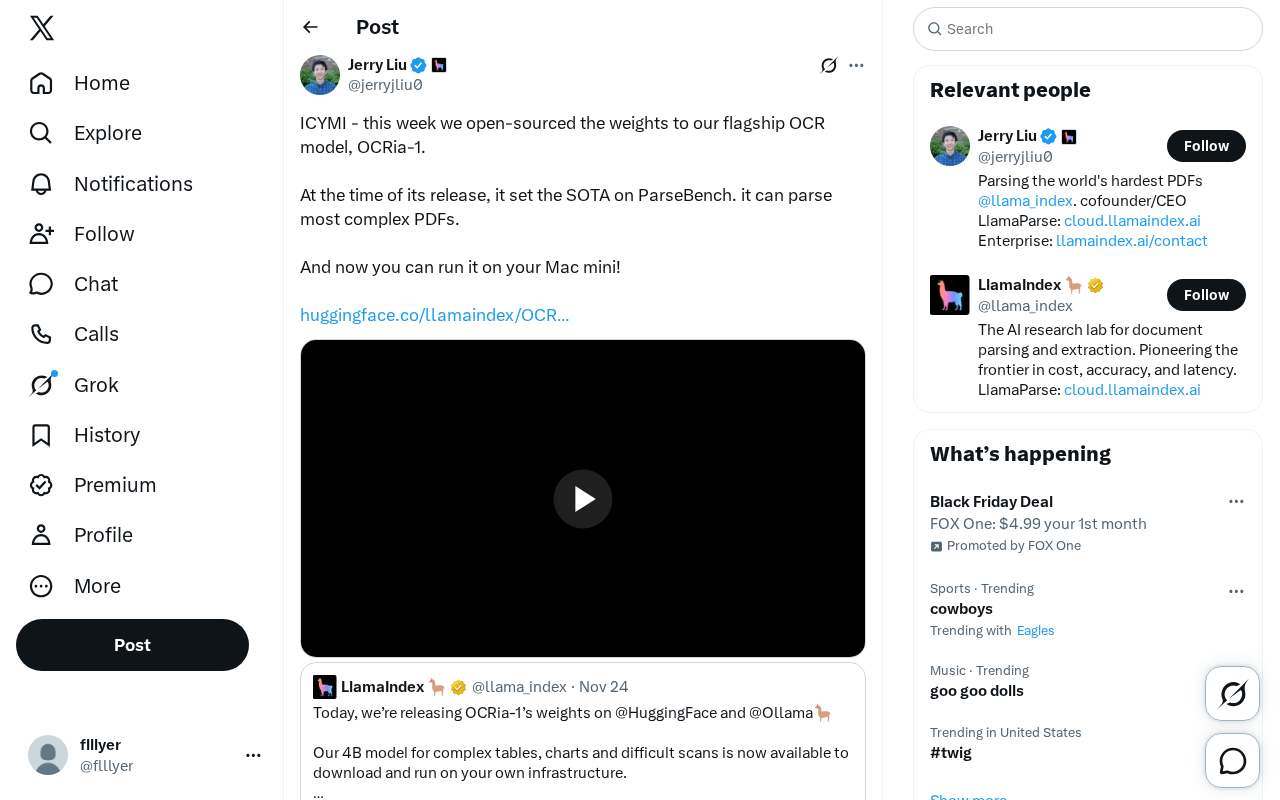
OCRia-1 model weights open-sourced, achieved SOTA on ParseBench, runs locally on a Mac mini.
OCRia-1 model weights were officially open-sourced this week. The official description states it achieved SOTA on the ParseBench benchmark and can parse most complex PDF documents (including multi-column, tables, and scanned documents). Open weights allow developers to deploy inference locally without relying on cloud APIs. The model can run on a Mac mini, with friendly hardware requirements, suitable for privacy-sensitive or offline scenarios. However, key details such as parameter scale, license, and inference speed have not yet been made public, and the ParseBench result also needs independent reproduction.
Open Source Move: OCRia-1 Model Weights Released
This week, the model weights for OCRia-1 were officially open-sourced. According to the official release information, the model achieved SOTA (state-of-the-art) results on the ParseBench benchmark at the time of release and is capable of parsing most complex PDF documents. For developers who need to process large volumes of PDFs, this means an additional high-performance OCR option that can be deployed locally.
Open-sourcing the weights means researchers and developers can freely download the model, inspect its architecture, and run inference on their own hardware without relying on cloud APIs.
Technical Capabilities: Complex PDF Parsing and SOTA Performance
OCRia-1's core capability centers on document parsing. The official description states that it "can parse most complex PDFs" — complex PDFs typically contain multi-column layouts, tables, mixed charts and images, scanned documents, and other unstructured elements, scenarios in which traditional OCR tools often perform poorly.
Achieving SOTA on the ParseBench benchmark indicates that the model's parsing accuracy at release exceeded other solutions of the same period. However, benchmark results only represent performance on a specific test set; actual effectiveness still needs to be evaluated against specific document types.
ParseBench is an evaluation benchmark in the document parsing field, designed to measure a model's parsing accuracy on complex layouts (such as multi-column, tables, mixed text and images, and scanned documents). Unlike general-purpose OCR benchmarks, ParseBench focuses more on structured information extraction and layout reconstruction capabilities. Its test set typically covers multiple document types, so achieving SOTA on this benchmark means the model leads in comprehensive parsing scenarios. Note, however, that benchmark results are affected by test set composition and evaluation metrics (such as character accuracy and layout reconstruction fidelity); SOTA on different leaderboards cannot be directly compared across benchmarks, and developers should validate against their actual business documents.
Local Execution: It Runs on a Mac mini Too
One noteworthy detail is that OCRia-1 can run on a Mac mini. This means the model's hardware requirements are relatively friendly, and ordinary developers can perform local inference without needing a high-end GPU server.
For privacy-sensitive or offline scenarios (such as processing internal documents or medical records), local execution capability is particularly critical. Users can complete OCR parsing without uploading data to the cloud.
Mac mini runnability typically relies on Apple's Unified Memory architecture and Metal acceleration (such as the MPS backend). The Apple Silicon chips (M series) in Mac mini share memory between CPU and GPU, enabling inference for small and medium-sized models without dedicated VRAM. However, "can run" does not mean "runs fast" — whether the model can inference smoothly on a Mac mini depends on parameter scale, quantization precision (such as 4-bit/8-bit), and whether optimized frameworks like Core ML or llama.cpp are used. For OCR tasks, input resolution and batch size also significantly affect latency, so actual throughput requirements should be assessed before local deployment.
Industry Impact and Limitations
OCRia-1's open source lowers the technical barrier to high-performance document parsing and may spur the emergence of more localized document processing tools. However, publicly available information is currently limited: key details such as the model's specific parameter scale, license terms, and inference speed have not yet been disclosed in the original material. Developers should consult the official repository for complete technical documentation before adoption.
In addition, the SOTA result on ParseBench needs independent reproduction and verification. The open-source community will typically provide third-party evaluation results quickly, at which point its actual capabilities can be judged more comprehensively.
One-line Summary
OCRia-1 model weights open-sourced, achieved SOTA on ParseBench, runs locally on a Mac mini.
Paragraph Summary
OCRia-1 model weights were officially open-sourced this week. The official description states it achieved SOTA on the ParseBench benchmark and can parse most complex PDF documents (including multi-column, tables, scanned documents, etc.). Open weights allow developers to deploy inference locally without relying on cloud APIs. The model can run on a Mac mini, with friendly hardware requirements, suitable for privacy-sensitive or offline scenarios. However, key details such as parameter scale, license, and inference speed have not yet been made public, and the ParseBench result also needs independent reproduction and verification. Overall, OCRia-1 provides a new localized high-performance option for PDF processing, but developers should consult the official repository and follow community evaluations before adoption.
Related articles
YOLO Object Detection for Absolute Beginners: Environment Setup and Core Concepts
Learn YOLO object detection from scratch: Python basics, VS Code, Miniconda environment setup. A Bilibili tutorial guides you step by step, with a desktop icon recognition project as your hands-on goal.

2026 Desktop Speaker Buying Guide: 24-Model Roundup and Pitfalls to Avoid
How to choose 2026 desktop speakers? Based on a Bilibili roundup of 23 products, this guide analyzes budget, interfaces, and placement by tier—under 100 yuan, 200–300, 300–600, and above 1,000—and reviews standouts like Huazai Pixelbar AI, Colorful X9 Pro, and Edifier G1500 MAX.
Akio SD Bundle 2026 Edition: One-Click Install & Zero-Basics Image Generation Tutorial
Akio Stable Diffusion bundle 2026 one-click install tutorial: text-to-image prompts, checkpoint and VAE selection, sampling parameters, seed reproduction, and ControlNet line-art repainting—generate images from zero basics.