Octomind Cloud: A Cloud-Based AI Coding Agent Platform with Zero API Keys

Octomind Cloud offers zero-API-key cloud AI coding agents with multi-model access and cross-device continuity.
Octomind Cloud and Hub is a cloud-native AI coding platform that eliminates API key management by pre-integrating 27+ LLMs behind a single login. Its agents run entirely in the cloud, enabling fire-and-forget workflows and cross-device session resumption. With per-second billing and a claimed 24/25 benchmark score surpassing Claude Code and Codex, it represents the shift from local AI coding tools to cloud-first platforms.
Introduction: Moving AI Coding to the Cloud
Today's AI programming tools are trapped in a common dilemma—local execution. Whether it's Claude Code or OpenAI's Codex, developers need to configure environments on their own machines, manage API keys, and once the laptop is closed, tasks are interrupted. Octomind Cloud and Hub aims to break this inertial thinking.
Current mainstream AI coding tools like Claude Code (Anthropic's command-line AI coding assistant) and OpenAI Codex (a code generation Agent based on GPT models) both rely on local terminal execution. Developers need to install CLI tools locally, configure environment variables, and manage API key rotation and access control. This pattern stems from the historical path of AI-assisted programming first appearing as IDE plugins—from GitHub Copilot's in-editor inline completions, to Cursor's deep IDE integration, to Claude Code's terminal Agent mode, tools have always been tightly coupled to the developer's local device. This means long-running tasks (like large codebase refactoring) consume local computing resources, and device sleep or network disconnection can interrupt tasks.
Its core proposition is simple and direct: one login, zero API keys, cloud Agents plus 27 models. This product reached #9 on Product Hunt, earning 97 upvotes and 7 comments, categorized under Productivity, Developer Tools, Artificial Intelligence, and GitHub.
Core Features: Cloud Execution and Cross-Device Session Continuity
Let AI Agents Work Independently in the Cloud
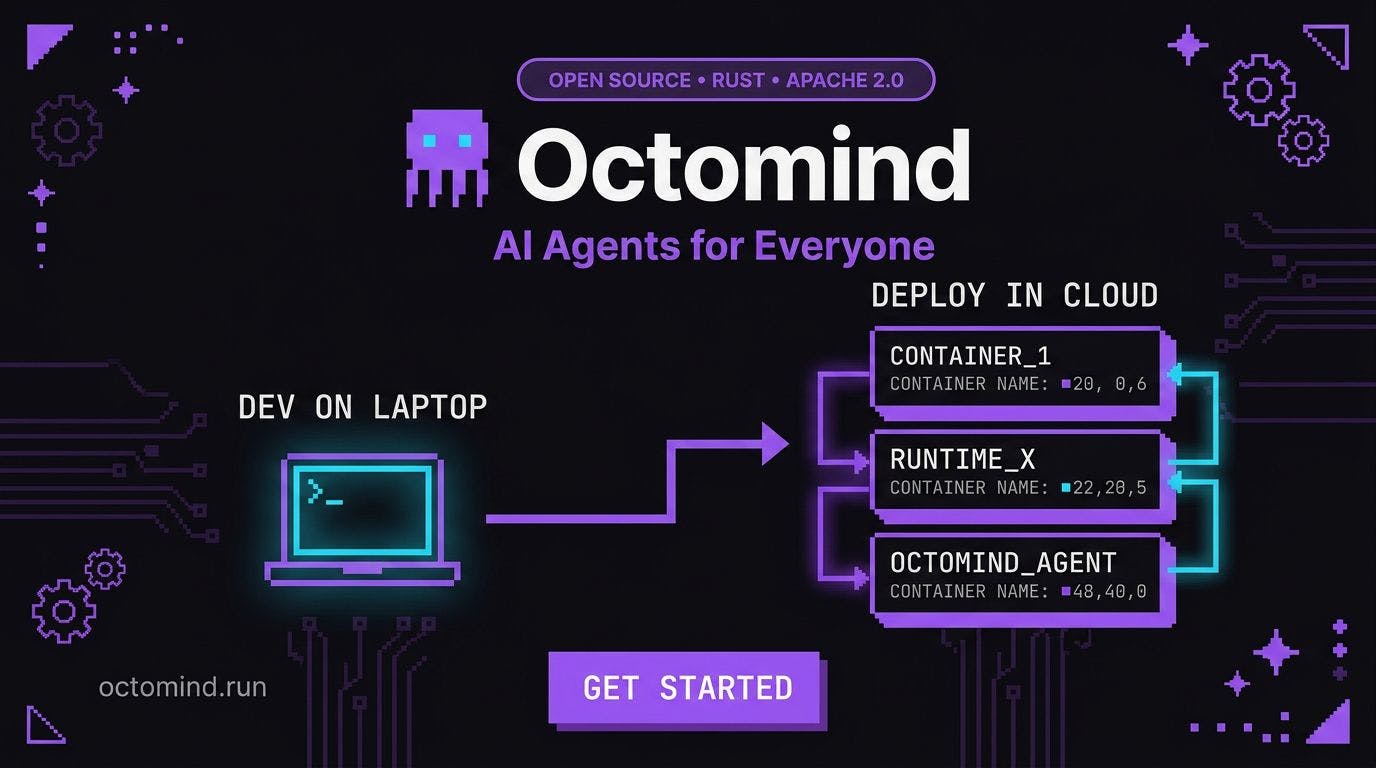
Octomind's most striking design choice is running AI Agents entirely in the cloud. Users simply select a machine, tell it what task needs to be done, and then can close their laptop and walk away. Tasks won't be interrupted when the local device shuts down—the Agent continues executing in the cloud.
This model solves a major pain point of local AI coding tools: developers being tethered to their devices. For coding tasks that require long execution times, batch refactoring, or large-scale test generation, cloud execution means a true "fire-and-forget" workflow.
"Fire-and-forget" is a term originating from the military domain that has been widely adopted to describe asynchronous computing paradigms. In software engineering, it refers to an execution model where the client sends a request without needing to maintain a connection to wait for a response. Cloud AI Agents typically implement this pattern through persistent task queues, state machine management, and asynchronous notification mechanisms. The Agent runs in a cloud virtual machine or container, task state is persisted to a database, and even if the client disconnects, the server-side execution process remains alive. Upon task completion, users are notified of results via WebSocket push, email notifications, or polling APIs. This stands in stark contrast to the traditional request-response model.
Seamless Cross-Device Session Resumption
The product emphasizes that "sessions can be resumed from any device." This means you can start a task on your office desktop, check progress on your laptop after getting home, or even review results on your phone. Session state is stored in the cloud, and devices are merely windows for access.
For distributed teams and mobile work scenarios, this design reduces the friction of switching work environments, making AI coding truly a "service" rather than "software" bound to a specific machine.
Zero-Barrier Multi-Model Access Experience
Built-in Models, No More API Key Management
Another major barrier with traditional AI coding tools is API key management. Developers need to separately register accounts on platforms like OpenAI and Anthropic, obtain keys and store them securely, while also monitoring usage and costs across providers.
API key management has become an increasingly complex operational burden in AI development. A typical AI coding workflow might simultaneously involve multiple model providers: OpenAI (GPT-4o, o3), Anthropic (Claude 4 Sonnet/Opus), Google (Gemini 2.5 Pro), and more. Each platform has its own independent account system, billing rules, rate limits, and key rotation strategies. Developers must not only securely store these keys (avoiding accidental commits to Git repositories) but also handle different authentication protocols (Bearer Token, OAuth, etc.), monitor respective usage quotas, and deal with emergency revocation procedures after key leaks. In team collaboration, key sharing and permission isolation add yet another layer of management complexity. Some teams use secret management services like HashiCorp Vault to cope, but this itself introduces additional infrastructure costs.
Octomind's messaging mentions two numbers—"27 models" in the tagline and "21 built-in models" in the body text. Regardless of the exact count, the core philosophy is consistent: the platform has pre-integrated multiple mainstream large models, and users don't need to apply for or configure any API keys themselves.
This "one login" experience compresses what was previously cumbersome multi-platform account management into a single entry point. For developers who don't want to dive deep into each model's integration details, or teams wanting to quickly switch between different models to compare results, this is a significant convenience.
Per-Second Billing: More Granular Cost Control
Also noteworthy is their billing approach—per-second billing. Compared to monthly subscriptions or per-token monthly packages, per-second billing more closely mirrors actual resource consumption. Charges are incurred only when the Agent executes tasks in the cloud; idle time is free.
Cloud computing billing has evolved from monthly, to hourly, to per-second granularity. AWS pioneered the shift from hourly to per-second billing for EC2 instances in 2017 (with a 60-second minimum), followed by Google Cloud and Azure. In the AI model invocation space, the mainstream billing method is per-token (with separate pricing for input/output tokens), such as OpenAI's GPT-4o at $2.5 per million input tokens. Per-second billing takes an approach more akin to cloud computing infrastructure—users pay for the compute time the Agent occupies, rather than paying separately for the model's token consumption. This means the platform assumes the risk and optimization responsibility for token costs, while users only need to focus on task execution duration. This model is friendly for short-task users, but for long tasks requiring extensive model inference, the platform needs precise pricing to avoid losses.
This extremely fine-grained billing approach can theoretically save costs for occasional users while making heavy users' spending more transparent and controllable. However, how the actual per-second rate stacks up against model invocation costs still needs to be verified through real-world usage.
Benchmarks: Comparison with Claude Code and Codex
Octomind presents a striking result: solving 24 out of 25 benchmark tasks, claiming to lead both Claude Code and Codex.
This is the most important differentiating selling point in their product marketing. If the data is accurate, it means Octomind's cloud Agent has reached or even surpassed the current top-tier AI coding tools in actual coding task completion rates.
However, such self-reported benchmark data warrants rational scrutiny. Commonly used benchmarks in AI coding include SWE-bench (software engineering tasks from real GitHub issues), HumanEval (OpenAI's function-level code generation evaluation set), and MBPP (Google's basic Python programming problem set). SWE-bench Verified is currently one of the most credible benchmarks for evaluating AI coding Agents, containing real bug-fix tasks extracted from 12 popular Python repositories. However, vendor-published benchmarks often suffer from several methodological issues: test set selection bias (cherry-picking), leniency of evaluation criteria, whether multiple retries with best-result selection are allowed, and whether the testing environment is completely fair and consistent with competitors. Independent evaluation bodies like LMSYS's Chatbot Arena mitigate these biases through blind evaluation and ELO scoring mechanisms, but an independent evaluation system for AI coding Agents is still being established.
The 24/25 score is certainly impressive, but real-world complex engineering scenarios are far more variable than standardized benchmarks. The specific task types, difficulty distribution, and evaluation criteria all require independent third-party verification.
Product Positioning: A Cloud-First AI Development Platform
From a product positioning perspective, Octomind Cloud and Hub represents an evolutionary direction for AI coding tools—from local plugins to cloud platforms.
The architectural evolution of AI coding tools has gone through three distinct phases: The first phase is the IDE plugin model, represented by GitHub Copilot, where model inference happens in the cloud but interaction is entirely embedded in the local editor; the second phase is the local Agent model, represented by Claude Code and Aider, where Agents run in the local terminal with the ability to read/write files and execute commands, but process lifecycle is bound to the local terminal; the third phase is cloud Agent platforms, where the Agent's execution environment, state storage, and compute resources are all in the cloud, with local devices serving only as interaction frontends. This evolutionary path aligns with the broader software industry trend from desktop applications to SaaS, but faces similar trade-offs—the cloud model brings convenience and scalability, yet makes concessions in data sovereignty, network latency, and offline availability.
Its value proposition can be summarized in three layers:
- Infrastructure layer: Provides cloud computing resources, allowing Agents to run independently of the developer's local environment
- Model aggregation layer: Integrates multiple large models, abstracting away underlying API complexity
- Experience layer: Single sign-on, cross-device session continuity, per-second billing, lowering the barrier to entry
This design is particularly suited for two types of users: individual developers who want to get started quickly without dealing with environment configuration, and teams that need standardized AI coding workflows. However, for enterprise users who prioritize local privacy and keeping code within their internal network, the cloud-first model may actually become a concern. For enterprises handling sensitive code, whether data leaves their controlled boundary is a key consideration in procurement decisions—this is also why many large enterprises still prefer on-premises deployment or private cloud solutions.
Conclusion
The "cloud Agent + zero keys + multi-model" combination proposed by Octomind Cloud and Hub addresses several real pain points in the usability of current AI coding tools. Closing your laptop while tasks keep running, resuming sessions across devices, and eliminating API key management—these experience improvements are genuinely attractive.
As for its claimed benchmark results surpassing Claude Code and Codex, more independent verification is needed before drawing conclusions. For developers following the cutting edge of AI coding, this is a product worth adding to the watchlist—it's not just a tool, but a microcosm of the "cloudification" and "platformization" trend in AI development tools.
Related articles

Chain of Thought Isn't Just for AI: How Humans Can Use CoT to Improve Thinking Quality
Chain of Thought isn't just a prompt trick for large models. Starting from a Hacker News discussion, this article analyzes why CoT works for human thinking too, breaks down actionable ways to transfer it, and highlights the key differences between human CoT and machine CoT.
Cloudflare Teams Up with OpenAI: Closi…
Cloudflare Teams Up with OpenAI: Closing the Loop from Vulnerability Discovery to Defense with AI
Cloudflare uses OpenAI Daybreak to investigate security vulnerabilities and generate reviewable remediation plans, while developers use Codex to boost coding efficiency and quality.

Orca Multi-Agent Orchestration in Practice: A Guide to Parallel Collaboration with Claude and Codex
Orca is Stable AI's free open-source agent workbench supporting 34 agents like Claude Code and Codex in parallel. Learn its Git worktree isolation, multi-model orchestration, and mobile management.