Offrun: One Workspace to Rule All Your Coding AI Agents

Offrun aims to manage all AI coding agents from one workspace, pointing to the shift from fragmented tools to agent orchestration.
As AI coding assistants multiply, developers face fragmentation and constant context-switching. Offrun debuted on Hacker News with a pitch to manage every coding agent from a single workspace, representing an emerging class of "agent orchestration layer" products. The article draws a parallel to how ops evolved from managing individual servers to Kubernetes cluster orchestration, arguing that unified scheduling, observability, and collaborative orchestration will become essential as multi-agent workflows go mainstream. Offrun is still early-stage with limited public information, but the direction it represents is worth tracking.
When You Have Too Many Coding Agents, Management Becomes the Problem
As AI coding assistants proliferate, developers are accumulating more tools than ever — Claude, various LLM-powered coding agents, automated scripting layers, and more. These tools operate independently, scattered across different terminals, windows, and config files, creating real management overhead. On Hacker News, a product called Offrun appeared as a "Show HN" post with a single core premise: manage every coding agent from one workspace.
The post hasn't gained much traction yet (6 upvotes, 2 comments), but the problem it addresses is universal. When a developer might be running multiple AI coding agents simultaneously, unified scheduling, monitoring, and coordination of those agents is becoming a genuine engineering need.
What Problem Offrun Is Trying to Solve
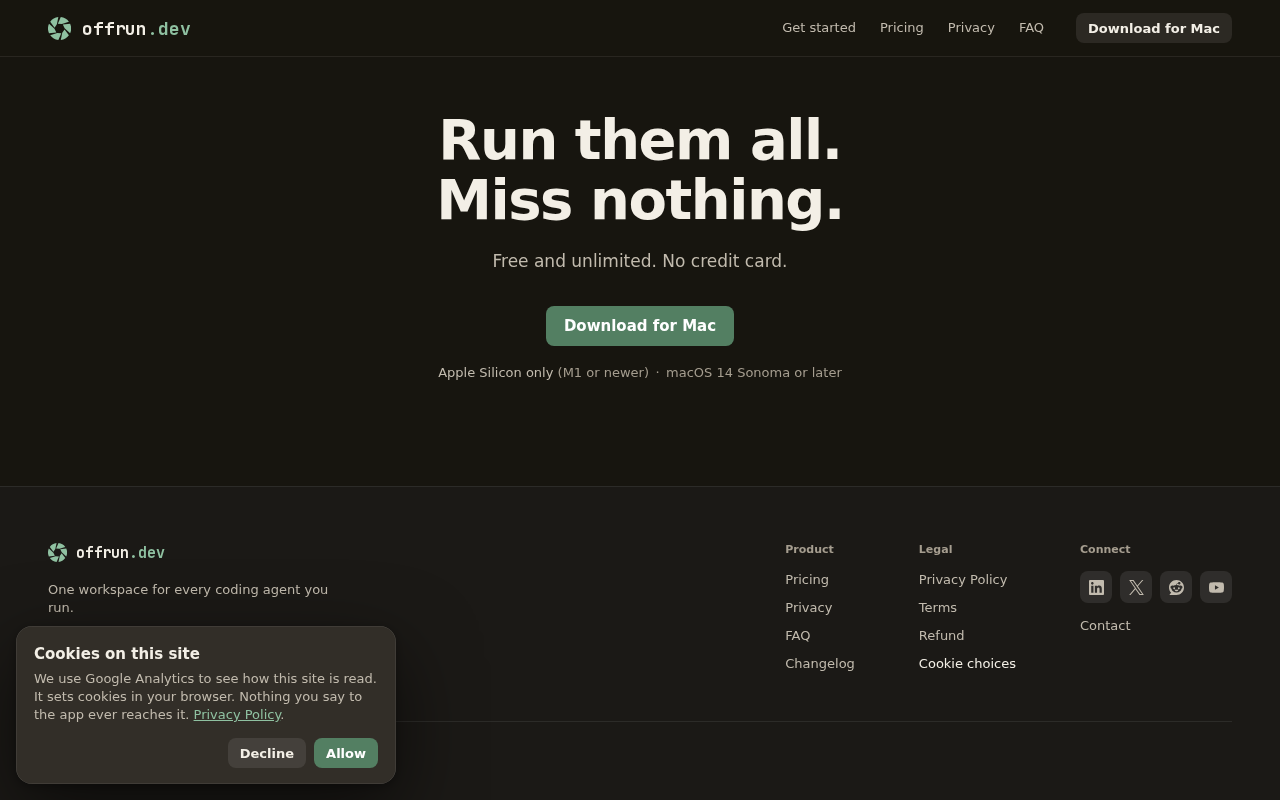
The tagline — "manage every coding agent from one workspace" — positions Offrun as a unified orchestration layer for coding agents. It aims to consolidate scattered agents into a single interface or workspace, so developers don't have to constantly switch between tools.
Products in this category typically build their value proposition around a few key points:
A Unified Entry Point
Rather than maintaining separate runtime environments and contexts for each agent, a centralized workspace lets developers see the status of all running agents in one place, issue tasks, and review outputs — all from a single pane of glass.
Reducing Context-Switching Costs
In real-world development, constantly switching between tools kills productivity. A centralized management workspace reduces cognitive load, letting developers focus on the task itself rather than juggling tool configurations.
Potential for Collaborative Orchestration
Taking it further: if multiple agents can collaborate within the same workspace — one handling code generation, another running tests, a third doing code review — this kind of orchestration could unlock productivity gains beyond any single tool. That said, based on what's publicly available, it's unclear how far Offrun has actually gone on collaborative orchestration.
Multi-Agent Orchestration is a hot topic in AI engineering right now. The core idea is to decompose a complex task into subtasks, assign them to agents with different specializations for parallel or sequential processing, and have a coordination layer aggregate the results. Several frameworks are already exploring this pattern: Microsoft's AutoGen enables conversational collaboration between multiple LLM agents; LangGraph uses directed graphs to define state transitions between agents; CrewAI focuses on organizing agent teams through role-based division of labor. The shared challenge across all these frameworks is handling context sharing, error propagation, and task rollback between agents. For developer-facing products like Offrun, whether their orchestration capabilities are built on top of these open-source frameworks or use a proprietary scheduling engine will directly determine their ecosystem compatibility and long-term competitiveness.
Why This Direction Is Worth Watching
AI coding tools are evolving from "single-point assistants" to "multi-agent collaboration." Over the past year, developer enthusiasm for coding agents has surged noticeably — but it's also exposed a real problem: tool fragmentation and the lack of unified management and observability.
Products like Offrun — "agent management workspaces" — are essentially filling a gap at the infrastructure layer. The analogy holds: just as ops went from managing individual servers to orchestrating clusters with Kubernetes, coding agents are now calling for their own orchestration layer. Whoever establishes the standard and the workflow habits at this layer has a chance to become a critical node in how developers work.
The Kubernetes analogy deserves elaboration. Kubernetes didn't solve "how to run a container" — it solved "how to schedule, monitor, and self-heal hundreds or thousands of containers at scale." It introduced declarative configuration, a unified resource view, and health-check mechanisms that turned operational complexity from something that grew linearly into something manageable. The challenges facing a coding agent management layer have a structurally similar shape: the barrier to using a single agent is already low, but as agent counts grow and tasks develop interdependencies, the absence of unified scheduling leads to resource waste, conflicting outputs, and debugging nightmares. Observability is especially critical in this context — developers need to understand, in real time, how many tokens each agent consumed, what actions it took, and at which step it failed, much like viewing container logs and metrics. Whoever first establishes a
kubectl-style standard operating interface at the agent layer could gain an integrating advantage similar to what Kubernetes achieved over the Docker ecosystem.
Current Limitations and Observations
To be objective: this Show HN post provides very limited substance. It's a single positioning sentence with no detail on product architecture, supported agent types, pricing model, or a live demo. The low community engagement also suggests the product is still in early validation — it hasn't yet found broad adoption.
For developers who are curious, here are the key dimensions to evaluate tools in this category:
- Compatibility: Does it support the specific coding agents you're already using?
- Observability: Can you clearly see each agent's runtime status, logs, and cost consumption?
- Extensibility: Does it expose interfaces for connecting custom agents?
- Local vs. Cloud: Is your code and context processed locally, or uploaded to the cloud?
Closing Thoughts
Offrun's emergence is a snapshot of AI coding tools maturing — once the number of tools explodes, the need for a management layer naturally surfaces. Even though it's still an early-stage Show HN project with limited public information, the direction it points toward — unified management of multiple coding agents — is undeniably a space worth tracking in the developer workflow of tomorrow. The real test will be whether it can deliver convincing answers on compatibility, usability, and genuine collaborative value.
Related articles

Chain of Thought Isn't Just for AI: How Humans Can Use CoT to Improve Thinking Quality
Chain of Thought isn't just a prompt trick for large models. Starting from a Hacker News discussion, this article analyzes why CoT works for human thinking too, breaks down actionable ways to transfer it, and highlights the key differences between human CoT and machine CoT.
Cloudflare Teams Up with OpenAI: Closi…
Cloudflare Teams Up with OpenAI: Closing the Loop from Vulnerability Discovery to Defense with AI
Cloudflare uses OpenAI Daybreak to investigate security vulnerabilities and generate reviewable remediation plans, while developers use Codex to boost coding efficiency and quality.

Orca Multi-Agent Orchestration in Practice: A Guide to Parallel Collaboration with Claude and Codex
Orca is Stable AI's free open-source agent workbench supporting 34 agents like Claude Code and Codex in parallel. Learn its Git worktree isolation, multi-model orchestration, and mobile management.