Oído Open-Source Speech Recognition: A $5 Microcontroller That Beats Whisper-tiny

A $5 ESP32-S3 chip running a 13M-parameter quantized model beats laptop Whisper-tiny on speech recognition.
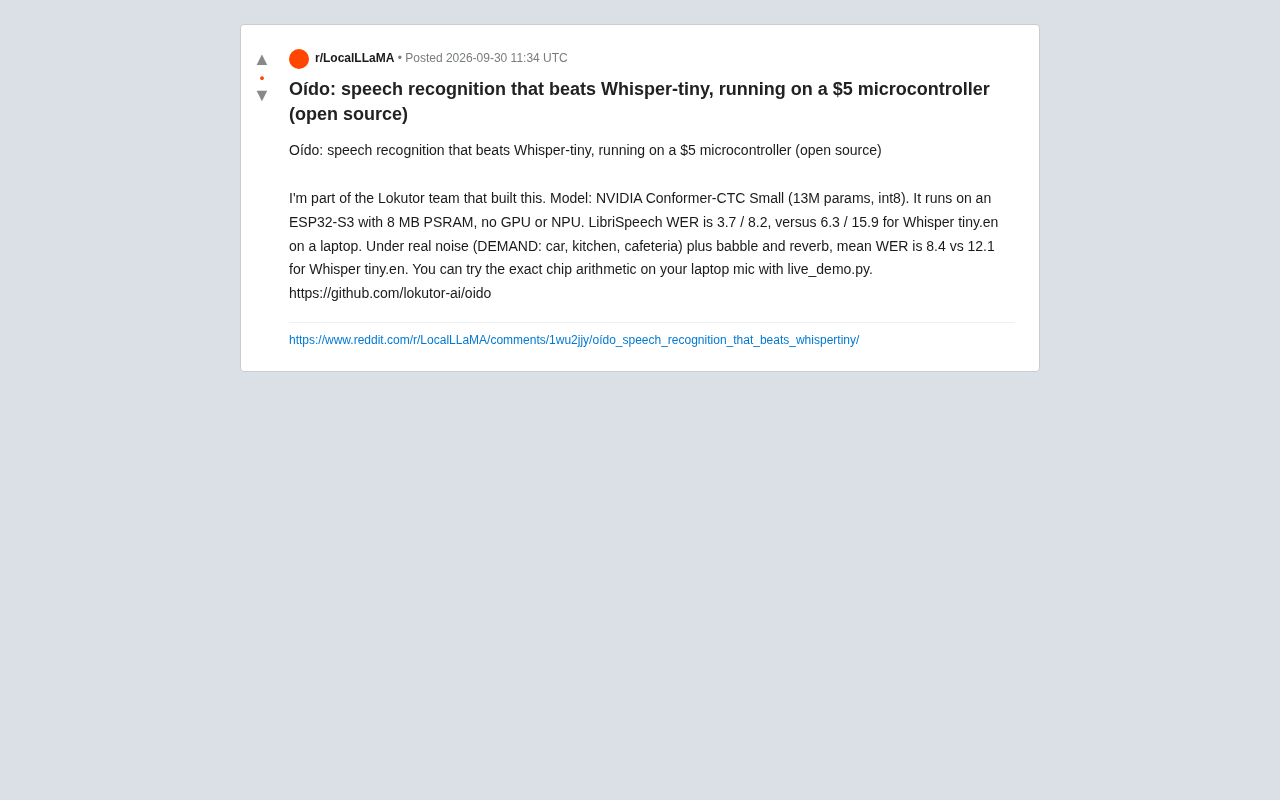
Oído is an open-source edge speech recognition project by Lokutor that deploys NVIDIA's Conformer-CTC Small (13M parameters, int8 quantized) on a ~$5 ESP32-S3 microcontroller with 8MB PSRAM — no GPU or NPU required. On LibriSpeech, it achieves WER of 3.7/8.2 versus Whisper-tiny.en's 6.3/15.9; in realistic noisy conditions with DEMAND noise, babble, and reverberation, it wins 8.4 vs. 12.1 WER. The project is open-sourced on GitHub with a local demo script.
One of edge AI's longstanding challenges is this: how do you run usable speech recognition on a microcontroller with no GPU, no NPU, and only megabytes of memory? The Oído project, open-sourced by the Lokutor team, offers a compelling answer — it runs on an ESP32-S3 chip that costs around $5, and its recognition accuracy surpasses Whisper-tiny.en running on a laptop.
Leveraging a 13M-Parameter Model for Edge Speech Recognition
Oído uses NVIDIA's Conformer-CTC Small model, which has approximately 13 million parameters and has been processed with int8 quantization. Compared to mainstream speech models with tens or even hundreds of millions of parameters, this is already remarkably lean — and int8 quantization further reduces memory and compute requirements, enabling it to fit into extremely resource-constrained embedded environments.
The runtime platform is an ESP32-S3 with 8MB PSRAM — a typical IoT-class microcontroller with no discrete GPU and no dedicated neural network accelerator (NPU). All inference runs entirely on the chip's own arithmetic capabilities. This means speech recognition no longer needs to rely on the cloud or high-performance endpoints — it can genuinely run on ultra-low-cost hardware.
Conformer-CTC combines two key technologies: Conformer is an architecture proposed by Google in 2020 that integrates convolutional modules into Transformer's self-attention mechanism, enabling it to simultaneously capture both long-range dependencies and local acoustic features in speech. This makes it significantly better at speech recognition than pure Transformer or pure CNN approaches. CTC (Connectionist Temporal Classification) is a decoding strategy that directly optimizes sequence probability end-to-end without requiring explicit alignment between input frames and output characters. During inference, it can output results frame by frame without waiting for a complete utterance, making it naturally suited for low-latency streaming scenarios. Compared to Whisper's autoregressive decoder, CTC has more predictable compute requirements and lower latency — one of the key reasons it can be deployed on resource-constrained microcontrollers. Int8 quantization compresses model weights and activations from 32-bit or 16-bit floating point to 8-bit integers, reducing memory usage and computation by roughly 4×, with typically acceptable precision loss — a standard technique for edge deployment.
Accuracy Comparison: A Tiny Chip Outperforms Laptop-Based Whisper-tiny
The most striking aspect of the project is its performance on both standard benchmarks and real-world noisy environments — outperforming Whisper-tiny.en running on a laptop in both cases.
LibriSpeech Clean Speech Test
On the LibriSpeech benchmark, Oído achieves a word error rate (WER) of 3.7 / 8.2 (for the clean and other subsets respectively), while Whisper-tiny.en on a laptop scores 6.3 / 15.9. Lower is better, and Oído achieves nearly half the error rate on both metrics.
LibriSpeech is the most widely used English speech recognition benchmark, sourced from audiobook recordings totaling approximately 1,000 hours. Its test set is divided into test-clean (good recording quality, standard accent) and test-other (poorer recording conditions or heavier accents), with the latter considered the more challenging measure. Word Error Rate (WER) is calculated by dividing the total number of substitutions, insertions, and deletions between the recognized output and reference text by the total number of words in the reference — lower values indicate better accuracy. A clean WER of 3.7% is an impressive result for a 13M-scale model, approaching the performance of models an order of magnitude larger.
Real-World Noise Environment Test
Clean lab speech doesn't represent real-world usage. The team further introduced the DEMAND noise dataset (covering environments such as cars, kitchens, and restaurants), combined with babble noise (overlapping speech from multiple people) and reverberation. Under these more realistic conditions, Oído achieves an average WER of 8.4, compared to 12.1 for Whisper-tiny.en.
Notably, a $5 chip outperforming a general-purpose model running on a laptop in noise robustness is a strong signal for the practical viability of edge devices.
DEMAND (Diverse Environments Multichannel Acoustic Noise Database) is a noise database designed for speech enhancement and noise robustness research, containing background noise recorded in 16 real-world environments including offices, subways, restaurants, and kitchens. It is commonly used to mix clean speech with noise for evaluating model robustness. Babble noise refers to background speech produced by multiple people talking simultaneously — particularly challenging for speech recognition systems because its spectral characteristics heavily overlap with the target speech. Reverberation simulates sound waves reflecting multiple times within an enclosed space, causing speech waveforms to "smear" and blurring frame-level acoustic features. These two types of interference are the most common challenges in real home and public deployment scenarios. Oído's continued lead under these conditions suggests that Conformer's convolutional modules provide inherent robustness against local time-frequency disturbances.
Why This Matters
Mainstream speech recognition solutions typically follow one of two paths: cloud-based APIs (introducing latency, privacy concerns, and connectivity dependency) or running larger models locally (with higher hardware requirements). Oído demonstrates a third path — deploying a targeted, optimized small model on extremely cheap hardware while maintaining acceptable or even superior accuracy.
Several technical choices here are worth examining. First, the Conformer-CTC architecture has structural advantages in streaming and short-utterance speech recognition. Paired with CTC decoding, it handles low-latency scenarios more gracefully than Whisper's autoregressive approach. Second, performing int8 quantization targeting a specific chip and faithfully reproducing the chip's exact arithmetic means developers can use live_demo.py on a laptop to experience inference results identical to what the actual chip produces — lowering the barrier to validation.
For smart home devices, wearables, offline voice assistants, and similar use cases, this combination of low cost, offline operation, and high accuracy is highly attractive. Devices can perform local speech understanding without internet connectivity, protecting privacy and eliminating ongoing cloud costs.
Getting Started
The project is open-sourced on GitHub (lokutor-ai/oido). The team provides live_demo.py, which lets you run the same inference pipeline as the chip using your laptop's microphone — making it easy for developers to evaluate performance before committing to hardware.
One caveat: the comparison figures are self-reported by the project team. Interested developers can reproduce and verify the results independently using the open-source code. For any claim of "beating model X," independent replication is always the most reliable approach.
Summary
Oído uses a 13M-parameter quantized Conformer-CTC model on a $5-class ESP32-S3 to achieve speech recognition accuracy that surpasses laptop-based Whisper-tiny — in both clean speech and noisy environments. It represents a pragmatic direction for edge speech AI: not chasing parameter scale, but precisely fitting the right model to ultra-low-cost hardware. For teams building embedded voice products, this open-source project is well worth trying.
Related articles

Software Factory in Practice: Building an Evaluable Self-Evolving Development Pipeline with Codex and Claude Code
Deconstructing a Codex and Claude Code software factory: control/data plane separation, foreman prompts for consistency, automatic triggers, and data-driven evaluation.

WorkBuddy Full Guide: How an AI Coworker Takes Over Workplace Automation
What is WorkBuddy? This article analyzes the core capabilities of this full-scenario AI agent: autonomous execution with deliverable results, local file processing, multi-agent parallelism, and workplace automation workflows, helping you judge its essential difference from ordinary AI chat tools.

The Truth About AI Agents: A Hundred Lines of Code + an LLM, Deconstructing the Agent's Underlying Logic
AI agents aren't a new AI species—just a language model plus tools, a loop, and a goal. Here's the underlying logic: how 100 lines of Python hit a 75% fix rate, why the harness beats the model, and Gartner's "agent washing."