Ollama Cloud Pro Unusual Usage Depletion: In-Depth Analysis of DeepSeek's Sudden Usage Spike
Analyzing why Ollama Cloud Pro's DeepSeek model usage suddenly spiked and how to optimize cloud AI allowances.
An Ollama Cloud Pro user reported DeepSeek model usage hitting session caps in under an hour—down from hours of daily use. This article analyzes potential causes including model version updates, token billing weight changes, and differences in output behavior between DeepSeek and Kimi models, while offering practical strategies for monitoring and optimizing cloud AI usage allowances.
A User Report from Reddit
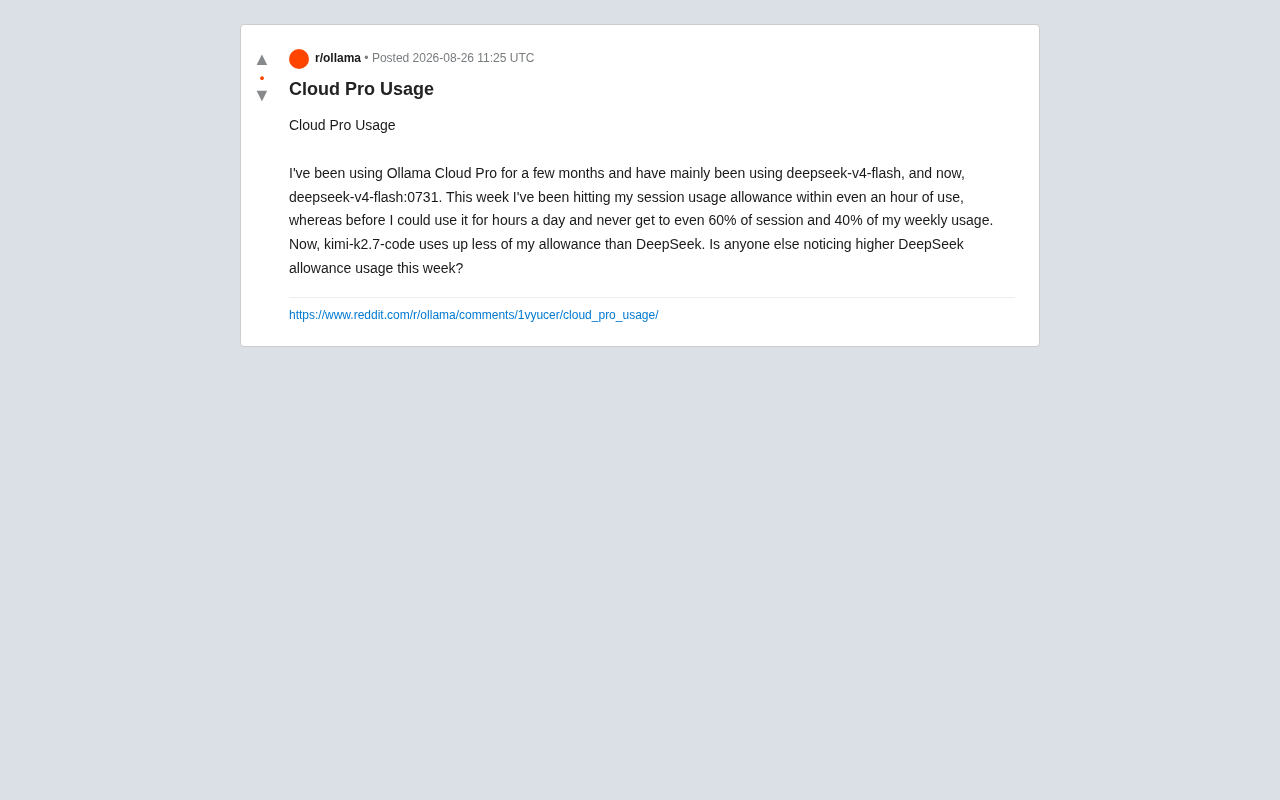
Recently, a long-time Ollama Cloud Pro subscriber posted on Reddit about a concerning phenomenon: their frequently used DeepSeekAd model suddenly started consuming usage allowance at an abnormally accelerated rate.
Ollama initially gained fame as an open-source local LLM runtime framework, allowing users to run open-source models like Llama and Mistral on their own hardware. As part of its commercialization efforts, Ollama launched the Cloud Pro subscription service, enabling users to access various high-performance models without local GPUs. This hybrid strategy—offering both local deployment tools and a cloud subscription service—is gradually becoming the mainstream approach in AI infrastructure. Cloud Pro uses a monthly subscription model where users receive a fixed usage allowance within a set fee, rather than the traditional API pay-per-call billing model.
According to the user, they had been using Ollama Cloud Pro for several months, primarily calling the deepseek-v4-flash model and its subsequent update, deepseek-v4-flash:0731. In the past, they could use the service continuously for hours each day without session usage ever reaching 60%, while weekly usage hovered around just 40%.
However, this week things took a dramatic turn—they reported hitting the session usage cap in less than one hour. Even more intriguingly, for the same coding tasks, the kimi-k2.7-code model consumed less allowance than DeepSeek. They posed the question to the community: has anyone else noticed a significant increase in DeepSeek's usage consumption this week?
The "Hidden Cost" Problem of Cloud Model Subscriptions
This seemingly simple help post actually touches on a widespread but often overlooked pain point in cloud-based LLM services—the opacity of usage billing.
How Allowance Gets Consumed
Unlike traditional per-call or time-based subscription billing, most cloud LLM services (including subscription platforms like Ollama Cloud Pro) typically measure user consumption based on token throughput.
Here it's important to understand what tokens actually are: Tokens are the fundamental units by which large language models process text, and they don't simply correspond to individual words or characters. For English text, one token roughly corresponds to 4 characters or 0.75 words; for Chinese, a single character may be encoded as 1-3 tokens, depending on the model's tokenizer. Different models use different tokenization schemes (such as BPE, SentencePiece, etc.), meaning the same text may be metered as different token counts across different models. This underlying difference directly impacts users' allowance consumption, yet is rarely made explicit by service providers.
Actual allowance consumption depends on several factors:
- Input token count: The user's submitted prompt and context length
- Output token count: The length of model-generated content
- Model-specific billing weight: Different models often have different "unit cost" coefficients
This means that even if a user's habits remain completely unchanged, any adjustment to an underlying model parameter can cause significant fluctuations in actual allowance consumption. This is precisely the technical root cause of the Reddit user's predicament.
Variables Introduced by Version Iterations
You may not have noticed, but the user mentioned using deepseek-v4-flash:0731—a version with a date tag. In model services, suffixes like :0731 typically represent a specific model snapshot or update batch.
In production-grade model services, model snapshots are a critical concept. Similar to software version numbers, model snapshots record the complete state of a model at a specific point in time, including weights, configuration parameters, system prompt templates, and more. A date tag indicates the model is a snapshot from that particular date. Service providers may fix bugs, adjust alignment strategies, or optimize output quality through snapshot updates without changing the model's main version number. These "silent updates" are often invisible to users but can significantly alter the model's output behavior and token consumption patterns.
During version iterations, model providers may:
- Adjust the model's default output length or reasoning depth, causing the same question to generate more tokens
- Modify billing weight coefficients, making equivalent token consumption correspond to higher allowance deductions
- Change context window handling, affecting input-side token metering
Any single one of these adjustments is sufficient to explain the "sudden usage spike this week" phenomenon.
Why Does DeepSeek Consume More Allowance Than Kimi?
Another detail observed by the user holds significant analytical value: kimi-k2.7-code actually consumed less allowance than DeepSeek. This comparison reveals differences in billing strategies across models.
Possible Explanations
First, differences in model scale and inference cost. As a newer flagship model, DeepSeek-V4 series may have larger parameter counts and higher inference costs than Kimi's code-specialized version. The DeepSeek series is renowned for its strong performance in mathematical reasoning, code generation, and other domains, competing with GPT-4-level models on multiple benchmarks. Its MoE (Mixture of Experts) architecture means that while the total parameter count is massive, only a subset of parameters is activated during each inference, balancing performance and efficiency. Nevertheless, cloud service providers often pass the inference costs of larger-scale models onto billing weight coefficients.
Second, differences in output behavior. Different models may vary in the level of detail they generate and the length of Chain-of-Thought expansion when processing the same task. Chain-of-Thought reasoning is a technique that has models show intermediate reasoning steps before outputting a final answer. Since OpenAI's o1 model brought this approach into the mainstream, an increasing number of models have begun including detailed reasoning processes in their output. This means that for the same programming problem, a model with enabled or enhanced Chain-of-Thought might first output hundreds of tokens of analysis before providing the code answer—and these "thinking" tokens are equally counted toward usage. The DeepSeek series is known for strong reasoning capabilities, and if this version update strengthened the output of reasoning processes, it would naturally consume more tokens. Some providers apply different billing rates to Chain-of-Thought tokens versus final output tokens, but not all platforms make this distinction.
Third, optimization of code-specialized models. From its name, kimi-k2.7-code is clearly a model optimized for coding scenarios. Kimi is a large language model series from Moonshot AI, and K2.7-code is a version specifically optimized for code generation. The key advantage of code-specialized models over general-purpose ones is that after targeted training, they can generate functionally correct code in a more concise manner, reducing redundant comments and unnecessary explanatory text. Additionally, code-specific tokenizers are typically optimized for programming language syntax structures, allowing code snippets to be represented with fewer tokens. This fundamentally improves token efficiency, resulting in less allowance consumption for equivalent tasks.
Practical Strategies for Dealing with Abnormal Usage
When facing cloud model usage anomalies, users can adopt the following strategies:
Monitoring and Diagnosis
- Check the provider's update logs: First confirm whether the model version in use has had any recent billing or behavior adjustments
- Comparative testing: Test different models with identical prompts to observe actual allowance consumption differences
- Streamline context: Avoid carrying excessively long conversation histories to reduce unnecessary input tokens
Model Selection Optimization
For specific scenarios like coding, choosing purpose-optimized models (such as Kimi's code version) can often reduce costs while maintaining quality. Users need not stick to a single model but should flexibly switch based on task type to achieve the "best cost-performance ratio."
Monitor Community Feedback
As this Reddit user did, promptly seeking confirmation in communities is an effective way to determine the nature of the issue—if it's a widespread phenomenon, it's likely due to provider-side adjustments; if it's an isolated case, you need to investigate changes in your own usage patterns.
Cloud AI Service Transparency Still Needs Improvement
This seemingly minor allowance consumption dispute reflects the room for improvement in billing transparency for subscription-based cloud LLM services.
Current cloud AI service billing models roughly fall into three categories: pay-per-API-call (like OpenAI's standard API), monthly subscription with fixed allowance (like ChatGPT Plus, Ollama Cloud Pro), and hybrid models (base subscription plus overage-based charges). The core challenge of subscription models lies in defining "fair use"—providers need to strike a balance between cost control and user experience. As model capabilities increase and inference costs rise, many platforms are shifting from "unlimited use" to "tiered allowance" models, making the transparency of allowance consumption an increasingly prominent issue.
When users cannot intuitively perceive the actual cost of each call, they can easily exceed expected consumption inadvertently. For service providers, promptly and clearly communicating model version changes and their impact on billing, along with providing granular usage analytics tools, will be key to building user trust. For users, understanding the underlying logic of token billing and developing cost awareness is becoming an essential skill in the era of increasingly ubiquitous AI tools.
Note: This article is based on analysis of a single Reddit user's feedback. The specific billing changes in DeepSeek's version update still await official confirmation or corroboration from additional user data.
Related articles

Workbuddy for Absolute Beginners: How a Desktop AI Agent Fits Into Real Workflows
A beginner's guide to the Workbuddy desktop AI agent: installation, claiming credits, file management, and building automated workflows—compared with CodeX for fit and cost, helping professionals shift from AI question-askers to AI managers.

OpenAI's New Agent Stack: Computer Use, Decisions API, and Ultra-Fast Workflows
OpenAI Dev Day unveiled a new agent stack: Computer Use outperforms humans, Decisions API delivers ultra-low-latency classification via Luna, Agents API opens the same Computer Use capabilities, and GPT-6.1 Sol costs only one-seventh of Astra. Core updates, benchmark data, and developer insights.

Liang Wenfeng Open-Sources DeepInfo Inference Framework, Takes On U.S. Ban
DeepSeek open-sources its DeepInfo inference framework after its models, featuring GPU/CPU cross-pipelining, small-model prediction with large-model verification, and full Huawei Ascend and NVIDIA chip support—facing the U.S. federal ban head-on. This article analyzes its significance for AI deployment and open-source strategy.