Ollama Heads to Seoul: Partnering with FriendliAI to Expand in the Korean AI Market

Ollama expands into the Korean market with a Seoul trip and FriendliAI partnership, signaling a shift from tool to ecosystem.
Ollama announced it will travel to Seoul in November to meet local users, customers, and partners and explore deepening its presence in the Korean market. The article highlights the partnership with Korean AI infrastructure company FriendliAI: Ollama excels at low-barrier local running of open-source models, while FriendliAI focuses on inference optimization and service-oriented deployment. Their complementary positioning could offer enterprises a seamless experience from local development to production deployment. The article analyzes Korea's active developer community, fast enterprise AI adoption, and large room for local ecosystem collaboration as aligned with Ollama's local running positioning. This move is seen as a transformation signal of Ollama shifting from a tool-type product relying on developer word of mouth to actively operating regional markets and exploring systematic commercialization, though the final outcome depends on the quality of implementation of the partnership details.
From Open-Source Tool to Market Strategy: Ollama's Korea Trip
Ollama officially announced on social media that the team will travel to Seoul in November to engage with local users, customers, and partners, and to explore ways to deepen its presence in the Korean market. This brief message sends a clear signal: the company that started as a tool for running large models locally is now extending from developer tooling toward regional ecosystem building.
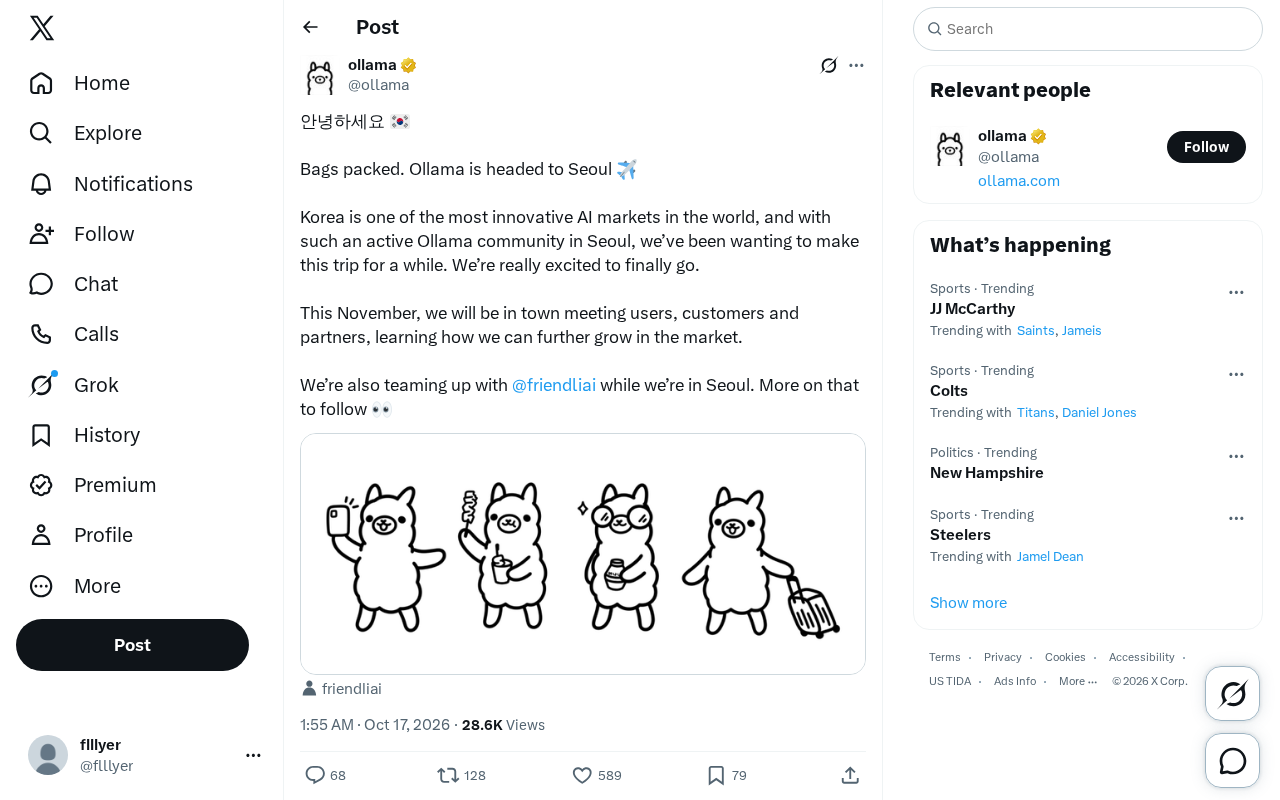
In the tweet, Ollama specifically noted that Korea is "one of the most innovative AI markets in the world" and that Seoul has an active Ollama community. The team admitted they had "wanted to make this trip for a long time" and have finally made it happen. Judging from the wording, this trip is not just brand exposure but carries clear commercial and ecosystem goals—meeting users, customers, and partners to understand how to grow further in the local market.
Teaming Up with FriendliAI: Complementarity Over Overlap
The most noteworthy partnership signal of this trip is Ollama's collaboration with FriendliAI. FriendliAI is a Korean AI infrastructure company focused on inference optimization and model serving. Although the details of the collaboration have not been announced, the two companies' business positioning suggests obvious room for complementarity.
Ollama's core strength lies in enabling developers to run open-source models locally with an extremely low barrier to entry, covering the entire workflow of model pulling, quantization, running, and management; FriendliAI excels at inference engines and service-oriented deployment, with performance advantages in enterprise scenarios. If the partnership materializes, possible directions include providing Korean enterprises with a seamless experience from local development to production deployment, or optimizing for Korean-language models and local developer habits. The phrase "More on that to follow" in the tweet indicates that the two sides are still brewing more specific actions.
Inference optimization refers to a series of techniques for improving performance during the inference phase after model training is complete, with the goal of reducing latency, increasing throughput, and reducing memory footprint while ensuring output quality. Common methods include operator fusion, KV Cache management, continuous batching, quantization (e.g., INT8/FP8), and speculative decoding.
Service-oriented model deployment means packaging a trained model into a service that can be called by production systems, involving engineering concerns such as API gateways, auto-scaling, multi-model routing, monitoring, and canary releases. FriendliAI's Friendli Engine is built around these two areas: providing an OpenAI-compatible inference service externally and supporting enterprise private deployment. This forms a layered relationship with Ollama's positioning toward single-machine, local developer operation—the former solves "running fast and handling concurrency," while the latter solves "running with a single command."
Why Korea?
Ollama's choice of Korea as a node for regional expansion is no accident. Several characteristics of the Korean AI market are worth noting:
High developer density and active community. Ollama directly pointed out the activity of the Seoul community in its tweet, which means the tool already has a certain user base and expansion costs are relatively manageable.
Fast enterprise AI adoption. Korea is advancing AI applications rapidly in finance, manufacturing, gaming, and content, with real demand for local deployment and inference efficiency—naturally aligned with Ollama's "local running" positioning.
Large room for local ecosystem collaboration. Partnering with local infrastructure companies like FriendliAI makes it easier to penetrate enterprise customers and the local cloud service ecosystem than going it alone.
Local deployment (on-premise / self-hosted) means models and inference services run within an enterprise's own data center or private cloud rather than calling external APIs. This demand is particularly prominent in the Korean market: on one hand, industries such as finance and manufacturing have strict compliance requirements for data leaving the country; on the other hand, Korean-language models (such as Naver's HyperCLOVA X and LG's EXAONE) are mostly provided in open-source or controllable ways, and enterprises tend to complete inference in internal environments. Ollama's local running capability precisely matches this demand, but its single-machine tool form can hardly directly support production-grade concurrency, which explains why an inference service layer like FriendliAI is needed to complete the last mile of enterprise deployment.
A Signal of Transformation from Tool to Ecosystem
Ollama's growth over the past few years has mainly come from developer word of mouth—a single simple command can run models like Llama, Mistral, and Gemma, giving it a considerable user base in local inference scenarios. But the ceiling of tool-type products is also obvious: user growth depends on the natural diffusion of the open-source community, and the commercialization path is relatively vague.
This Seoul trip, together with the partnership with FriendliAI, can be seen as a step in Ollama's shift from "being used by developers" to "actively operating regional markets." Meeting customers and partners and understanding local needs point toward a more systematic exploration of commercialization. For developers focused on local AI deployment, this also means Ollama may follow up with actions in Korean-language support, enterprise features, and service integration.
Of course, a single trip and a teaser tweet are not enough to judge the final form of the partnership. Whether Ollama can gain a firm foothold in the Korean market depends on the quality of implementation of the partnership details and whether it can find a sustainable commercial rhythm while maintaining the trust of the open-source community.
One-line Summary
Ollama heads to Seoul to expand in the Korean market, teaming up with FriendliAI to signal a transformation from tool to ecosystem.
Paragraph Summary
Ollama announced it will travel to Seoul in November to meet local users, customers, and partners and explore ways to deepen its presence in the Korean market. The article notes that the most noteworthy signal of this trip is Ollama's collaboration with Korean AI infrastructure company FriendliAI: Ollama excels at low-barrier local running of open-source models, while FriendliAI focuses on inference optimization and service-oriented deployment. Their positioning is complementary, with the potential to provide enterprises with a seamless experience from local development to production deployment. The article analyzes that the Korean market has an active developer community, fast enterprise AI adoption, and large room for local ecosystem collaboration—all aligned with Ollama's local running positioning. This move is seen as a transformation signal of Ollama shifting from a tool-type product relying on developer word of mouth to actively operating regional markets and exploring systematic commercialization, though the final outcome still depends on the quality of implementation of the partnership details.
Related articles

AI Writes Code, Will Programmers Lose Their Jobs? The Truth About Devin's Autonomous Programming
Devin and other autonomous AI coding agents are changing software development: from Copilot-assisted coding to fully automated engineering agents, the programmer's role shifts from writing code to system design and oversight. This article analyzes the impact of AI programming on employment, code security, and junior developer training, as well as the real direction of programmer demand under the efficiency paradox.

Citigroup's 14,000 Engineers Use Devin, Slashing Tech Outsourcing Bill by 30%
Citigroup's 14,000 engineers used AI coding agent Devin to cut its tech vendor bill by 30% and speed releases 30-40%, while JPMorgan says AI gains aren't in earnings yet.

AGENTS.md in Practice: Making Coding Agents Actually Work
AGENTS.md and CLAUDE.md can boost coding agent performance, but research shows misuse raises costs 20%. Here's what to write, what to delete, the 200-line and 32KB limits, monorepo nesting rules, and a security warning.