Ollama Local LLM Deployment Guide: The 170K-Star Open Source Tool That Runs DeepSeek, Qwen, Kimi, and More
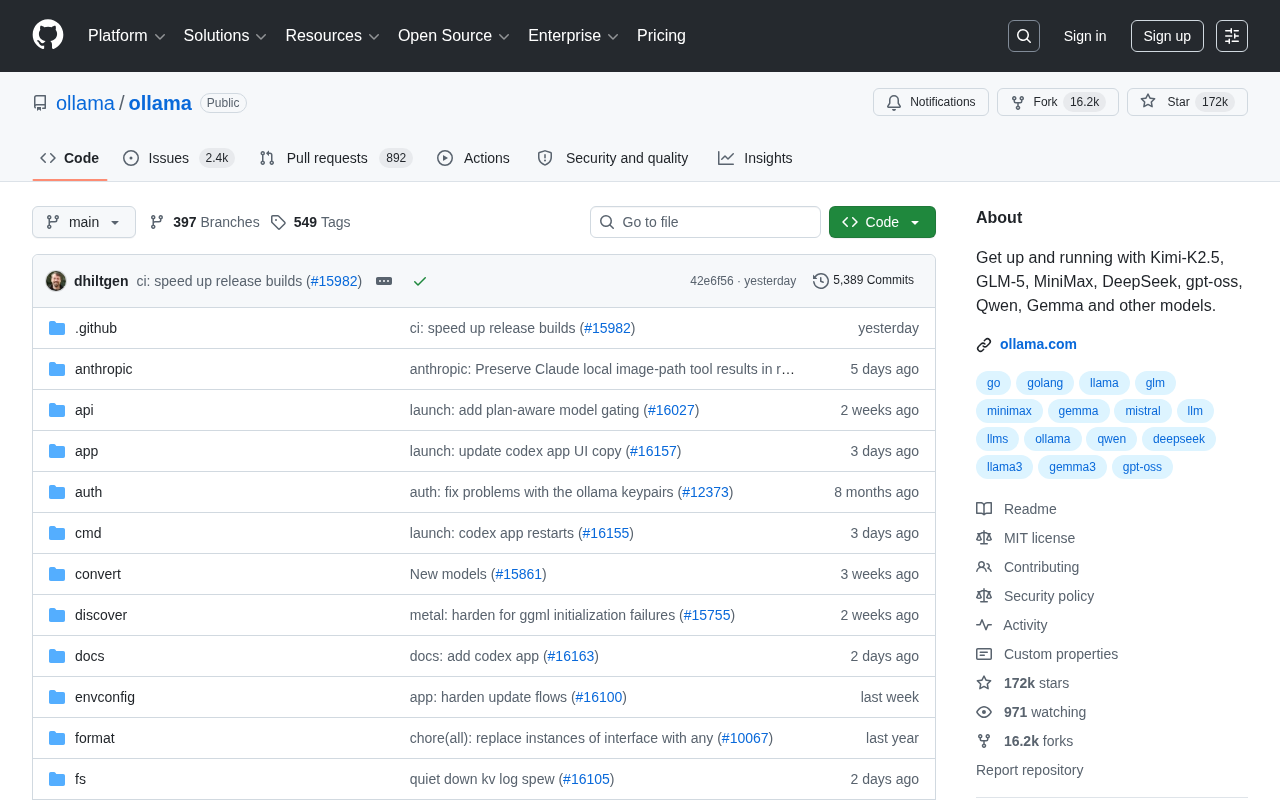
Ollama lets you run DeepSeek, Qwen, Kimi, and other top LLMs locally with a single command.
Ollama is a Go-based open source tool with 170K+ GitHub stars that makes local LLM deployment effortless. With one command like `ollama run deepseek-r1`, users can run leading models including DeepSeek, Qwen, Kimi-K2.5, and GLM-5 — no cloud API, no token fees, and full data privacy on macOS, Linux, and Windows.
Ollama Local LLM Deployment Guide: The 170K-Star Open Source Tool That Runs DeepSeek, Qwen, Kimi, and More
When 170,000 stars light up a command-line tool, the real question isn't "how cool is it to run models locally" — it's "who's actually paving the last mile of AI democratization?" Ollama, an open source project written in Go, answers that question in the most straightforward way possible: one command, and a large language model is running on your own machine.
What Is Ollama? One Command to Run a Local LLM
Ollama is an open source tool designed specifically for local large language model (LLM) deployment. In plain terms, it packages up the entire pipeline — model downloading, quantization, and inference — so all you need to do is type a single command in your terminal, like ollama run deepseek-r1, and a full AI model is up and running on your computer.
No cloud API. No per-token billing. No sending your data to someone else's server.
As of now, Ollama has surpassed 170,000 stars on GitHub, with nearly 16,000 forks — making it the most popular open source project in the local LLM deployment space, bar none. It supports macOS, Linux, and Windows, covering the vast majority of users' environments.

Which Models Are Supported? A Map of the 2025 Open Source LLM Landscape
Ollama's current model lineup is impressively stacked. The names mentioned in the title essentially form a snapshot of the 2025 open source LLM landscape:
- DeepSeekAd: Developed by DeepSeek, DeepSeek-R1 is renowned for its reinforcement learning-driven chain-of-thought reasoning, delivering exceptional performance on math and coding tasks at a remarkably low cost
- Qwen (Tongyi Qianwen): Alibaba's open source model series, ranging from 0.5B to 72B+ parameters — Qwen3 has become one of the most active open source LLM families
- Kimi-K2.5: An iteration from Moonshot AI, with long-context handling as its signature strength, alongside continuously improving reasoning and code generation capabilities
- GLM-5: Zhipu AI's fifth-generation general-purpose language model, excelling in Chinese language understanding and multimodal capabilities
- MiniMax: From the AI company founded by Yan Junjie, with deployments spanning text generation and multimodal domains
- Gemma: Google DeepMind's open source lightweight model series, built on the same technology as Gemini, ranging from 2B to 27B parameters and optimized for consumer-grade hardware
- gpt-oss: A general term for open source GPT-style models — check the official Ollama model library for specifics
One interesting detail: the majority of models highlighted in the title are Chinese — Kimi, GLM, DeepSeek, Qwen, and MiniMax are all domestic Chinese products. Meta's LLaMA series is certainly supported by Ollama, but it didn't even make the headline. What does that tell us? China's open source model offensive has grown strong enough to reshape the narrative itself.
Why Go? A Smart Engineering Decision
Ollama is built with Go, and that wasn't an arbitrary choice. Several of Go's characteristics directly address the pain points of local deployment tooling:
- Cross-platform compilation: One codebase compiles into macOS, Linux, and Windows builds — no headaches
- Single binary distribution: Users download one file and run it, no Python virtual environments or dependency conflicts to wrestle with
- High concurrency performance: Goroutines are naturally suited for handling concurrent requests from multiple users
Compared to Python-ecosystem alternatives (like text-generation-webui or vLLM's local deployment setup), Ollama genuinely outclasses them by a full tier in terms of ease of use.
That said, Go's ecosystem is nowhere near C++ and CUDA when it comes to low-level AI operator optimization. As models grow larger and quantization techniques become more complex, Ollama will inevitably run into a performance ceiling.

The Real Value of Local Inference: It's Not Just About Saving on API Costs
Many people assume running models locally is purely about saving money — no per-token fees. That's certainly a benefit, but it's far from the most important one.
Data sovereignty is the real story.
When enterprises feed sensitive data into cloud-hosted models, compliance risk hangs over them like a sword of Damocles. Medical records, financial data, legal documents — once these leave your local environment, there's no telling how they'll be handled. Ollama makes "local AI capability" genuinely accessible, and for small-to-medium businesses and privacy-sensitive use cases, that's a true liberation.
Local inference also delivers several concrete advantages:
- Offline availability: Works without an internet connection, no network dependency
- Lower latency: Data doesn't make a round trip to a remote server, so responses are faster
- Predictable costs: One-time hardware investment, zero marginal cost over the long run
Of course, every coin has two sides. Local deployment means users take on responsibility for model safety and output alignment themselves. Cloud providers at least maintain safety guardrails — locally run models have none of those constraints. The barrier to misuse is getting lower, and that's a reality we can't ignore.
How Defensible Is Ollama's Moat? Honestly, It's Fragile
Ollama's success is fundamentally a victory for the "anti-cloud rebellion." When the OpenAIs of the world locked their models behind API paywalls, Ollama handed power back to individual developers with a single command — that's the real meaning behind those 170,000 stars.
But we should also be clear-eyed: Ollama's moat is actually quite fragile. At its core, it's a packaging layer around a model distribution system and inference engine. The technical barriers don't lie in Ollama's own hands — they lie in the upstream model providers' willingness to open source their work. The collective arrival of Kimi-K2.5, GLM-5, DeepSeek, and Qwen signals that Chinese AI companies have started treating "being listed on Ollama" as a kind of entry ticket into the open source ecosystem. It's a subtle power dynamic: Ollama needs great models to attract users, and model providers need Ollama to reach the developer community.
Who needs whom more? Right now it looks like mutual symbiosis — but the balance of power could shift at any time.
Final Thoughts
Ollama has proven one thing: in the age of AI, the greatest power doesn't belong to those who train models — it belongs to those who put models within everyone's reach.
But when anyone can run an unconstrained AI locally, are we liberating productivity, or opening Pandora's box?
That question can't be answered by 170,000 stars. We'll have to figure it out ourselves.
Related articles
 Tutorials
ChatGPT Plus Subscription Guide: Are GPT-5.5, image-2, and Codex Worth the Upgrade?
A detailed look at ChatGPT Plus features — GPT-5.5, image-2, and Codex — with a Plus vs Pro comparison and a complete step-by-step subscription guide for users outside the US.
 Tutorials
Harness AI Engineering in Practice: Using Claude Code to Master Enterprise-Level E-Commerce Development
Deep dive into Harness AI Engineering: master enterprise e-commerce development with Claude Code using the Rules, Skills, Wiki, and Changes framework.
 Tutorials
Cursor + Codex Dual-IDE Collaboration: A Practical Methodology for Open-Source Project Customization
A complete methodology for open-source project customization based on real-world experience, detailing the Cursor+Codex dual-IDE workflow, seven-stage process, MVP validation, and AI source code reading techniques.