Ollama Max Account Banned with 403 Error: Paying Users Face a Service Trust Crisis

Ollama Max paid subscriber faces 403 ban after two weeks with zero customer support response.
A paid Ollama Max subscriber was suddenly locked out with a 403 error just two weeks into their subscription, receiving no response from support for three days. This incident highlights potential causes including risk control false positives and payment issues, while exposing critical gaps in Ollama's customer support infrastructure as it transitions from open-source tool to commercial service.
Incident Overview
Recently, a paid Ollama Max subscriber posted on the Reddit community seeking help, reporting that their account was suddenly locked just two weeks after subscribing. They continuously received a "403 Your account is currently unavailable" error when trying to log in. What troubled this user even more was that three days after sending a detailed appeal email to the official support address, they still hadn't received any reply — not even an automated ticket confirmation.
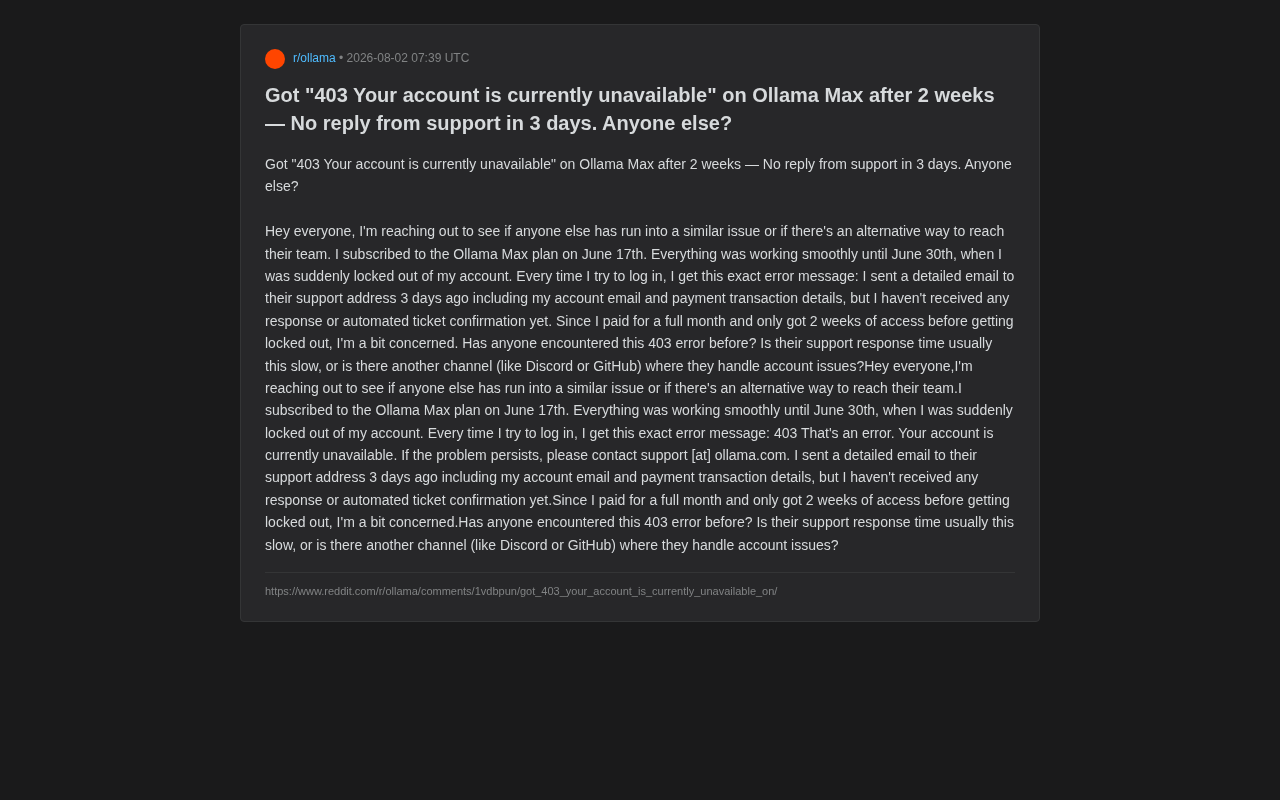
The user subscribed to the Ollama Max plan on June 17th. Everything worked fine initially, but by June 30th, their account was suspended without warning. Since they had paid for a full month but only received two weeks of actual access, this experience sparked widespread community discussion about the reliability of Ollama's commercial services.
Possible Causes Behind the Ollama Max 403 Error
While the post didn't provide a specific reason for the account ban, from a technical perspective, a "403 Your account is currently unavailable" error typically points to several possible scenarios.
Risk Control System False Positive
Many AI service providers deploy automated risk control mechanisms to prevent abuse (such as API call limits exceeded, abnormal traffic, suspected bot behavior, etc.). These systems are prone to false bans when lacking sufficient human review, causing legitimate paying users to be caught in the crossfire.
Modern AI service platforms' risk control systems typically rely on multi-dimensional behavioral analysis, including API call frequency, geographic distribution of request source IPs, token consumption per unit time, concurrent connections, and other metrics. These systems often employ a hybrid architecture of rule engines and machine learning models: rule engines handle clear threshold triggers (e.g., exceeding N requests per minute), while ML models identify more complex anomaly patterns. The problem arises when these systems have overly aggressive thresholds, or when the training data insufficiently covers the diversity of normal user behavior, leading to False Positives that incorrectly flag legitimate usage as abuse.
Payment-Related Issues
Although the user claims to have paid for the full month, it's possible that a dispute on the payment gateway side, a refund risk flag, or a bank chargeback alert triggered an automatic account freeze.
A Payment Gateway is the intermediary layer connecting merchants and banking systems, with common examples including Stripe, PayPal, and Adyen. When the bank side detects suspicious transactions (such as cross-border payments, multiple subscriptions/cancellations in a short period, or CVV verification failure retries), it sends risk signals to the gateway. Many SaaS platforms configure automated rules: once a risk flag is received from the payment gateway, the corresponding account is immediately frozen to avoid potential fraud losses. While this "ban first, investigate later" strategy effectively reduces the platform's financial risk, it creates a terrible experience for legitimate users, especially when there's no clear notification mechanism.
Terms of Service Violation Determination
Some platforms suspend accounts deemed to have violated usage policies, but proper practice should include a clear violation explanation rather than just a vague "account unavailable" message.
You might not have noticed, but Ollama originally gained recognition as an open-source local LLM running tool, with its core value being enabling users to conveniently deploy open-source models like Llama and Mistral on local devices. "Ollama Max" and similar paid cloud subscription services are part of its commercialization exploration.
Ollama was born in 2023, with its core product being a command-line tool that allows users to run various open-source large language models on local Mac, Linux, or Windows devices with simple commands like ollama run llama3. Its underlying inference optimization is based on llama.cpp, supporting quantized models in GGUF format, significantly lowering the technical barrier for local LLM deployment. As of 2024, Ollama supports over a hundred models with more than 100,000 GitHub stars, making it one of the most popular tools in the local AI inference space. Its commercialization attempts (such as the Ollama Max cloud service) aim to provide cloud inference capabilities for users who lack high-performance local hardware, while generating revenue to support continued development. When open-source tools extend into commercial services, they often have significant gaps in customer support system maturity.
Absent Customer Support: A More Serious Problem Than the 403 Error
The most concerning aspect of this incident isn't actually the 403 error itself, but the complete absence of support response. The user explicitly mentioned that three days after sending an appeal email, they hadn't even received an automated ticket confirmation — exposing serious deficiencies in Ollama Max's customer support processes.
Why Absent Support Is Fatal
For paid subscription services, customer support isn't just after-sales assurance — it's the cornerstone of user trust. When users encounter account anomalies, even an automated "We have received your request" confirmation email can significantly reduce anxiety. Complete silence, however, rapidly erodes user confidence in the brand.
Based on community feedback, this user even began seeking non-official channels like Discord and GitHub to resolve their account issue — which itself demonstrates that the official support channel is effectively non-functional. For a company hoping to transition from open-source community to commercial business, such support experiences are undoubtedly a red flag.
What to Do When Your AI Service Account Gets Banned: Practical Solutions
If you've encountered a similar situation where your paid AI service account has been banned, the following tips might help.
Multi-Channel Parallel Appeals
Don't rely solely on a single email channel. Try these simultaneously:
- Official Social Media: Publicly @mention the official account on platforms like X (Twitter). Public channels often get faster responses.
- GitHub Issues: For projects with open-source backgrounds like Ollama, their GitHub repositories typically have active maintainers. Try politely raising the issue there.
- Discord Community: Many AI tools have administrators or community managers on duty in their official Discord servers.
Preserve Complete Documentation
Make sure to save all evidence including subscription confirmation emails, payment records, error screenshots, etc. If the issue remains unresolved for an extended period, these materials can serve as basis for filing a dispute refund with your payment platform (such as your credit card issuer or PayPal).
Consider Refund Protection
If the service provider remains unresponsive and you've paid but cannot use the service, initiating a dispute (chargeback) through your payment channel is a legitimate means of protecting your rights. However, it's best to first allow the service provider reasonable response time (typically 7-14 business days).
A chargeback (dispute refund) is a consumer protection mechanism provided by credit card networks (Visa, Mastercard, etc.) for cardholders. When a cardholder believes a transaction involves fraud, service non-delivery, or significant discrepancy from description, they can initiate a dispute with their issuing bank. The issuing bank temporarily refunds the amount to the cardholder while sending a dispute notification to the merchant. The merchant has a time window (typically 30-45 days) to submit evidence in rebuttal. If the merchant cannot provide sufficient proof of service delivery, the refund becomes permanent, and the merchant may also be charged an additional dispute processing fee (typically $15-$25 per case). An excessively high chargeback rate (above 1%) may even lead to termination of the merchant's payment processing account.
Conclusion: The Trust Test of Open-Source Project Commercialization
This seemingly ordinary account dispute reflects a challenge commonly faced by many open-source projects during commercialization: strong technical capabilities but immature operational systems.
Open Source Commercialization has been an important trend in the tech industry in recent years, with typical paths including the Open Core model, Managed Service model, and value-added service model. Success stories like Red Hat, GitLab, and HashiCorp have validated the viability of this path. However, the core challenges in transitioning from a community-driven open-source project to a commercial service include: cultural conflict (open-source communities value transparency and autonomy, while commercial operations require processes and controls), team capability gaps (engineer-dominated teams often lack operational functions like customer success and technical support), and user expectation gaps (free tool users have high tolerance, while paying users have clear requirements for SLA and response times).
Ollama has an excellent reputation in the local LLM deployment space, but when it launches paid cloud services, user expectations naturally align with those for mature commercial products — stable service, transparent rules, and timely support are all indispensable. Any missing link could squander the community trust that was painstakingly built.
For users currently evaluating various paid AI services, this case also serves as a reminder: before subscribing, take the time to understand the provider's support response mechanisms and refund policies, keeping a safety net for unexpected situations. As of publication, whether this user's issue has been resolved remains unknown, and we will continue to monitor user feedback on similar services.
Related articles

Laptops: The Last Bastion of Plaintext Secrets
Developer laptops are the last security blind spot for plaintext secrets. This article analyzes risks in .env files, shell history, and tool configs, offering practical solutions like OS keystores, dynamic injection, and short-lived credentials.

Go Microservices in Practice: Detailed Architecture for E-Commerce, AI Agent, and IM System Integration
Deep dive into integrating e-commerce, AI Agent, and IM systems under Go microservices architecture, covering unified auth, gRPC, componentized Agent engines, and group chat bots.

X Platform's Recommendation Algorithm Caught Filtering Brazilian Election Content, Reigniting Algorithm Transparency Debate
X (formerly Twitter) was found filtering Brazilian election content in its For You feed, sparking debate over algorithm transparency and free speech.