Ollama Switches to Credit-Based Pricing: Legacy Pro Users Could Lose 67% of Their Token Allowance
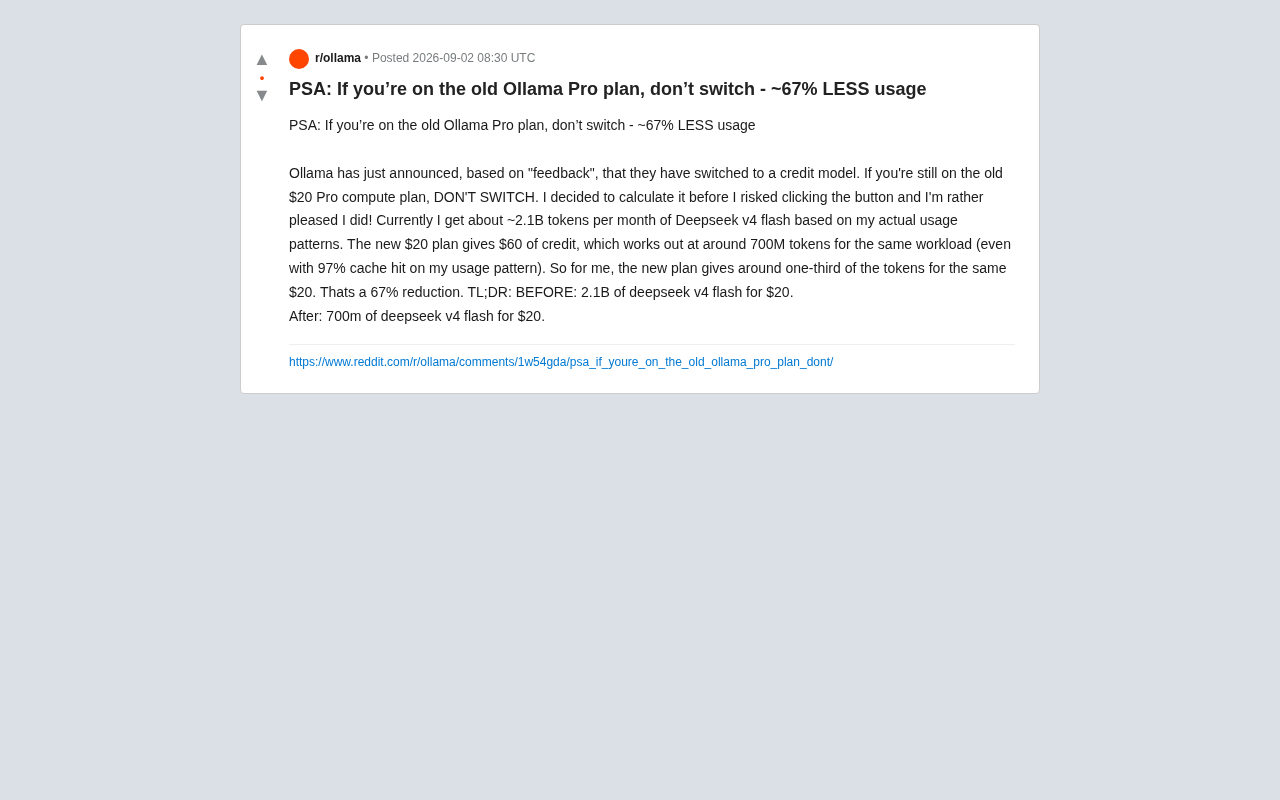
Ollama's new credit pricing cuts legacy Pro users' token allowance by 67% at the same $20/month price.
Ollama is replacing its fixed-rate Pro plan with credit-based pricing. A Reddit user's detailed analysis shows that the same $20/month now delivers only 700M tokens instead of 2.1B on the legacy plan — a 67% reduction. Even with a 97% cache hit rate factored in, the new plan is far worse for power users. The case highlights the broader industry trend of AI services shifting from buffet-style to à la carte pricing, and underscores the importance of running your own cost calculations before switching plans.
Overview: A Major Change to Ollama's Paid Plans
Recently, Ollama — the popular local large language model runner — announced a pricing overhaul. Citing "user feedback," the company is transitioning from fixed compute plans to a credit-based model. The change has sparked heated discussion on Reddit, where a user still on the legacy $20 Pro plan posted a PSA: If you're still on the old plan, do NOT click the switch button — your actual usable quota could shrink dramatically.
Ollama is an open-source framework for running large language models locally, allowing users to download, run, and manage various open-source models (such as Llama, Mistral, Gemma, etc.) on their own machines. Its core selling point is dramatically lowering the technical barrier to local model deployment — no need to manually configure Python environments, download model weights, or deal with quantization formats. A single command is all it takes to run a model. Beyond its free local functionality, Ollama also offers cloud-based paid services that give users access to more powerful proprietary models or higher compute capacity. This controversy centers on the paid service tier.
This type of shift — from flat-rate plans to usage-based billing — is hardly uncommon in the AI tools subscription space, but for power users, it almost always means a significant increase in effective costs. This particular user ran the numbers before switching, and the results made him glad he didn't pull the trigger.
Old vs. New: The Math That Matters
The user performed a detailed cost analysis based on his actual usage patterns. Here are the key findings:
Token Allowance: Old Plan vs. New Plan
- Legacy $20 Pro Plan: Approximately 2.1 billion (2.1B) tokens per month of Deepseek v4 flash usage.
- New $20 Credit Plan: Provides $60 in credits, which under the same workload translates to roughly 700 million (700M) tokens.
A quick note on what tokens actually are: In the LLM world, a token is the fundamental unit of text processing. One token is roughly equivalent to ¾ of an English word, or 1–2 Chinese characters. Every token the model processes requires GPU compute, so token count directly determines API cost. Tokens are split into input tokens (the user's prompt) and output tokens (the model's response). Output tokens typically cost more than input tokens because the generation process requires sequential inference computation. When we say 2.1 billion tokens, that figure covers both input and output combined.
The Deepseek v4 flash model mentioned in the user's analysis is also worth explaining. Deepseek is an LLM series developed by the Chinese AI company DeepSeek. The "flash" suffix typically indicates an inference-optimized, lightweight variant that maintains strong capabilities while significantly reducing inference cost and latency. These flash-tier models are increasingly popular across the industry — Google's Gemini Flash and Anthropic's Claude Haiku follow a similar positioning. The user's choice of Deepseek v4 flash for benchmarking suggests his workload prioritizes cost-efficiency over peak performance, which also explains his massive token consumption — low-cost models tend to be used for large-scale batch processing tasks like document summarization, data extraction, or automated code generation.
One important detail: this analysis already factored in the user's 97% cache hit rate — meaning that even under extremely favorable caching conditions, the new plan still delivers only about one-third the tokens of the old plan.
Cache hit rate, in the context of LLM API calls, refers to the reuse ratio of the KV Cache (key-value cache). When users send multiple requests with similar prefixes, the model doesn't need to recompute the attention key-value pairs for already-processed tokens — it simply reads the cached results. A 97% cache hit rate means the vast majority of the user's requests share similar context prefixes, which is very common in batch processing, RAG (Retrieval-Augmented Generation) pipelines, or code completion scenarios. Many API providers offer substantial discounts on cache-hit tokens (typically 1/4 to 1/10 of the regular price), so a high cache hit rate should significantly reduce actual costs. Yet even accounting for this favorable factor, the new plan's token allowance still shrinks dramatically — which underscores just how large the gap between the two plans really is.
Here's the breakdown:
| Plan | Monthly Cost | Available Tokens (Deepseek v4 flash) |
|---|---|---|
| Legacy Pro Plan | $20 | ~2.1 billion |
| New Credit Plan | $20 | ~700 million |
Same $20 per month, but 67% fewer tokens. For a user consuming billions of tokens monthly, this effectively triples the per-unit cost.
Why Such a Big Difference?
The Fundamental Distinction Between Flat-Rate and Credit-Based Pricing
Flat-rate compute plans follow an "all-you-can-eat" logic: as long as you stay within the compute ceiling, you don't need to worry about the cost of individual calls. Marginal cost approaches zero. This is extremely favorable for power users, since high-frequency, high-volume usage is amortized across a single fixed price.
Credit-based pricing, on the other hand, puts an explicit price tag on every token consumed. $60 in credits might sound like "more" than a $20 plan, but once you calculate the actual per-token cost, heavy users will burn through those credits in no time.
In short:
- Light users: Credit-based pricing may actually be a better deal — pay only for what you use, with no waste.
- Heavy users: Credit-based pricing represents a clear cost increase. The value advantage of flat-rate plans vanishes.
What's Really Behind the "User Feedback" Justification
Ollama attributes this change to "user feedback." From a business perspective, if a small number of power users are consuming disproportionate compute on a flat-rate plan, the cost pressure on the provider becomes immense. Switching to credits is essentially a way to more precisely pass costs through to high-consumption users — a common commercial correction in subscription-based AI services.
This pricing evolution is playing out across the entire AI industry. Early on, many services (like ChatGPT Plus at $20/month) adopted "buffet-style" pricing with generous usage caps. But as user bases grew, providers discovered that a small percentage of power users consumed far more GPU compute than expected, making marginal costs impossible to cover. OpenAI, Anthropic, and other leading companies have all repeatedly adjusted rate limits or introduced tiered pricing as a result. Credit-based billing essentially shifts the pricing model from "monthly buffet" to "à la carte," giving providers more precise control over their cost structure. But it also means that as pricing transparency increases, power users will clearly feel the rise in actual spending. Ollama's adjustment is yet another instance of this industry-wide trend playing out among small and mid-sized AI tool providers.
However, this also serves as an important reminder: when a platform says it's "optimizing" or "responding to feedback," the changes aren't necessarily good news for every user segment. For individual users, the most reliable basis for judgment is always a calculation grounded in your own real usage data — not the "more credits" headline in official marketing materials.
Before You Switch: A Practical Cost Analysis Guide
Four Steps to Calculate Your True Cost
The greatest takeaway from this case is a simple but easily overlooked principle: Before clicking any "upgrade" or "switch" button, run a cost analysis based on your actual usage.
Here's how:
- Track your real usage: Check how many tokens you actually consume per month. Don't estimate by gut feeling. Most AI services provide usage dashboards or API call logs — these are your most reliable data sources. If you're using Ollama's local service, check the token statistics in its logs.
- Calculate the new plan's effective per-token cost: Divide the credit amount offered in the new plan by the per-token price of the model you use. This gives you the actual number of usable tokens. Keep in mind that token pricing varies enormously across models — premium models (like GPT-4o or Claude Opus) can cost 10–50x more than lightweight models, so make sure to calculate based on the models you actually use.
- Factor in caching: If your workload has a high cache hit rate, include this discount in your calculations for a more realistic comparison. You can estimate your cache hit rate by analyzing the proportion of shared prefixes across your requests.
- Compare side by side: Put the old and new plans next to each other at the same price point and same workload. The difference will be immediately obvious.
Strategies for Power Users
For power users like the one in this case — consuming billions of tokens per month — the shift from flat-rate to credit-based pricing is almost always a red flag. A few recommendations:
- If the old plan is still available, keep it — it's usually the more economical choice. In the SaaS industry, honoring legacy plans for existing users (a so-called "grandfather clause") is common practice, but providers may force migrations at some future date, so stay alert for announcements.
- Watch whether Ollama will force-migrate legacy plan users, and have backup plans ready.
- Evaluate alternative local deployment solutions or competing services to see if you can meet high-frequency usage needs at lower cost. For users with sufficient technical skills, fully local deployment approaches (using tools like vLLM or llama.cpp to run models directly on your own GPUs) require higher upfront investment, but for long-term, large-scale usage scenarios, the per-token cost is often far lower than any cloud-based paid plan.
Conclusion
Ollama's shift from flat-rate to credit-based pricing is a common step in subscription service evolution, but its impact varies enormously across different user segments. This Reddit user's straightforward cost analysis helped him avoid a 67% reduction in token allowance and served as a wake-up call for the entire community.
As AI tool subscriptions become increasingly mainstream, a "better deal" on paper isn't necessarily a better deal in practice. Building the habit of proactively calculating costs before changing billing plans is a fundamental skill every AI tool user should develop.
Related articles
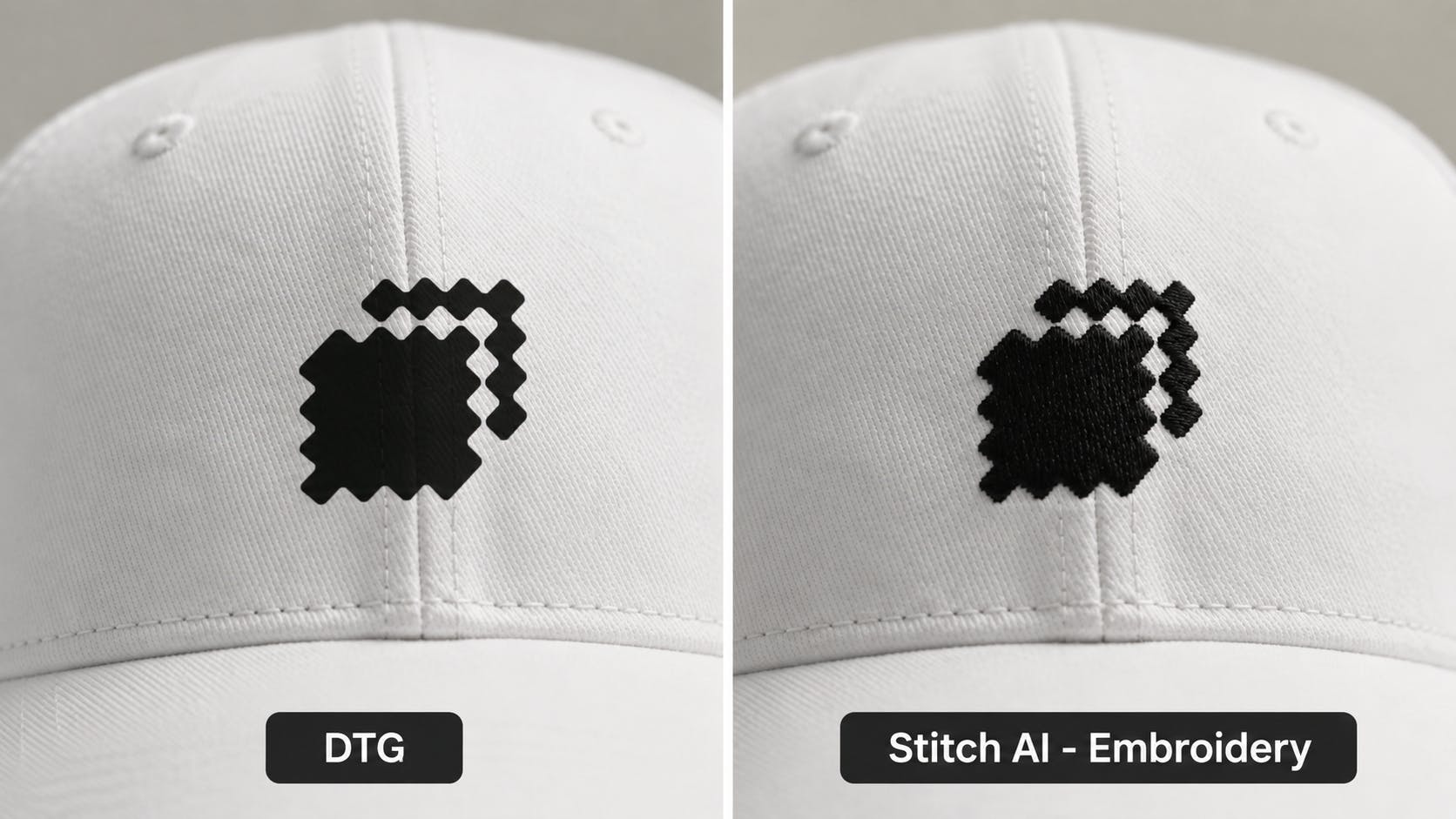
Stitch AI: An Embroidery Digitizing AI Agent That Generates Production-Ready Machine Files in 15 Seconds
Stitch AI is the first embroidery digitizing AI agent that reads artwork like a pro digitizer, auto-planning stitch direction, density, and pull compensation to generate DST/PES machine files, production sheets, and mockups in 15 seconds.

Claude Fable 5.1 Deep Dive: Anthropic's Most Powerful AI Model for Coding and Knowledge Work
Claude Fable 5.1 is Anthropic's most advanced coding and knowledge work model, built on the Claude 5 Mythos architecture. This deep dive covers its core capabilities, differences from Mythos 5.1, and deployment options.
deepeye: A Free Tool for Real-Time Deepfake Detection Right in Your Browser
deepeye is a free Chrome extension that detects deepfakes in real time—AI-generated photos, video calls, and voice messages—without uploading files.