Stitch AI: An Embroidery Digitizing AI Agent That Generates Production-Ready Machine Files in 15 Seconds
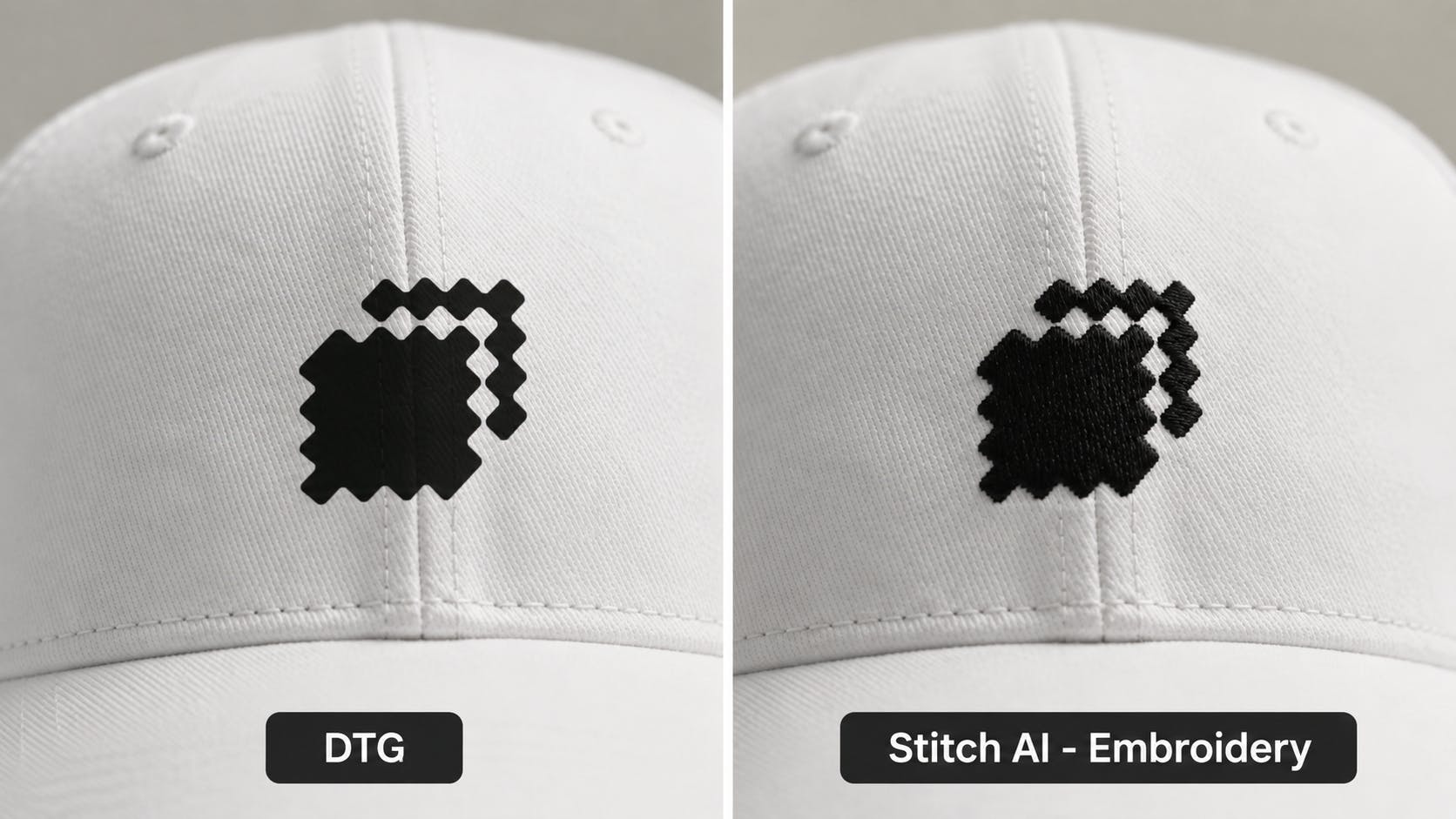
Stitch AI automates embroidery digitization, generating production-ready machine files in 15 seconds.
Stitch AI by Dynamic Mockups is the first AI agent for embroidery digitization, converting artwork into production-ready machine files (DST, PES) in just 15 seconds. It analyzes designs at the region level — planning stitch direction, density, and pull compensation like a professional digitizer — while also outputting production sheets, stitch counts, and lifestyle mockups. Targeting e-commerce sellers, custom workshops, and brand teams, it dramatically reduces the time and cost barriers of traditional embroidery digitization workflows.
When Traditional Embroidery Craftsmanship Meets AI Agents
Embroidery Digitizing is one of the most technically demanding processes in the garment and textile customization industry. At its core, it involves converting continuous visual information into discrete stitch sequences executable by embroidery machines. Professional digitizers must plan stitch direction, stitch density, and fabric pull compensation region by region, transforming an ordinary design into a machine-readable file. Common machine file formats include Tajima's DST format, Brother's PES format, and Melco's EXP format, each encoding stitch coordinates and control instructions differently. Professional digitizers typically use specialized software like Wilcom, Pulse, or Hatch to manually plan stitch types (such as satin stitch, fill stitch, running stitch, etc.) for each area. Digitizing a moderately complex logo usually takes 1–3 hours, and intricate designs can consume an entire day — all while being heavily dependent on the practitioner's accumulated experience.
Stitch AI, launched by Dynamic Mockups, was built to tackle exactly this pain point. Positioning itself as "the first embroidery digitizing AI agent," its core value proposition is straightforward: let AI interpret artwork from the perspective of a professional digitizer and automatically handle the entire pipeline from image to machine file — all in just 15 seconds.
How Stitch AI Works: Automating Embroidery Digitization
"Reading" Artwork Like a Professional Digitizer
A key claim in Stitch AI's technical description is that it "reads artwork like a professional digitizer." This goes beyond simple image-to-vector conversion or path tracing — it involves understanding artwork at a semantic level, recognizing the texture, edge complexity, and material feel of different regions, and making differentiated stitch planning decisions accordingly.
Specifically, Stitch AI performs region-level analysis of artwork and outputs three critical parameters:
- Stitch Direction: The angle of stitches in different areas directly affects the sheen and dimensional quality of the finished product. Stitch direction influences sheen because embroidery thread reflects light differently depending on its angle — parallel stitches produce a satin-like luster, while cross-directional stitches diminish this reflective effect. Skilled digitizers deliberately leverage this property to create visual depth.
- Stitch Density: Too dense causes fabric distortion; too sparse results in uneven fill. Standard satin stitch density is approximately 4–5 stitches per millimeter. Excessive density not only wastes thread but also causes the needle to repeatedly pierce the same area, leading to fabric damage — a particularly critical issue on lightweight fabrics.
- Pull Compensation: Fabric contracts under tension during the embroidery process, requiring geometric compensation to be pre-applied in the file. Specifically, as the needle penetrates the fabric and pulls the thread taut, the material shrinks by 0.2–0.5mm along the stitch direction. Digitizers must pre-enlarge the design in the corresponding direction to counteract this deformation, and the compensation coefficient varies for different fabrics (e.g., cotton, nylon, leather).
The combination of these three parameters determines the upper limit of embroidery quality, and they represent the hardest aspects of digitization to automate. Stitch AI's ability to achieve fine-grained, region-level planning across all three dimensions is the core of its technical value.
A Complete Production File Package in 15 Seconds
Once processing is complete, Stitch AI delivers four types of files in a single output:
- Embroidery Machine Files: Standard formats (such as DST, PES, etc.) that can be directly imported into embroidery machines
- Production Sheet: Contains color sequences, thread change instructions, and other production-side information
- Stitch Count: Used for cost calculation and production time estimation
- Lifestyle Mockup Preview: A visualization ready to be used in client proposals
The mockup preview deserves special attention. It merges "technical file generation" and "business presentation" into a single step — designers or sales staff receive both the machine files and client-ready visual assets simultaneously, significantly shortening the quoting and approval cycle.
Industry Pain Points: The Efficiency Bottleneck in Embroidery Digitization
The Cost and Time Dilemma of Traditional Digitization
Traditional embroidery digitization services currently operate under two mainstream models:
- In-house dedicated digitizers: High labor costs with limited capacity
- Outsourcing to third-party providers: Typically requires a 24–72 hour turnaround, with per-design pricing ranging from $10–$50
For e-commerce sellers, small custom garment workshops, and rapid prototyping scenarios, both the time cost and financial threshold of existing workflows pose substantial barriers. The global embroidery machine market is projected to reach approximately $2.5 billion by 2030, with custom embroidery services growing the fastest within that segment. A large number of sellers on platforms like Etsy, Printful, and Printify offer personalized embroidery products (such as custom hats, polo shirts, workwear, etc.). The typical pain point for these sellers is that each design requires individual digitization, while order volumes are often just dozens or even single digits. Under the traditional outsourcing model, the $10–$50 digitization fee per design directly erodes profit margins. Stitch AI is targeting precisely this market opportunity that has long been suppressed by inefficient workflows.
Why an AI Agent, Not Just an Automation Tool
Stitch AI defines itself as an "Agent" rather than a simple automation tool. The core distinction is that an agent possesses the ability to plan and make decisions about tasks, rather than merely executing predefined rules.
Within the AI technology landscape, the fundamental difference between an agent and a traditional automation tool lies in the agent's closed-loop capability of perception–reasoning–action. Traditional auto-digitizing tools (such as the built-in Auto-Digitizing features in early embroidery software) are essentially rule-based image processing pipelines: first perform color separation, then edge detection, and finally fill stitches according to preset parameters. This approach works acceptably for simple designs, but when facing complex compositions, it often generates excessive redundant stitches or erroneous paths — the industry widely acknowledges that its output quality falls far short of manual digitization. The AI agent paradigm is different: it can semantically understand artwork like a human expert — distinguishing primary elements from backgrounds, recognizing the different processing requirements of text versus graphics, and dynamically adjusting strategies based on context. This aligns conceptually with the task planning principles of LLM-driven Agent architectures.
From a product performance standpoint, Stitch AI's region-level parameter planning — applying different stitch strategies to different areas within the same artwork — is a direct manifestation of this planning capability. Rather than processing an entire image with a fixed set of parameters, it dynamically selects the optimal stitch approach for each region, which is consistent with the technical essence of an "agent."
Who Is Stitch AI For? Key Use Cases and Potential Limitations
User Groups That Benefit Most
Stitch AI's advantages are most pronounced in the following scenarios:
- On-demand custom e-commerce: High SKU counts with low per-item volumes, requiring frequent design rendering and quoting
- Rapid brand prototyping: Shortening the confirmation cycle from design draft to physical sample
- Small custom workshops: No in-house digitizer, yet wanting to avoid paying outsourcing fees for every order
- Sales and proposal scenarios: Using mockup previews to quickly visualize custom solutions for clients
Key Considerations Before Adoption
Any AI tool that claims to replace a specialized profession needs to withstand the test of actual production. For Stitch AI, the following aspects warrant careful evaluation:
- Processing boundaries for complex artwork: Gradients, small text, and highly complex designs are challenging even for human digitizers — AI performance on these edge cases still requires further validation. It's worth noting that embroidery is inherently a discrete expression medium that cannot achieve continuous tonal transitions like printing. Gradient effects typically need to be simulated through blended thread colors or adjusted stitch density, which places extremely high demands on the digitization algorithm.
- Output format compatibility: Different embroidery machine brands have varying format requirements — users should confirm the list of supported formats in advance. There are currently over 20 common formats in the industry. Beyond the mainstream DST and PES, there are Tajima's TBF, Barudan's FDR, ZSK's ZSK format, and others, each handling maximum stitch length, jump stitch commands, and color sequence encoding differently.
- Degree of parameter intervention: Fully automatic output is certainly efficient, but for professional users with customization needs, whether stitch parameters can be manually adjusted directly impacts workflow integration depth.
Conclusion: A Typical AI Deployment Path in Vertical Craft Domains
What Stitch AI does is conceptually clear and compelling: compressing a highly experience-dependent professional process down to 15 seconds through an AI agent approach. This direction represents a typical path for AI penetration into vertical craft domains — not a simple transfer of general capabilities, but deep modeling for specific processes.
In fact, this model has already seen multiple analogous cases in manufacturing and craft industries: Shaper Origin in woodworking uses computer vision to guide handheld CNC machining, WASP in ceramic 3D printing combines algorithms to generate complex vessel forms, and Lectra in garment cutting uses AI to optimize pattern layout and reduce fabric waste. The common thread across these cases is that AI doesn't replace the entire production workflow — instead, it precisely targets the bottleneck steps that are most dependent on human experiential judgment while also being highly repetitive, thereby leveraging efficiency gains across the entire value chain. Stitch AI's approach to the embroidery digitization step is yet another confirmation of this pattern.
The product currently has 96 upvotes on Product Hunt, ranking 11th on the daily leaderboard — a moderately above-average level of attention among similar vertical tools. If you're involved in custom embroidery or related supply chain operations, Stitch AI is worth adding to your efficiency tool evaluation list.
Related articles

Workbuddy for Absolute Beginners: How a Desktop AI Agent Fits Into Real Workflows
A beginner's guide to the Workbuddy desktop AI agent: installation, claiming credits, file management, and building automated workflows—compared with CodeX for fit and cost, helping professionals shift from AI question-askers to AI managers.

OpenAI's New Agent Stack: Computer Use, Decisions API, and Ultra-Fast Workflows
OpenAI Dev Day unveiled a new agent stack: Computer Use outperforms humans, Decisions API delivers ultra-low-latency classification via Luna, Agents API opens the same Computer Use capabilities, and GPT-6.1 Sol costs only one-seventh of Astra. Core updates, benchmark data, and developer insights.

Liang Wenfeng Open-Sources DeepInfo Inference Framework, Takes On U.S. Ban
DeepSeek open-sources its DeepInfo inference framework after its models, featuring GPU/CPU cross-pipelining, small-model prediction with large-model verification, and full Huawei Ascend and NVIDIA chip support—facing the U.S. federal ban head-on. This article analyzes its significance for AI deployment and open-source strategy.