Ollama v0.40.0 Released: MLX Acceleration Enabled by Default on Apple Silicon

Ollama v0.40.0 makes Apple's MLX framework the default runtime on Apple Silicon Macs, with no configuration needed.
Ollama v0.40.0 (pre-release) defaults to Apple's MLX framework for supported model architectures on Apple Silicon Macs, replacing the general-purpose llama.cpp backend. MLX is deeply optimized for Apple's unified memory architecture, offering better inference throughput and memory efficiency. The update adds MLX support for gemma4, qwen3.6, qwen3.5, and decision models including Nimble, tev1, clef, and clef-flash. The runtime switch is fully transparent to users, staying true to Ollama's out-of-the-box philosophy. Production users are advised to test before upgrading as the release is still pre-release.
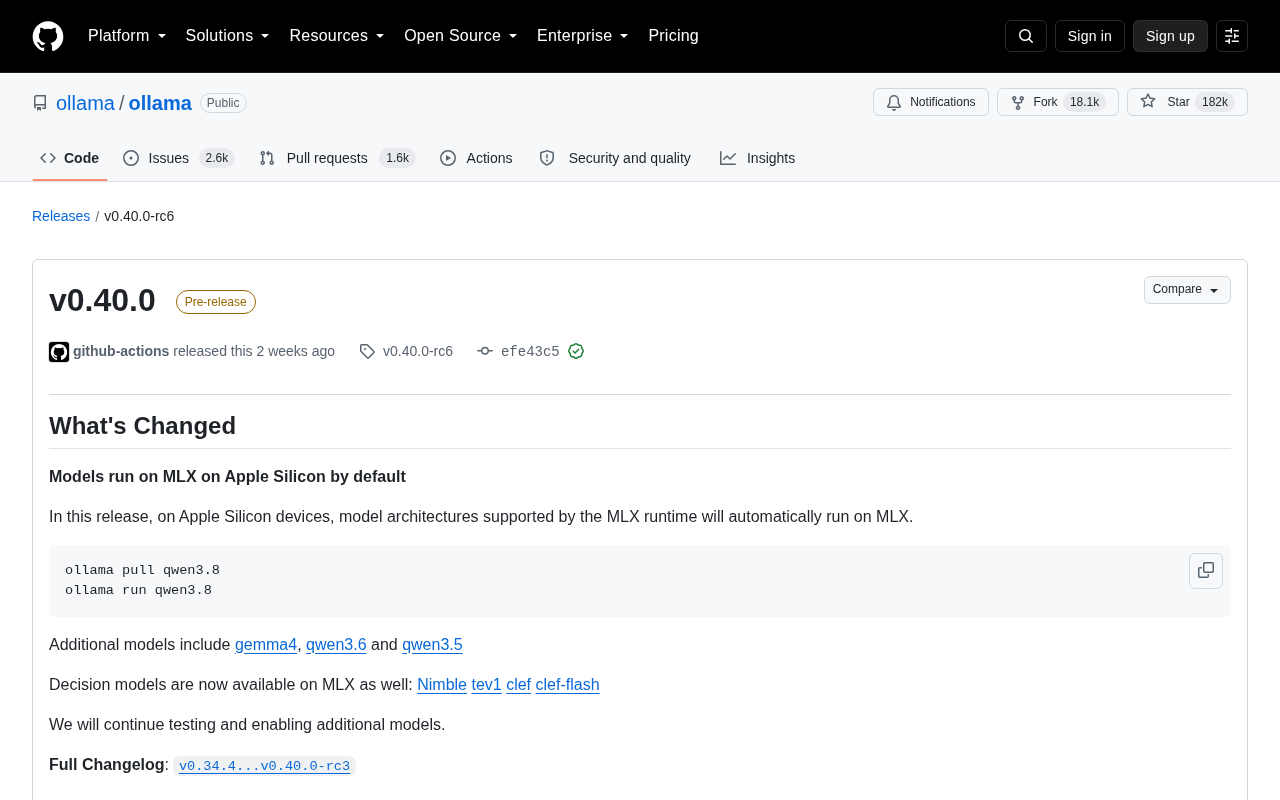
Ollama has released v0.40.0 (currently still in Pre-release), and the biggest change in this update is that supported model architectures will now execute via the MLX runtime by default on Mac devices with Apple Silicon chips. For developers and enthusiasts running large models locally on Mac, this translates to inference performance that's better tuned to Apple's hardware.
MLX Becomes the Default Runtime on Apple Silicon
MLX is Apple's official machine learning framework, deeply optimized for the unified memory architecture and GPU/Neural Engine found in Apple Silicon. In previous versions, Ollama primarily relied on llama.cpp-based inference backends. With v0.40.0, model architectures that support MLX will automatically switch to MLX execution on Apple chips — no manual configuration required.
For everyday users, nothing changes about how you interact with Ollama. It's still the same familiar command-line workflow:
ollama pull qwen3.8
ollama run qwen3.8
The runtime switch is completely transparent — when you pull and run a model, Ollama automatically determines whether the architecture supports MLX, and if so, routes execution through MLX by default. This "best by default" design philosophy lowers the barrier to optimizing local inference.
MLX was open-sourced by Apple's machine learning research team in late 2023, with its core design philosophy centered on "unified memory first": on Apple Silicon, the CPU, GPU, and Neural Engine share the same physical memory pool, eliminating the need to copy data between devices. This is fundamentally different from traditional NVIDIA GPU setups, where data must be transferred over a PCIe bus. For LLM inference, this means model weights can be accessed directly in memory by both the GPU and Neural Engine, removing the overhead of shuttling data between VRAM and system RAM. By comparison, llama.cpp does support Metal acceleration (Apple's GPU API), but it's a general cross-platform implementation that hasn't been specifically tuned for the unified memory architecture. MLX's API design draws inspiration from NumPy and PyTorch, making it accessible to developers familiar with the Python ML ecosystem and easier for model developers to adapt to.
Expanded Model Support
According to the official Release Notes, beyond the core MLX-by-default change, this update also expands the list of models that can run on MLX. Models mentioned include gemma4, qwen3.6, and qwen3.5.
Additionally, a category of models described as "Decision models" has been added to MLX support, including:
- Nimble
- tev1
- clef
- clef-flash
The team also stated they will continue testing and gradually expanding MLX support to more model architectures — meaning the current list is just a starting point, and future releases will likely cover a broader range of models.
"Decision models" are a class of lightweight models optimized for structured decision-making, reasoning chain planning, or tool-calling scenarios. Unlike general-purpose conversational LLMs, they typically have fewer parameters and lower latency, making them well-suited for frequent invocation in edge or local environments. Names like Nimble, clef, and clef-flash have limited visibility in mainstream public model communities, and may represent experimental models developed through partnerships or internal testing at Ollama. Their inclusion in the MLX support list signals an early investment in local Agent workflows and tool-calling use cases.
What This Means for Local Deployment Users
The practical value of this update is most visible in the local inference experience for Mac users. MLX is specifically optimized for Apple Silicon's unified memory architecture, often delivering better memory efficiency and inference throughput compared to general-purpose backends — especially when running larger models, where it can more fully leverage the compute capabilities of M-series chips.
Ollama is already one of the most popular tools for running large models locally (with over 180,000 Stars on GitHub), and its native MLX support further cements Mac's position as a local AI development platform. For users who regularly run model experiments and prototype on MacBook, upgrading to v0.40.0 delivers a near-zero-effort performance boost.
It's worth noting that v0.40.0 is currently marked as Pre-release, meaning features and stability are still being validated. Users running production workloads or with higher stability requirements are advised to evaluate in a test environment before upgrading.
Summary
The core of Ollama v0.40.0 is making MLX the default runtime on Apple Silicon, while expanding the range of models supported by MLX. It continues Ollama's signature "out-of-the-box" product philosophy — users don't need to think about the underlying runtime to get hardware-native inference performance on Mac. As the team continues to roll out support for more model architectures, the MLX + Ollama combination is well worth keeping an eye on.
Related articles

Chain of Thought Isn't Just for AI: How Humans Can Use CoT to Improve Thinking Quality
Chain of Thought isn't just a prompt trick for large models. Starting from a Hacker News discussion, this article analyzes why CoT works for human thinking too, breaks down actionable ways to transfer it, and highlights the key differences between human CoT and machine CoT.
Cloudflare Teams Up with OpenAI: Closi…
Cloudflare Teams Up with OpenAI: Closing the Loop from Vulnerability Discovery to Defense with AI
Cloudflare uses OpenAI Daybreak to investigate security vulnerabilities and generate reviewable remediation plans, while developers use Codex to boost coding efficiency and quality.

Orca Multi-Agent Orchestration in Practice: A Guide to Parallel Collaboration with Claude and Codex
Orca is Stable AI's free open-source agent workbench supporting 34 agents like Claude Code and Codex in parallel. Learn its Git worktree isolation, multi-model orchestration, and mobile management.