Ollama v0.40.12 Update: MLX Adds Support for LFM3 and d1 Models

Ollama v0.40.12 adds LFM3 and d1 model support to the MLX backend—a low-risk, routine expansion.
Ollama has released v0.40.12. The only substantive change is the addition of support for the LFM3 and d1 model families on the MLX inference backend via commit #19333, further expanding local model choices for Apple Silicon users. The release is GPG-signed with key ID B5690EEEBB952194 and the commit is marked Verified, so supply chain integrity can be verified. The article notes that this update has no breaking changes and no interface adjustments—it's a routine model library expansion: a low-risk upgrade for existing MLX backend users, but not a strong reason to upgrade for those still on the fence. The original release information doesn't disclose parameters, capabilities, or performance data for the two models, so actual speed and output quality need to be verified by users in a test environment.
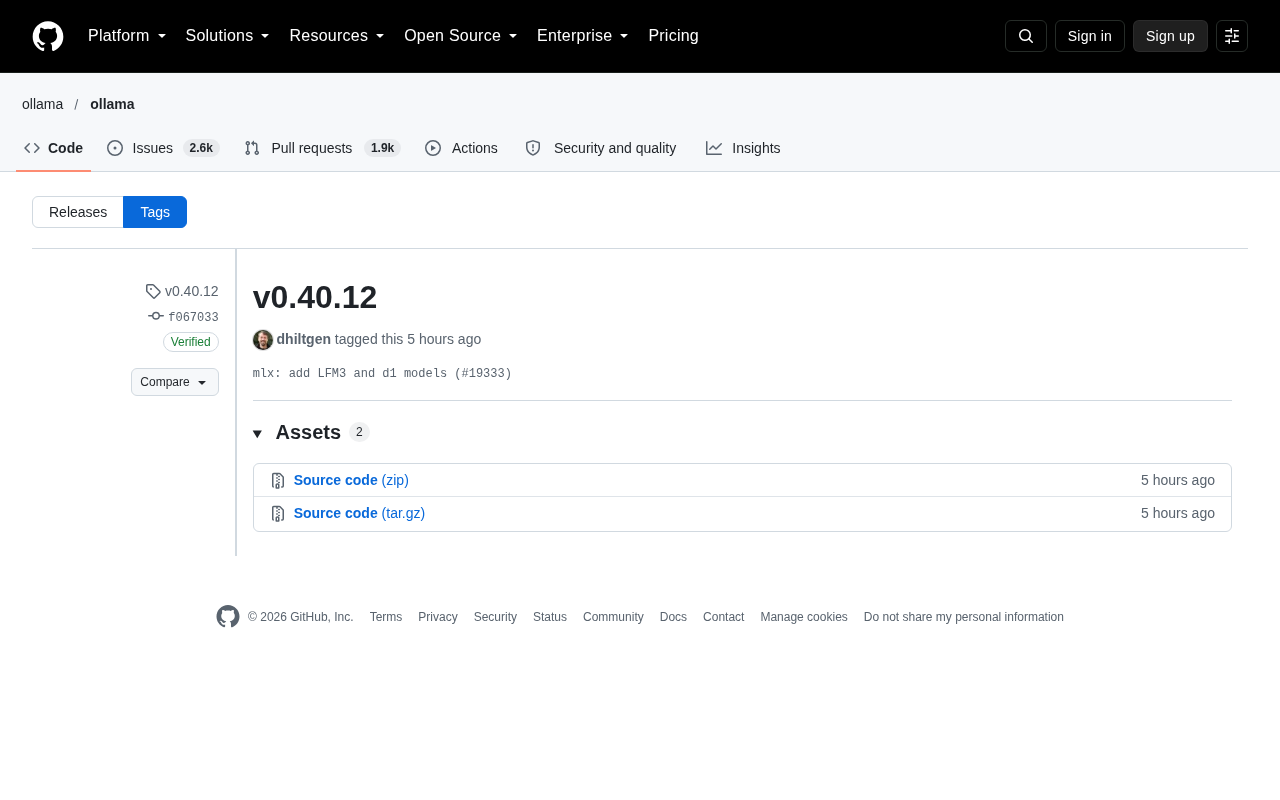
Ollama has released version v0.40.12. It's a modest update in scope, but the direction is worth noting: it adds support for two models, LFM3 and d1, on the MLX backend (commit #19333). For users running local models on Apple Silicon, this means the pool of available models has grown a little wider.
Core Change: New Model Support on the MLX Backend
According to the commit record on GitHub, the only substantive change in this release is "mlx: add LFM3 and d1 models." In other words, Ollama's MLX inference path can now load and run LFM3 and d1 model families.
MLX is Apple's machine learning framework for its own chips, which Ollama uses to optimize inference performance on the Mac. Ollama had already supported a set of models through MLX, and adding LFM3 and d1 shows the team is continuing to track actively developed model families in the community rather than focusing only on a handful of top-tier models.
Why These Two Models?
The original release information doesn't elaborate on the specific parameters, capabilities, or intended use cases of LFM3 and d1—it only gives the model names. Judging by naming, LFM3 continues the LFM series, while d1 is a relatively new identifier. For developers focused on local deployment, the practical impact is this: after upgrading to v0.40.12, you can try these two models in an MLX environment without having to handle conversion and adaptation yourself.
It's worth noting that there is currently no public benchmark data showing how these two models perform on MLX. The source material also provides no performance metrics, so no quantitative judgment about speed or quality is made here.
MLX is an array computing and machine learning framework that Apple open-sourced in late 2023, designed specifically for Apple Silicon's unified memory architecture. Its key difference from PyTorch is that the CPU and GPU share the same physical memory, so tensors don't need to be explicitly copied between devices—which significantly reduces data movement overhead when running large language models on a Mac. MLX also offers bindings for multiple languages including Python, Swift, and C++, and includes built-in inference-optimized operators for Transformer architectures. Ollama treats MLX as an inference backend separate from llama.cpp, precisely because of its memory efficiency on M-series chips. Note that MLX's capabilities depend on the specific macOS version and chip generation; older Intel Macs do not support this path.
So-called "model adaptation" is not simply copying files. Different model families often differ in architectural details—for example, how attention layers are implemented, positional encoding schemes, tokenizer vocabularies, RoPE parameters, and even tensor naming conventions. Ollama needs to write corresponding loading logic and weight mappings for each new model, and sometimes adjust quantization and KV Cache implementations. "Connecting to the MLX path" means enabling Ollama to correctly map the model's computation graph onto MLX operators. Therefore, each new model addition is essentially a small-scale engineering port, which is why the community pays attention to commit-level changes.
Release Process and Trustworthiness
This version is published on GitHub with a GPG signature, using signing key ID B5690EEEBB952194, and the commit is marked as Verified. dhiltgen tagged v0.40.12 on 27 Oct at 15:47.
For users running Ollama in production or experimental environments, signature verification means you can confirm that the release package comes from the official maintainer and hasn't been tampered with. While these engineering details are inconspicuous, they are a basic safeguard for supply chain security for teams relying on local inference services.
GPG signing is a standard integrity verification mechanism in the Git and GitHub ecosystem. Maintainers sign tags or commits with their private key, and anyone can use their public key to verify that the signature was generated by them and that the content hasn't been altered. The Verified badge shown by GitHub indicates that the signature is bound to the committer's account and has passed platform verification. For a tool like Ollama that distributes binaries and model files, forming a traceable chain from source tag to release artifact reduces the risk of man-in-the-middle tampering or forged versions. In practice, teams can add public key fingerprints to their internal compliance lists and verify signatures before pulling in automated upgrade scripts.
Significance for the Local Inference Ecosystem
Ollama's release cadence has been fairly steady, with minor version updates typically focused on model support and backend adaptation. v0.40.12 continues this pattern: no breaking changes, no interface adjustments—just new models connected to the MLX path.
Looking at the trend, local inference tools are shifting from "can it run" to "how broadly can it run." Users are choosing Ollama increasingly not just for ease of use, but also for the breadth of model coverage. The addition of LFM3 and d1 gives Mac users a few more experimental options without leaving the Ollama workflow.
If you're already using Ollama's MLX backend, upgrading to v0.40.12 is a low-risk operation. If you're still on the fence, this version alone isn't a strong reason to upgrade—it's more of a routine expansion of the model library.
Quick Start Suggestions
After upgrading, you can try the new models through Ollama's standard model pull process. For specific commands and model tags, refer to the official model library; the original release information doesn't provide example commands, so no guesses are made here.
For teams that need a stable environment, it's advisable to first verify the output quality and resource usage of LFM3 and d1 in a test environment before deciding whether to incorporate them into daily workflows. MLX backend performance is closely tied to the specific chip model and memory configuration, so actual experience will vary.
Related articles

Will GitHub Die? Open Source Maintainer Burnout and the Collaboration Crisis in the AI Era
Lex Fridman podcast discussion on open source maintainer burnout and GitHub's predicament: massive pull requests overwhelm core maintainers, and AI worsens code bloat. Using math journal peer review and Poincaré conjecture verification as analogies, the article analyzes why verification in knowledge production must be deliberately slow, and how open source communities can avoid the failure mode of maintainers exiting.
Stop Building Cookie-Cutter AI Websites: 3 Tools That Transform Your Coding Agent
Three tools that boost AI coding agents: FFmpeg skill for local video editing in Claude Code and Cursor, Hallmark's 50 design themes to fix cookie-cutter AI sites, and Jailbreaks' 25+ model prompts.

How America's Gerontocracy Squeezes the Younger Generation
Americans over 55 hold nearly three-quarters of national wealth, alongside an 80-year-old president and elderly congressional leaders. The Atlantic's Idrees Kahloon explains how gerontocracy drives up housing costs, squeezes opportunities for the young, and explores zoning reform and child poverty reduction as practical fixes.