Ollama v0.40.9-rc2 Fix: Flint Reply Issue When Thinking Mode Is Disabled
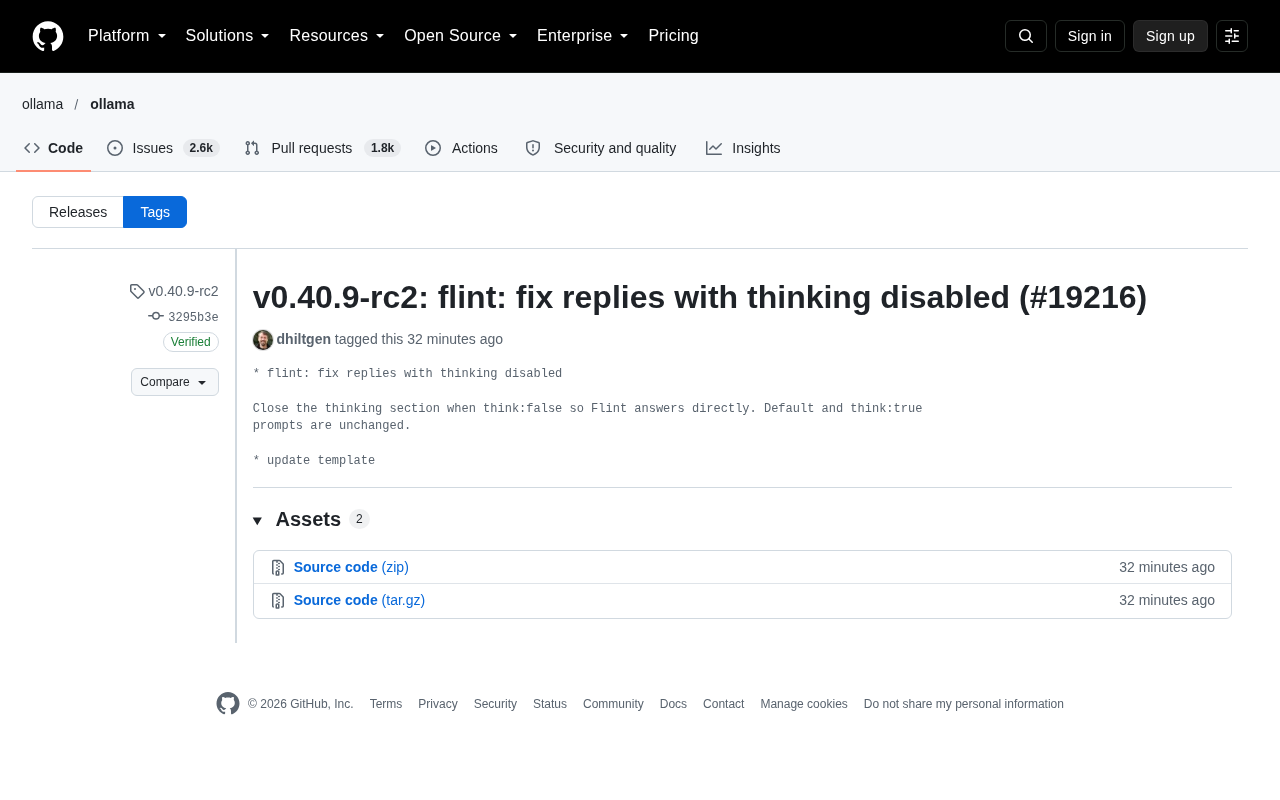
Ollama v0.40.9-rc2 fixes Flint still outputting thinking content when think:false.
Ollama released candidate version v0.40.9-rc2, with a precise fix for the Flint model submitted by developer dhiltgen: when a request explicitly specifies think:false, Flint closes the thinking block and directly outputs the final answer instead of incorrectly generating a thinking section. The commit also updates the prompt template to keep template logic consistent with the new behavior; the default setting and the think:true path are unchanged, so existing use cases that rely on the thinking process are unaffected. The article notes that this fix has practical value for developers using Flint for reasoning or conversation—disabling thinking is often used to reduce latency or simplify output, and if the model still outputs thinking content it will break downstream parsing and the user experience. Because it is a release candidate, stability should still be fully evaluated before upgrading in production.
Fix Details: Direct Reply When think:false
According to the commit message, the core of this fix is "Close the thinking section when think:false so Flint answers directly." In other words, when think:false is specified in the request, Flint closes the thinking block and directly outputs the final answer. Previously, even with the thinking option disabled, the model could still generate thinking content, resulting in replies that did not meet expectations.
The commit also updates the template (update template) to ensure that the prompt stays consistent with the new behavior logic. For the default setting and prompts with think:true, the behavior remains unchanged, so existing use cases that rely on the thinking process are not affected.
The role of the template in Ollama
Every model in Ollama comes with a Modelfile, where the TEMPLATE directive defines how the system prompt, multi-turn history, and the current user message are assembled into the actual prompt the model receives, including conditional variables such as {{ .Think }}. Whether the model "enters thinking" depends largely on whether the template still injects thinking-guiding instructions or retains the opening marker of the thinking block when think is false.
This commit also modifies the template, indicating that the root cause lies at the prompt level rather than the sampling level: parameters alone cannot prevent the model from continuing to write a thinking section; the template must conditionally close or omit the opening marker of the thinking block based on the value of think before the model goes directly into answer generation. This also explains why the fix keeps both the default and think:true paths unchanged—the conditional branch only affects the false path.
Version Background and Impact
v0.40.9-rc2 is a release candidate (rc2), meaning it is in the testing phase before the official release. This version number is associated with commit hash 3295b3e and was tagged by dhiltgen on 22 Oct 18:38.
This fix has practical significance for developers using Flint for reasoning or conversation: disabling thinking mode is often used to reduce latency or simplify output, and if the model still generates a thinking section, it will break downstream parsing or the user experience. After the fix, the semantics of think:false are clearer, helping to build more controllable AI applications.
Release candidates (rc) and semantic versioning
The rc in v0.40.9-rc2 stands for release candidate, i.e., the final testing phase before features are frozen and the version is ready to become an official release; the suffix 2 indicates that this is the second candidate of that version. Under semantic versioning (SemVer), an increment in the PATCH position of MAJOR.MINOR.PATCH usually corresponds to a bug fix, while hyphenated suffixes such as -rc indicate a pre-release, which by default sorts lower than the official release with the same number in dependency resolution.
Therefore, when using range constraints such as ^0.40 in CI or a package manager, rc versions are usually not pulled automatically and must be specified explicitly. This is also one of the technical reasons for "caution when upgrading in production": candidate versions may still contain uncovered regressions, and their behavior may still change before the official release.
How to Understand Flint's Thinking Switch
Flint is one of the models in the Ollama ecosystem and supports optional thinking-process output. Thinking mode lets the model show its reasoning steps before giving an answer, which suits scenarios that require transparency; disabling thinking pursues direct, concise replies. This fix ensures a clear behavioral boundary between the two modes, so developers can switch as needed without worrying about mode confusion.
The relationship between thinking mode and "reasoning models"
Thinking mode is an output paradigm widely adopted by reasoning models since 2024 (such as the OpenAI o series, DeepSeekAd-R1, Qwen3, etc.): before generating the final answer, the model first outputs an intermediate text known as "thinking content" or a "reasoning trace." This content is usually wrapped in special markers such as thinking ... response, or returned at the API layer through a separate reasoning field.
For developers, the value and cost of thinking mode coexist. Enabling thinking can improve accuracy on complex reasoning tasks (mathematics, code, multi-step planning) and make the decision process auditable; but the cost is higher token consumption, longer time to first token, and text mixed into the output that is not the final answer, requiring extra parsing. Therefore, mainstream inference frameworks all provide switches, such as Ollama's think parameter, vLLM's enable_thinking, and the various reasoning_effort options. The essence of this fix is to make the think:false switch truly take effect at the template level, rather than serving only as a soft constraint at the prompt level.
Upgrade Recommendations
If you are using Flint and rely on think:false to get direct replies, it is recommended to test v0.40.9-rc2 to verify the fix. Because it is a candidate version, stability should be fully evaluated before upgrading in production. The default behavior and the think:true path are unaffected, so the upgrade risk is relatively manageable.
Overall, this is a small and precise fix that reflects Ollama's ongoing refinement of model behavior consistency.
Related articles

AgentCore in Practice: Connecting Custom Tools and MCP Servers to Agents
DebuggerCafe tutorial shows how to connect custom tools and MCP servers to Amazon Bedrock AgentCore agents, covering tool contract design, MCP reuse, and production concerns.

816B Parameters Scores Only 39? The Real Cost-Effectiveness of the Open-Source LLM Parameter Race
Meta's 816B Muse Spark Open scores just 39 on Artificial Analysis, while 180B Qwen3.8-Flash-Next scores 40. This article analyzes 11 open-weight models' parameters vs. scores, exploring the real impact of activated parameters, quantized size, and deployment cost.

Aerial Manipulators: The Next Step for Drones from 'Seeing' to 'Changing'
Starting from a Reddit discussion, this article analyzes the technical challenges, potential applications, and deployment bottlenecks of aerial manipulators, exploring the key challenges for drones moving from environmental perception to physical manipulation.