Olostep: A Web Scraping API That Turns Web Pages into AI-Ready Data
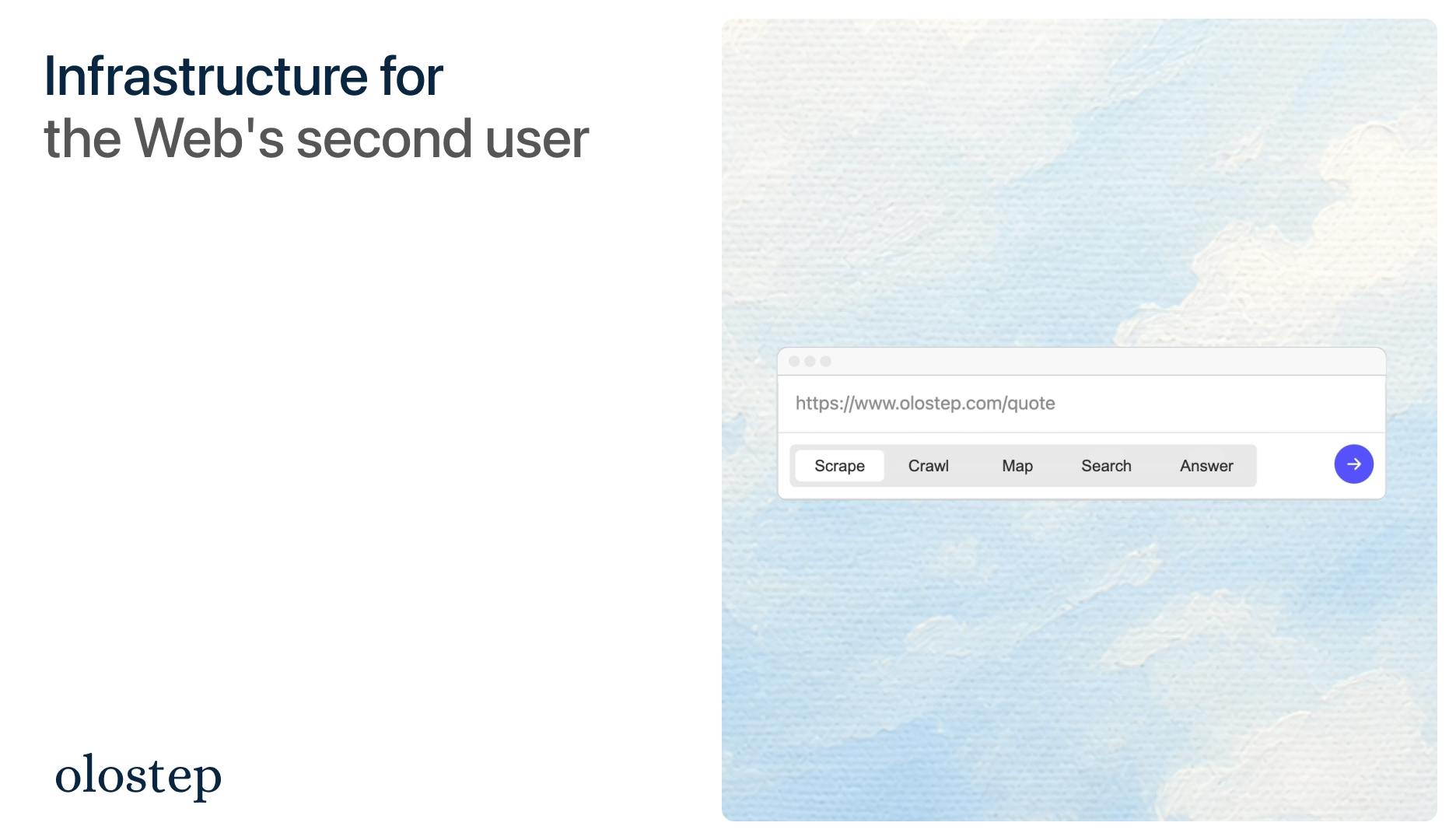
Olostep is a scalable API that converts web pages into clean Markdown and JSON for AI applications.
Olostep is a web scraping API that transforms any URL into LLM-ready Markdown, JSON, or structured data, eliminating the need for developers to maintain complex crawling pipelines. Designed for RAG knowledge bases, AI Agents, and data monitoring, it handles anti-bot mechanisms, JavaScript rendering, and HTML noise removal. Competing with tools like Firecrawl and Jina Reader, Olostep reflects the growing demand for AI-native web data infrastructure.
When AI Becomes the Web's Second User
When the internet was born, web content was designed primarily for human readers: layouts, images, ads, and navigation bars were all crafted to suit how our eyes browse. But with the rise of large language models (LLMs), an entirely new class of "users" is consuming web content at massive scale—AI. The problem is that web pages designed for humans are full of noise for machines: redundant HTML tags, deeply nested JavaScript, ad scripts, and dynamically rendered content all make data extraction extraordinarily difficult.
This difficulty goes far beyond a simple "wrong format" issue. In the HTML source of a modern web page, meaningful text content typically accounts for only 10%-30% of the total character count. The rest consists of CSS style definitions, JavaScript code, ad tracking scripts, SEO meta tags, and other markup that adds nothing to semantic understanding. When this noise is fed directly into an LLM, it not only burns through the limited context window (such as GPT-4 Turbo's 128K token window) but also dilutes the attention weight on key information, causing the model to misinterpret core content. Even trickier, modern frontend frameworks (like React, Vue, and Next.js) extensively use client-side rendering (CSR) or hybrid rendering modes, meaning much of the content doesn't even exist in the initial HTML—it only appears in the DOM after JavaScript execution. This poses a fundamental challenge for traditional HTTP request-based crawlers.
Olostep, which recently launched on Product Hunt and shot up to #4 on the daily leaderboard, takes direct aim at this pain point. Its tagline is simple and clear: "Turn the Web into Clean Data for AI."
Olostep's Core Capabilities: From Web Pages to Structured Data
Olostep provides a scalable web data API designed specifically for "the web's second user—AI." Its core capability can be summed up in one sentence: effortlessly convert any URL into LLM-ready Markdown, JSON, or structured data.
Say Goodbye to Manually Maintaining Scraping Pipelines
For developers, this means no longer needing to maintain a complex crawling and parsing pipeline. Traditional web scraping involves handling anti-bot mechanisms, rendering JavaScript, cleaning HTML, removing ads and navigation elements, and a host of other tedious tasks. Olostep wraps all of these steps into simple API calls.
The output format options are purposefully designed:
- Markdown: This is one of the most ideal formats for feeding into large models. There's a deep technical reason why Markdown has become the "native language" of LLMs—virtually all major LLMs include massive amounts of Markdown content in their training data (from GitHub repositories, technical documentation, Wikipedia, etc.), which means models have a natural understanding of Markdown syntax. Compared to raw HTML, Markdown uses minimal markup characters (like #, *, -, , etc.) to express rich document structure, reducing token consumption by 50%-80%. For the same article, the HTML version might consume 3,000 tokens, while the equivalent Markdown version might only need 800-1,200 tokens—under token-based API pricing models, this difference directly impacts costs. At the same time, Markdown preserves heading hierarchies, nested lists, code blocks, and other semantic structures, making it ideal input for RAG (Retrieval-Augmented Generation) systems.
- JSON / Structured Data: Suited for scenarios requiring precise mapping of web page fields to databases or business logic, such as scraping product prices, article metadata, or contact information.
Why "Clean Data" Is Critical for AI Applications
In AI application development, the principle of "Garbage In, Garbage Out" is amplified to the extreme. If the input fed to a model is full of HTML noise, it not only wastes precious context window space and token budgets but can also lead to model misunderstandings and hallucinations. The "clean data" that Olostep emphasizes is fundamentally about raising the data quality floor for AI applications.
Typical Use Cases for Olostep
The target users for products like Olostep are crystal clear, primarily concentrated in the following development scenarios:
RAG and Knowledge Base Construction
When building enterprise knowledge bases or vertical domain Q&A systems, you often need to scrape large volumes of web content as source material. The Markdown output from Olostep can go directly into the embedding pipeline, skipping the intermediate cleaning step entirely.
It's worth taking a deeper look at why RAG systems are so dependent on data quality. Retrieval-Augmented Generation (RAG) is one of the most mainstream architecture patterns for enterprise AI applications today. The core idea is: rather than relying on the model's own parametric knowledge, retrieve relevant document fragments from an external knowledge base at inference time, inject them as context into the prompt, and let the model generate answers based on real data. The typical workflow includes: document chunking → embedding → storage in a vector database (such as Pinecone, Weaviate, Milvus, etc.) → semantic retrieval at query time → feeding the retrieval results along with the user's question into the LLM. In this pipeline, if the input documents contain large amounts of HTML tags, navigation menu text, or ad content, they will not only pollute the semantic representations in vector space but also return irrelevant fragments during retrieval, ultimately leading the model to produce low-quality or even incorrect answers. This is why converting web pages to clean Markdown is a critical preprocessing step in the RAG pipeline.
AI Agents and Automated Workflows
Today's hot AI Agents need the ability to "read web pages"—whether it's querying real-time news, researching competitors, or extracting specific information. A stable, scalable web data API is essential infrastructure for an Agent's perception of the outside world.
AI Agents have been one of the most central developments in the AI field since 2024. Their essence is endowing large language models with the ability to plan autonomously, invoke tools, and interact with their environment. Unlike traditional single-turn Q&A, Agents can decompose complex tasks, formulate execution plans, and achieve goals by calling external tools (such as search engines, APIs, code executors, etc.). For example, an investment research Agent might need to visit a company's website for the latest earnings report, browse news sites for industry trends, and review competitor product pages for feature comparisons. If the Agent had to process raw HTML and extract information on its own every time, it would not only be inefficient but also prone to breaking when web page structures change. A web data API like Olostep effectively serves as the Agent's "perception layer"—transforming the chaotic web into structured information that the Agent can efficiently understand and reason about. Companies like OpenAI, Anthropic, and Google are all exploring similar web interaction capabilities in their respective Agent frameworks, which validates the importance of this kind of infrastructure from the demand side.
Data Collection and Monitoring
For teams that need to regularly monitor web page changes or collect market data, structured JSON output can seamlessly integrate with downstream data analysis pipelines.
Market Landscape: The Competition for Web-to-AI Data
You may not have noticed, but Olostep isn't alone in its space. In recent years, a wave of similar products has emerged, including Firecrawl, Jina Reader, Exa, and others, all solving the same problem: how to efficiently convert the open web into data that LLMs can consume.
This validates a trend from the sidelines—as AI applications explode, "AI-native web data infrastructure" is becoming a real and rapidly growing market. In the past, web crawling was discussed in the context of search engine indexing and data analysis. Today, the primary purpose of scraping the web has shifted to "feeding models." The evaluation criteria for these tools have changed accordingly: it's no longer just about crawl speed and success rate, but also about how LLM-friendly the output content is.
For developers, the key considerations when choosing such API services typically include:
- Anti-bot capabilities: Can it bypass sophisticated protection mechanisms? Behind this is an ongoing, ever-escalating technical arms race—modern websites commonly deploy multi-layered defenses. Security providers like Cloudflare, Akamai, and PerimeterX offer bot detection solutions that analyze hundreds of signals including TLS fingerprints, HTTP header characteristics, mouse movement patterns, and browser environment consistency to distinguish between human and machine traffic. Specific techniques include JavaScript challenges, CAPTCHA verification, IP rate limiting, and browser fingerprinting (Canvas fingerprinting, WebGL fingerprinting). To reliably bypass these protections, service providers typically need to maintain large-scale proxy IP pools (including residential and data center IPs), use real browser environments (such as Chromium-based Playwright or Puppeteer), and even integrate CAPTCHA-solving services. The cost of building and maintaining this infrastructure is extremely high, which is the core economic rationale for developers choosing managed API services over building their own crawlers.
- Rendering capabilities: Can it handle JavaScript dynamic content?
- Output quality: Is the data cleaning thorough?
- Scalability: Can it support high-volume concurrent requests?
- Pricing: Are costs manageable?
Olostep's emphasis on being "scalable" directly addresses the need for large-scale data processing.
Conclusion: The "Shovel Sellers" of the AI Era
Olostep represents a class of infrastructure products that "sell shovels" during the gold rush. In this wave of AI prospecting, rather than building their own fragile crawler systems, an increasing number of developers prefer to call mature data APIs directly, focusing their energy on higher-level model and business logic.
That said, these tools face some common challenges: copyright and compliance boundaries around web data, cost control for large-scale scraping, and maintaining stability as anti-bot technology continues to advance.
Compliance issues deserve particular attention. Web data scraping and usage are in a rapidly evolving legal gray zone. Since 2024, several landmark lawsuits have been shaping the legal framework in this area: The New York Times v. OpenAI challenges the legality of mass-crawling news content for model training; the EU's AI Act and Digital Services Act impose stricter compliance requirements on automated data collection. On the technical side, the robots.txt protocol has long served as a "gentleman's agreement" between websites and crawlers, specifying which pages are allowed or forbidden for crawling, but the protocol carries no legal enforcement power. Some websites have begun introducing new standards like ai.txt, specifically declaring data usage policies for AI training purposes. For businesses using such services, it's important to clearly distinguish between different use cases—real-time queries (such as an Agent reading a web page to answer a user's question) and large-scale model training are fundamentally different from a legal perspective. The former more closely resembles ordinary web browsing behavior, while the latter faces significantly greater copyright disputes.
For teams considering adopting Olostep, the recommendation is to start with small-scale validation in real scenarios—test its crawl success rate and output quality on your target websites before committing to a full-scale rollout.
Regardless, Olostep's emergence reminds us once again: the internet in the AI era is being redefined as a data source for machines. Whoever can efficiently transform messy web pages into clean, structured data holds a critical gateway to AI applications.
Related articles
GPT-6 Astra Voice Mode Hands-On: A Voice-Driven Personal Automation Operating System
In-depth analysis of GPT-6 Astra voice mode demo, showing how voice commands complete video-to-article conversion, landing page building, calendar management, and more. Codex-powered multi-threaded collaboration is redefining AI automation workflows.
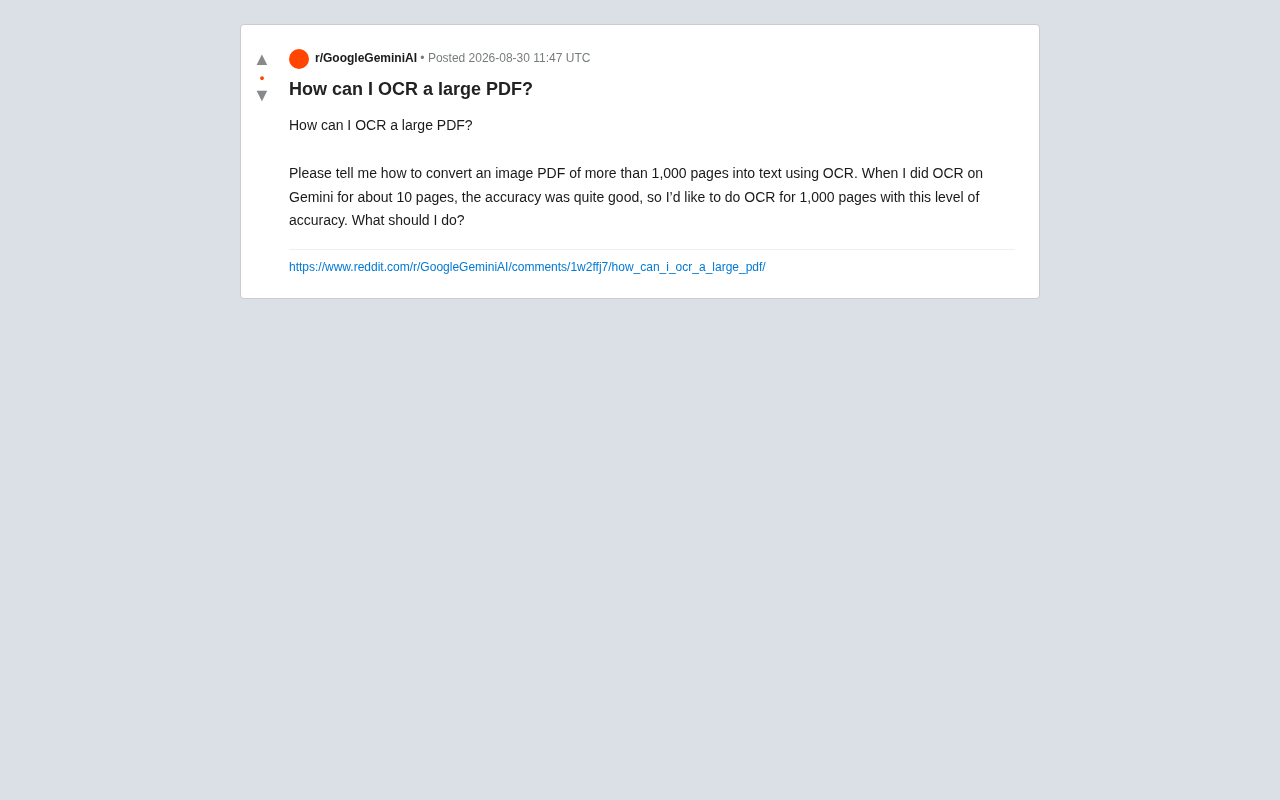
A Complete Guide to AI OCR for Large PDF Documents with 1000+ Pages
How to handle OCR for 1000+ page scanned PDFs using AI: covers Gemini batch calls, Tesseract, PaddleOCR, and cloud OCR services with accuracy, cost, and speed comparisons.
DeepSeek Harness Open Source Explosion: Deep Dive into Plugin Hot-Swapping Architecture
DeepSeek Harness open-source coding framework hits 150K GitHub stars with "everything is a plugin" architecture rivaling Claude Code. Deep dive into dynamic hot-swapping, trace tracking, and critical security gaps.