Omarchy: DHH's AI Agent-Malleable Linux Desktop Workstation
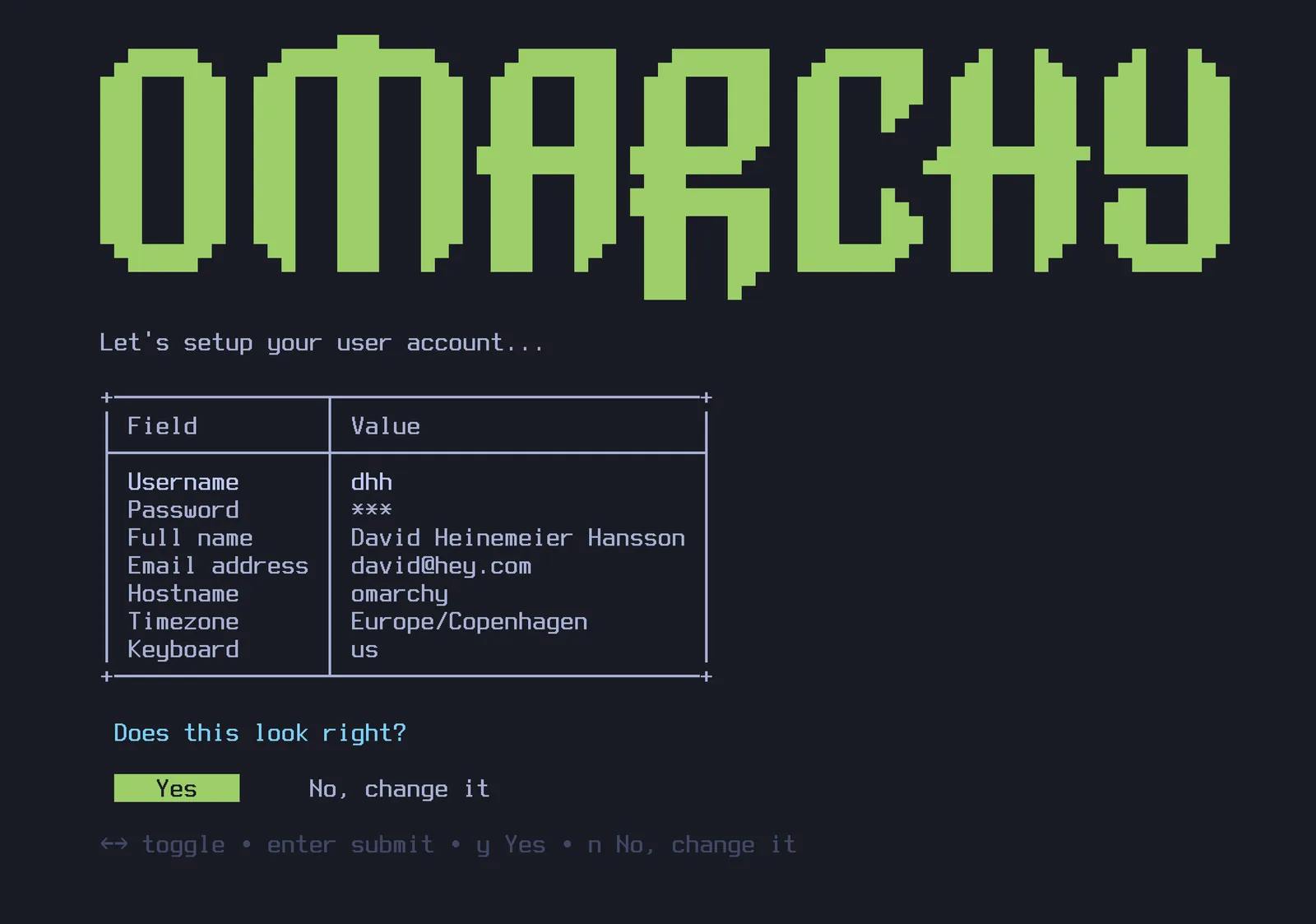
DHH's Omarchy turns Linux desktops into AI agent-malleable workstations built on Arch and Hyprland.
Omarchy is a Linux desktop workstation created by DHH (Ruby on Rails creator) built on Arch Linux, Hyprland, and Quickshell. Its standout feature is full AI agent malleability — users can reshape system configurations using natural language via coding agents. Following an omakase (convention over configuration) philosophy with keyboard-first design, it delivers a complete, opinionated setup that's both developer-ready and AI-friendly.
When Linux Meets the AI Agent Era
The Linux desktop ecosystem has never lacked tinkerers, but most people eventually burn through their initial enthusiasm in the midst of endless configuration. Omarchy aims to fundamentally change this dynamic — it's not just another "best configuration tutorial," but a complete desktop workstation solution redesigned for the AI agent era.
The project was initiated by renowned developer DHH (David Heinemeier Hansson, creator of Ruby on Rails), built on Arch Linux, the Hyprland window manager, and Quickshell. Its core philosophy is "omakase" (Japanese for "I'll leave it to you") — letting the system make decisions for you instead of trapping you in an endless hell of options.
What Is Omarchy: The Core Philosophy of a Malleable Operating System
The Omakase Design Philosophy: Convention over Configuration
The word "omakase" is no stranger to the software world — Ruby on Rails itself is famous for this philosophy: the framework makes sensible default decisions, allowing developers to focus on business logic rather than configuration details. Behind this lies a core software engineering design principle: "Convention over Configuration" (CoC). The central idea is that tools should provide reasonable default behavior for the most common use cases, and developers only need to explicitly configure things when deviating from the defaults. This forms an interesting contrast with Python's "explicit is better than implicit" philosophy, reflecting two fundamentally different engineering value systems. Rails leveraged this philosophy to dramatically lower the barrier to web development in the mid-2000s, and the "build a blog in 15 minutes" demo video once circulated widely in the developer community. Omarchy applies the same logic to the entire Linux desktop environment: rather than confronting users with hundreds of configuration options, experienced maintainers make reasonable decisions upfront, and users only need to adjust as needed from there.
It comes pre-configured with a complete, keyboard-centric workstation setup, covering system-level theming, package update mechanisms, and most critically — built-in coding agent support. What users receive isn't a bag of loose parts, but a machine that's already been tuned and ready to go.
Technical Choices: Why Hyprland + Arch Linux
Arch Linux uses a Rolling Release model, which fundamentally differs from distributions like Ubuntu and Fedora that follow fixed release cycles. Rolling release means system packages are continuously updated to the latest versions — users don't have to go through the tedious process of major version upgrades, nor do they suffer from outdated software due to fixed release schedules. Another notable feature of Arch is its package manager pacman and the community-driven AUR (Arch User Repository), the latter hosting a massive number of third-party packages with ecosystem coverage far exceeding the official repositories. For Omarchy, choosing Arch means users always have access to the latest Hyprland and AI toolchain, with the trade-off of occasional system maintenance.
Hyprland is a tiling compositor based on the Wayland display protocol that began rapidly gaining users in the Linux community around 2022. To understand its positioning, you need to know the evolution of the Linux graphics stack: the traditional X11 (X Window System) protocol is nearly 40 years old, with inherent architectural limitations such as weak security isolation, poor HiDPI support, and inflexible multi-monitor scaling. Wayland, as the modern replacement for X11, merges the compositor and display server into one, addressing these issues at the protocol level. Hyprland's uniqueness among Wayland compositors lies in the fact that it's not just feature-complete — it also invests heavily in visual effects. Smooth window animations and Bézier-curve-interpolated workspace transitions make it quite the outlier in a tiling window manager community dominated by a "minimalist and functional" aesthetic, attracting a large number of younger users who value visual experience. Hyprland's configuration file uses a custom declarative syntax that is well-structured and highly programmable — which is precisely the technical prerequisite enabling AI agents to reliably modify it.
The combination of the two is highly competitive in both performance and aesthetics. Omarchy adds Quickshell as a shell component on top of this, forming a cohesive, interlocking tech stack. This selection was not arbitrary — Hyprland's configuration language is naturally suited for programmatic modification, providing the technical foundation for subsequent AI agent intervention.
AI Agent Malleability: Omarchy's True Differentiator
Using Natural Language to Let AI Directly Modify Desktop Configuration
Omarchy's most noteworthy feature is that it explicitly positions "coding agents can reshape the entire system configuration" as a core selling point. This means users don't need to personally consult Hyprland documentation or manually edit configuration files — they can describe their requirements in natural language and let the agent handle the actual configuration changes.
This design philosophy aligns closely with the current trajectory of AI programming tools. The evolution of AI-assisted programming has roughly gone through three stages: the code completion stage represented by GitHub Copilot (from 2021), the conversational code generation stage represented by ChatGPT/Claude (from 2022), and the currently emerging Agentic Coding stage — where AI doesn't just generate code snippets but acts as an autonomous agent capable of perceiving context, executing multi-step tasks, directly manipulating file systems, running commands, and managing configurations. Anthropic's Claude Code, OpenAI's Codex CLI, and various open-source agent frameworks (such as AutoGen, LangGraph) are all typical products of this stage. Omarchy extends this trend to the operating system configuration layer, designing the entire desktop environment as an agent-friendly modifiable object — one of the most thorough implementations of this direction to date.
Configuration as Code: The Deep Logic of Structured Design
What makes this design possible rests on a key prerequisite: the entire system's configuration is structured and programmatically modifiable. "Configuration as Code" and "Infrastructure as Code" (IaC) are core practices in the DevOps domain, with tools like Terraform, Ansible, and Nix embodying this philosophy. The core value lies in describing system state using version-controllable, auditable, and reproducible declarative text, thereby eliminating "Configuration Drift" — the deviation between actual system state and expected state that accumulates through manual modifications.
The Arch + Hyprland ecosystem is inherently built on plain-text configuration files, and Omarchy further integrates and standardizes on top of this, enabling agents to read and modify system settings at every level in a consistent manner. In theory, the entire system state can be fully described by a single Git repository — which is precisely the foundational condition for AI agents to operate reliably. This stands in stark contrast to traditional Linux distributions, which often have GUI configuration tools and underlying config files coexisting in parallel, creating state inconsistency problems. Omarchy's plain-text, structured configuration approach is exactly the form easiest for AI agents to work with.
Keyboard-First Efficient Workflow Design
Balancing Efficiency Gains with Learning Curve
"Keyboard-first" is a design principle Omarchy repeatedly emphasizes. The efficiency philosophy of Tiling Window Managers (TWMs) is rooted in a simple observation: for developers, switching between and laying out multiple windows is an extremely frequent operation, and dragging windows with a mouse is one of the least efficient forms of this operation. Tiling WMs automatically fill screen space with windows, prevent window overlap, and handle all layout operations through keyboard shortcuts. i3, Sway, and dwm are classic representatives in this space, with Hyprland being their modern evolution. This workflow, together with Vim's modal editing and tmux's session management, forms a complete "keyboard-driven development" toolchain — all three share the characteristic of a steep initial learning curve in exchange for long-term muscle memory payoff.
For users accustomed to graphical interfaces, there is indeed an adaptation cost. But for developers who spend most of their time in terminals and editors, a keyboard-first workflow often delivers substantial efficiency gains. Omarchy lowers the entry barrier for this toolchain through unified shortcut key design: users don't need to design keybinding schemes from scratch and can directly inherit battle-tested default configurations while retaining room for future customization.
System-Level Theming and Visual Consistency
Omarchy provides system-level theming support, meaning terminals, editors, application windows, and other interface elements can maintain visual consistency, rather than each managing its own styling as in traditional Linux desktops. This feature might seem like a minor detail, but for users who spend extended hours at their workstations, the reduction in visual noise is a genuinely perceptible improvement in experience.
DHH's Product Perspective and Design Philosophy
As the project's initiator, DHH has embedded his naming logic and product vision into Omarchy. David Heinemeier Hansson is a Danish software engineer who released Ruby on Rails in 2004 and received the Google-O'Reilly "Hacker of the Year" award in 2005. He has long been a controversial voice in the tech industry: on the engineering side, he criticizes the over-complication of microservices and advocates for the "Majestic Monolith"; on the product side, he co-authored Rework with Jason Fried, presenting a systematic critique of Silicon Valley's "996-style" work culture; on the policy side, his public confrontation with Apple's App Store policies ultimately led to U.S. Congressional hearings on the matter. He has long been critical of over-complexity in software, and Rails' "Convention over Configuration" principle extends naturally into Omarchy: you get a carefully considered set of defaults, and if you want to change something, the tools (including AI agents) are right at hand. Omarchy's essence is replacing the "toolbox" role with a "curator" role, a stance that isn't always popular in the open-source community — some see it as limiting freedom, while others view it as a pragmatic engineering decision. For Omarchy, its target users are most likely developers who agree with the judgment that "good defaults are more valuable than infinite options."
Omarchy's Current Status and Future Outlook
Omarchy received 88 upvotes on Product Hunt, ranking 9th, categorized under Linux, Artificial Intelligence, and GitHub. These numbers reflect that it's still in its early stages, but the attention comes from a well-defined target audience — developers who need a Linux desktop and have expectations for AI tool integration.
From a broader perspective, Omarchy represents a trend worth watching: development environments are evolving from "collections of tools" to "intelligent workstations that can be dynamically reconfigured by AI." When every configuration item in a desktop environment exists as structured text and every operation is transparently accessible to AI agents, "let AI adjust my development environment" will transform from a novel demo into a standard component of daily workflows. Regardless of how far Omarchy itself ultimately goes, this direction is already clear enough. For the next generation of developer workstations, deep integration of AI agents will be a standard feature, not an optional one.
Key Takeaways
Related articles

Chain of Thought Isn't Just for AI: How Humans Can Use CoT to Improve Thinking Quality
Chain of Thought isn't just a prompt trick for large models. Starting from a Hacker News discussion, this article analyzes why CoT works for human thinking too, breaks down actionable ways to transfer it, and highlights the key differences between human CoT and machine CoT.
Cloudflare Teams Up with OpenAI: Closi…
Cloudflare Teams Up with OpenAI: Closing the Loop from Vulnerability Discovery to Defense with AI
Cloudflare uses OpenAI Daybreak to investigate security vulnerabilities and generate reviewable remediation plans, while developers use Codex to boost coding efficiency and quality.

Orca Multi-Agent Orchestration in Practice: A Guide to Parallel Collaboration with Claude and Codex
Orca is Stable AI's free open-source agent workbench supporting 34 agents like Claude Code and Codex in parallel. Learn its Git worktree isolation, multi-model orchestration, and mobile management.