Omarchy Partners with Alibaba on China Edition, Sparking Debate Over Open-Source Neutrality and Censorship Red Lines

Omarchy China's pre-installed WeChat and DingTalk spark debate over open-source neutrality, with DHH and critics clashing on endorsement.
Omarchy Linux founder DHH announced a partnership with Alibaba on Omarchy China, offering domestic CDN, mirrors, Chinese localization, and pre-installed WeChat, DingTalk, and WPS Office. DHH defended the deal on scale, risk exposure, and version isolation, stressing merit-based, fully open-source collaboration. Critics say pre-installation differs from optional installs: WeChat requires real-name authentication, so Omarchy effectively concedes its no-ID-verification principle in China and endorses the censorship system by default bundling.
The Story: What Is Omarchy China
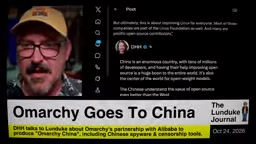
According to the YouTube channel The Lunduke Journal, Omarchy Linux founder DHH announced a partnership with Alibaba to launch a customized version for the Chinese market—Omarchy China. According to DHH's public statement, this version will provide mirrors and CDN within China, come pre-installed with WeChat, DingTalk, and WPS Office, and include Chinese localization and input method support, with the goal of being "usable without a VPN."
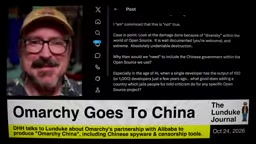
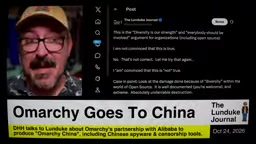
The news quickly sparked controversy in the open-source community. The focus of the debate is not localization itself, but the nature of the pre-installed applications: tools like WeChat and DingTalk have long been noted by outside observers as deeply tied to China's content censorship and data regulatory system. In his video, Lunduke quoted DHH's responses line by line and explicitly stated that "nothing has been edited," letting viewers judge for themselves.
Omarchy Linux is an Arch Linux distribution led by David Heinemeier Hansson (DHH), the creator of Ruby on Rails. It targets developer desktop scenarios and features a preconfigured Hyprland window manager, a minimalist installation process, and a highly automated development environment. The project gained rapid attention after its release in 2025. Its design philosophy emphasizes "works out of the box" and "developer autonomy," while explicitly opposing regulatory requirements such as age verification and identity verification. DHH himself is a highly influential opinion leader in the open-source community, and his public positions often spark widespread discussion.
Alibaba's role in this collaboration is not that of a traditional code contributor. According to public information, Alibaba will provide CDN acceleration and mirror sites within China, handle Chinese translation and localization, and ensure Omarchy works out of the box on specific hardware (such as Quenbook laptops). This collaboration model is not uncommon in open-source projects—commercial companies exchange infrastructure support for ecosystem influence, but typically do not involve substantive control over upstream code.
DHH's Defense: Open Source, Leverage, and Realism
DHH's response to the criticism can be summarized in three layers. The first is the scale argument: China has tens of millions of developers, and letting them participate in open source benefits the whole world, and China "understands the value of open source better than the West" because it has experienced being cut off by commercial vendors. The second is the exposure argument: the Linux Foundation's engagement with China far exceeds Omarchy's, and if cooperating with China were a problem, "the Linux kernel would have a problem first, then American companies like Apple that manufacture hardware in China," and Omarchy ranks "very low" on the risk list. The third is the division-of-labor argument: the Chinese edition pre-installs Chinese applications, the international edition is unaffected, and "Chinese people already use these applications anyway."
On the governance side, DHH emphasized that all contributions are merit-based, fully open source, and available for anyone to review. Alibaba's role is mainly CDN, mirrors, Chinese translation, and ensuring Omarchy works out of the box on the upcoming Quenbook laptops.
When asked about a hypothetical scenario in which "a journalist is arrested for using Omarchy," DHH responded with an analogy: the UK once arrested a 15-year-old boy for mocking a politician—if he had used Omarchy, should that be blamed on Omarchy too? "A Chinese journalist critical of the CCP is more likely to use an iPhone—should Apple also be responsible? That's as nonsensical as saying Smith & Wesson is responsible for shootings."

The Linux Foundation is a nonprofit technology consortium founded in 2000 to support the development of the Linux kernel and the open-source ecosystem. Its members include global tech giants such as Huawei (platinum member), Microsoft, Google, and Intel. Platinum members hold board seats, and annual fees are typically $500,000. DHH cited Huawei's membership to argue that the deep intertwining of Chinese companies with global open-source governance is already an established fact, and Omarchy's collaboration is not a special case.
Meritocracy is one of the core governance principles of the open-source community, meaning contributors gain recognition and influence based on code quality and technical contribution rather than identity, affiliation, or political stance. DHH emphasized that Alibaba's participation is entirely based on this principle and that all code is open source and auditable, intending to frame the collaboration within the scope of technical neutrality. Critics, however, point out that meritocracy governs code contributions, while pre-installed applications are product design decisions—and the two are subject to different evaluation standards.
The Core Rebuttal from Critics: Pre-installation Is Endorsement
Lunduke's criticism is not aimed at DHH personally. He repeatedly emphasized his respect for DHH in the video, describing their exchange as "pleasant and friendly," and praised Omarchy's commitment to meritocracy. His fire is concentrated on one point: pre-installation and optional installation are two different things.
His chain of argument goes like this: Omarchy previously took "no age verification, no identity verification" as its banner, and DHH himself had strongly criticized related legislation; but if Omarchy China pre-installs applications like WeChat by default, and those applications in actual use require real-name authentication and sit within a censorship system, then the "no ID verification" principle is substantively conceded in the Chinese edition. He further asks: if the same bundling happened in the US or Europe, would Omarchy accept it? "I'm fairly certain the answer is no."
He also questioned the deal from a benefit perspective: Omarchy does not lack funding (according to him, roughly $25–26 million in financing plus token support from several AI companies), and the marginal contribution of Chinese developers is hard to quantify in the era of AI-assisted development. "I've racked my brain and I can't figure out what benefit this brings to Omarchy itself or to international users."
Real-name authentication requirements are a foundational system of internet service regulation in mainland China. Under the Cybersecurity Law and relevant departmental regulations, applications such as instant messaging, social media, and payments must authenticate users' real identity information. Applications such as WeChat and DingTalk forcibly bind phone numbers and associate identity information in actual use, and users who have not completed authentication cannot use core functions. This means that pre-installing such applications effectively brings users into the real-name system, directly conflicting with the "no identity verification" principle Omarchy previously promoted.
Default bundling is a sensitive concept in antitrust and consumer rights. In software distribution, there is a fundamental difference between default pre-installation and user-initiated installation: the former leverages inertia to lower the usage threshold and constitutes de facto recommendation and endorsement; the latter preserves users' space for autonomous decision-making. Open-source distributions typically pride themselves on "minimal pre-installation and user-configuration," and Omarchy China's pre-installation list is therefore seen as a departure from that tradition.
Three Factual Anchors Under Cross-Verification
Although the material here comes mainly from a single video source, the information cited in it can be cross-verified with public records.
First, the governance structure of Alibaba and Tencent. Both companies have internal Party organizations, and their founders are Party members. This is public information among large Chinese tech companies, and Lunduke also states it as background in the video.
Second, the composition of the Linux Foundation's Chinese members. DHH mentioned that Huawei is a platinum member of the Linux Foundation. This claim can be checked against public sponsor lists, is a verifiable fact, and is the factual basis for his "exposure argument."
Third, the real-name requirements for pre-installed applications. The real-name system requirements for applications such as WeChat in mainland China are an established regulatory fact, and this is the premise for the inference that "pre-installation involves identity verification."
Views that must be labeled as single-source include: Lunduke's argument that "diversity harms open source" and his description of Omarchy's funding scale. These are the commentator's personal judgments and were not independently corroborated in the source material.
The Old Problem of Open-Source Neutrality, in a New Scenario
The essence of this debate is how open-source projects handle the old problem of "value neutrality" in cross-border collaboration. DHH's position is close to the classic liberal engineering view: software is a tool, contributions are judged by code quality, and political consequences are borne by users and states. The critics' position is: default configuration is a design decision, and design decisions convey a value hierarchy.
An noteworthy middle ground is this: localization, mirror acceleration, and translation contributions all fall into the low-controversy category; pre-installing applications with censorship and real-name attributes crosses a certain line. Lunduke also offered his own compromise at the end—"I'm not opposed to Omarchy having a Chinese edition. Do good Chinese localization, let users easily install the software they want themselves, including WeChat—that's all fine. But when you start bundling those things by default, you've gone off track."
For readers concerned with open-source governance, this case provides an observable sample: when a distribution that sells itself on "anti-censorship, anti-verification" enters a heavily regulated market, how will it redefine the boundaries of its principles? DHH's answer is "the international edition is unaffected"; the critics' answer is "principles should not have geographic versions." Behind these two answers are different understandings of the boundaries of responsibility for open-source projects, and consensus is likely hard to reach in the short term.
One-line Summary
Omarchy's China edition pre-installing WeChat and DingTalk sparks controversy over open-source neutrality, with DHH and critics clashing over whether pre-installation constitutes endorsement.
Paragraph Summary
Omarchy Linux founder DHH announced a partnership with Alibaba to launch a China-customized edition, Omarchy China, offering domestic CDN, mirrors, Chinese localization, and pre-installed WeChat, DingTalk, and WPS Office. DHH responded to censorship concerns with three arguments: scale benefits, risk-exposure ranking, and version isolation, emphasizing that the collaboration is merit-based and fully open source. Critics argue that pre-installation is fundamentally different from optional installation: applications like WeChat require real-name authentication, so pre-installation means Omarchy has substantively conceded its "no identity verification" principle in the Chinese edition, and default bundling constitutes de facto endorsement of the censorship system. The controversy is essentially about the boundaries of value neutrality and design responsibility in cross-border open-source collaboration, with each side holding its ground on whether principles should have geographic versions.
Related articles

The KLD Metric Is Misunderstood: The Truth About Quantitative Model Evaluation
A Reddit discussion reveals KLD is widely misunderstood: it's a diagnostic tool for quantized models, not a quality leaderboard. This article explains how KLD is measured, its manipulability risks, and why high KLD doesn't mean a bad model.

Argus: An Open-Source, Free Agentic Security Operations Platform
Argus is an MIT-licensed, free agentic security operations platform for SOC alert investigation and response. This article covers its agentic design, practical value for security teams, and open-source adoption challenges.

PHP RCE Challenge: An Offensive-Defensive Experiment with Bitcoin
The "Steal My Bitcoin" project on Hacker News uses a Bitcoin bounty to test the real exploitability of a PHP RCE vulnerability, sparking security community debate.