PHP RCE Challenge: An Offensive-Defensive Experiment with Bitcoin

A developer offers a Bitcoin bounty to publicly test whether a PHP RCE vulnerability can actually be exploited.
The article introduces the "Steal My Bitcoin" project on Hacker News: after panicking over a recently discovered PHP remote code execution vulnerability, the developer decided to use Bitcoin as a bounty and publicly challenge whether anyone could actually exploit the vulnerability to steal the Bitcoin. The post received 274 points and 127 comments, with the community divided on the vulnerability's actual exploitability; some believe that multiple layers of protection in modern PHP configurations and frameworks would limit the attack's effectiveness. The article also technically analyzes the conditions required for RCE exploitation and notes that such public bounties are both a technical experiment and a new form of vulnerability disclosure and community collaboration, reminding developers to value dependency updates, secure coding, and protections such as WAF.
A Bitcoin Bounty to Test the Real Exploitability of a PHP RCE
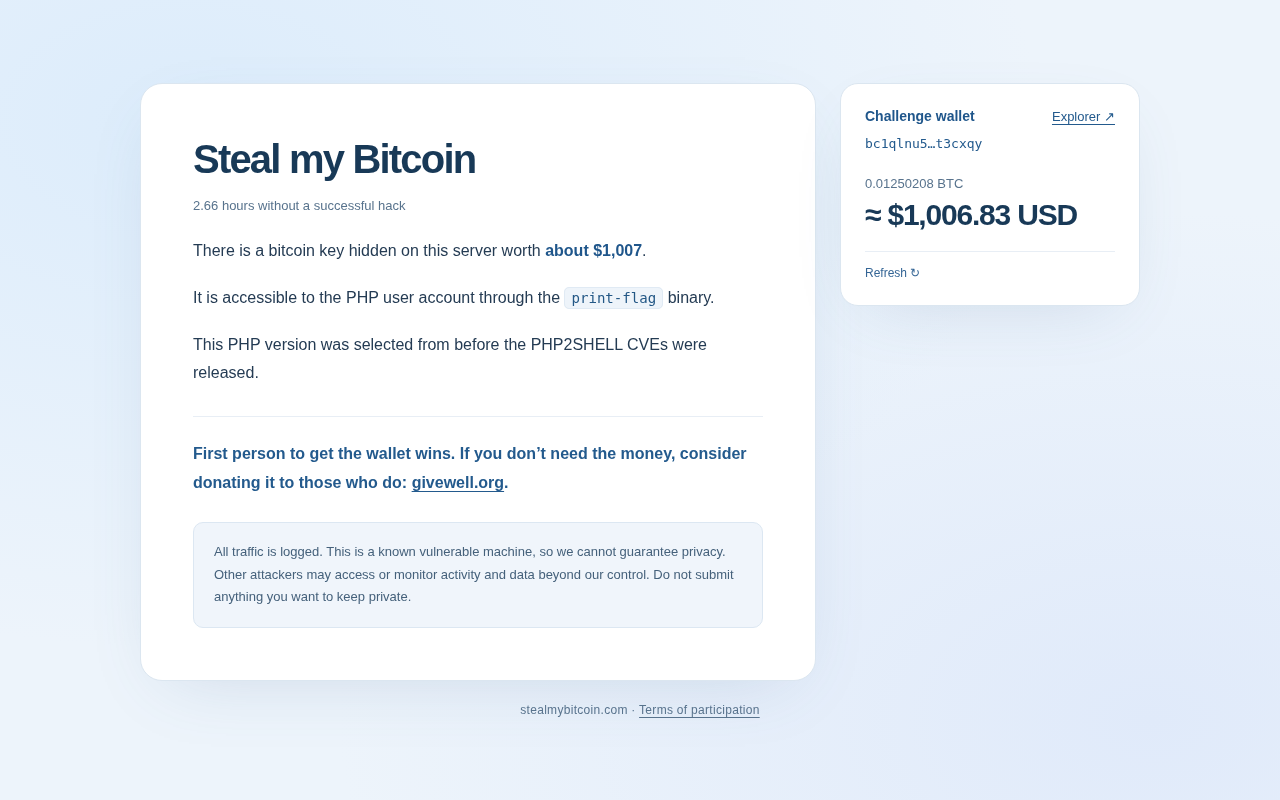
Recently, a noteworthy project called "Steal My Bitcoin" appeared on Hacker News. Curious whether anyone could actually exploit a PHP remote code execution (RCE) vulnerability, the developer decided to use Bitcoin as a bounty and launch a public challenge. After being posted, the project quickly gained 274 points and 127 comments, sparking heated discussion in the security community.
The core of the challenge is simple: if you can steal the Bitcoin through this PHP RCE vulnerability, it's yours. The developer admits that over the past few days they had been panicking about this vulnerability, and now wants to see whether any expert can truly exploit it.
Vulnerability Background and Community Reaction
According to the developer, this PHP RCE was discovered recently, but the specific details were not elaborated in the post. Judging from the discussion in the comments, many people are skeptical about the actual exploitability of the vulnerability. Some point out that modern PHP configurations and frameworks usually come with multiple layers of protection built in, and relying solely on RCE may make it difficult to directly achieve the attack goal. Security researchers also shared their own testing approaches, believing that a specific environment would be required to reproduce it.
In the developer's own words: "Made this because I'm curious if anyone out there has figured out how to actually use this PHP RCE we spent the last few days panicking over. Have fun!"
This approach of publicly testing a vulnerability through a bounty is not uncommon in the security community, but using Bitcoin directly as a prize increases the challenge's appeal and sense of realism.
PHP RCE (Remote Code Execution) refers to a class of vulnerabilities in which an attacker can make a PHP application execute arbitrary code or system commands through a remote request. Common causes include insecure eval(), controllable include/require paths, deserialization vulnerabilities, and executing uploaded files without validation. RCE is generally regarded as one of the most critical vulnerability types, because once successfully exploited, an attacker can often directly read server files, steal credentials, plant backdoors, or even fully take over the host. However, actual exploitability depends heavily on the runtime environment: disable_functions, open_basedir, SELinux/AppArmor, container isolation, and PHP-FPM permission configurations can all restrict "code execution" to a limited scope, making it difficult for an attacker to directly read wallet private keys or initiate outbound transfers.
An In-Depth Technical Analysis
Exploiting a PHP RCE vulnerability usually requires several conditions: a controllable input point, the ability to bypass filtering mechanisms, and a server configuration that allows arbitrary code execution. According to community discussion, this vulnerability may originate from a flaw in a popular library or framework, but the developer did not disclose specific details, so outsiders can only speculate based on limited information.
From a security protection perspective, this kind of challenge also reminds developers that even seemingly harmless code snippets can become the starting point of an attack chain. Regularly updating dependencies, using secure coding practices, and deploying a Web Application Firewall (WAF) are all effective means of reducing risk.
Web Application Firewall (WAF) is a protection layer positioned in front of a web server that detects and blocks attack traffic such as SQL injection, XSS, and RCE through rule sets or machine learning models. For RCE, a WAF can block common command concatenation signatures, abnormally encoded payloads, and known exploit patterns, but it is not a silver bullet: encoding bypasses, chunked transfer, protocol parsing differences, and zero-day vulnerabilities can all evade detection. Therefore, a WAF is better suited as one layer of defense in depth rather than a replacement for dependency updates, input validation, and the principle of least privilege.
Vulnerability Disclosure refers to the process by which security researchers or developers inform relevant parties about vulnerability information and gradually make it public. Common models include responsible disclosure (notifying the vendor privately first and giving a remediation window before public disclosure), full disclosure (immediately publishing all details), and the "bounty-driven public verification" embodied by this challenge. Publicly offering a bounty to test exploitability is essentially using community power to assess the actual risk level of a vulnerability before real attackers do, while also carrying the risk of exposing the attack surface, so it requires careful trade-offs.
Implications for Developers
This project is not only a technical game but also a public security education. It demonstrates another possibility for vulnerability disclosure: rather than panicking privately, offer a public bounty and leverage the community to verify the real impact of the vulnerability. For ordinary developers, following such challenges helps them understand the mindset of attackers, so they can set up defenses in advance in their own projects.
Conclusion
"Steal My Bitcoin" is still ongoing, and it is not yet known whether anyone has successfully taken the Bitcoin. But regardless of the outcome, this experiment has successfully sparked discussion about PHP security and vulnerability exploitation. If you are interested in the details, you can visit Hacker News to view the original post and comments.
Related articles

OneMemory 1.4.2 Released: A Self-Hosted Shared Memory Tool Built for AI Agents
OneMemory 1.4.2 released: a self-hosted shared memory server supporting MCP and REST, with writer tracking, distrusted list, offline command queuing, and safer upgrade backups. Ideal for individual developers and AI agents.

How Can RAG Debugging Knowledge Be Retained? The Knowledge Management Pain of AI Teams
How can AI teams effectively retain and reuse knowledge from RAG debugging and audits? This article analyzes three current knowledge management modes and their pain points, and explores the technical feasibility and business challenges of an evidence-supported case memory system.

Reactive Optimizers: Rewriting Optimizer Source Code During Training — A New Paradigm for Performance Gains
Reactive Optimizers dynamically rewrites optimizer source code during training for code-level adaptivity. This article explains its core mechanism, differences from meta-learning, and challenges in stability and reproducibility, and explores its potential impact on AI training frameworks.