Omarion SEC CLI: How a Self-Healing Autonomous Agent Tackles AutoGPT's Persistent Problems
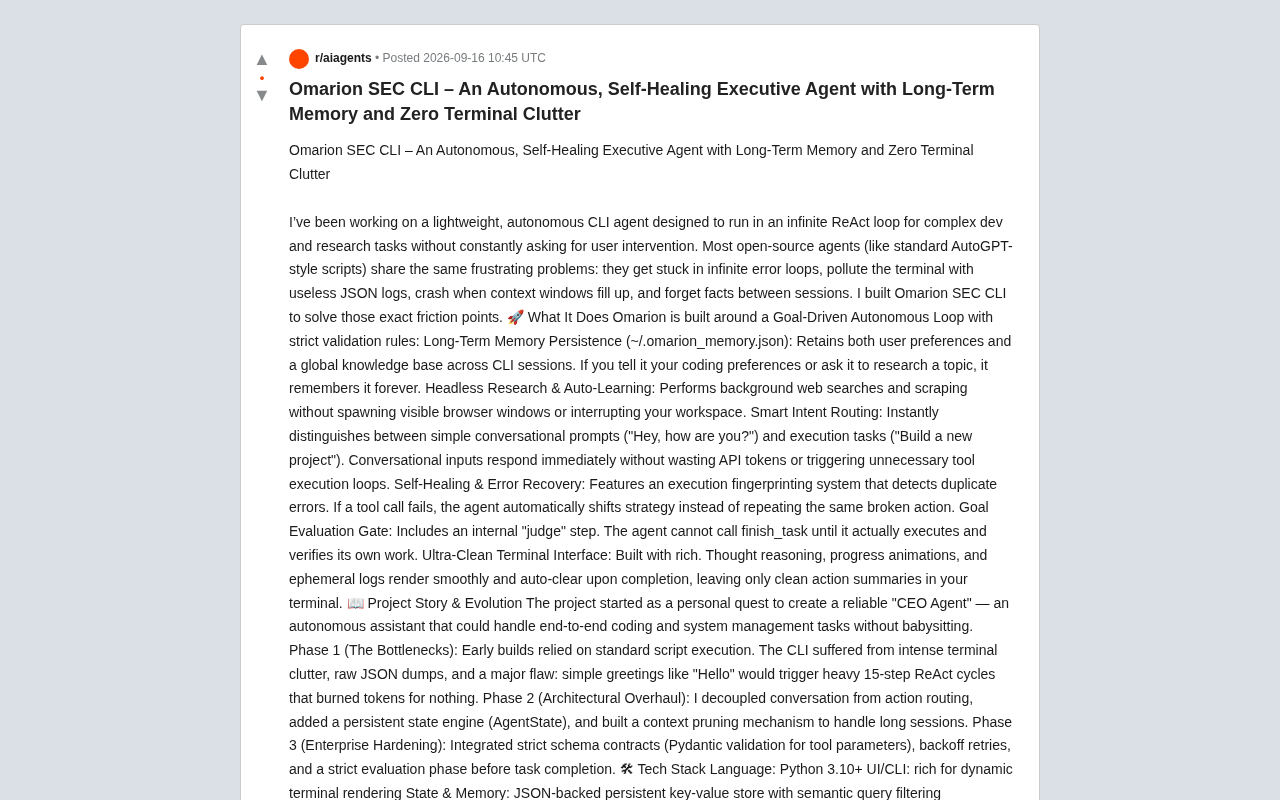
Omarion SEC CLI uses self-healing, intent routing, and persistent memory to fix AutoGPT's core failure modes.
Omarion SEC CLI is a command-line autonomous agent designed from scratch to address the chronic failures of AutoGPT-style tools: infinite error loops, terminal log pollution, context window crashes, and between-session amnesia. Its core contribution is treating constraints as the first design principle — an execution fingerprinting system detects repeated failures and forces strategy switches; a goal evaluation gate requires the agent to actually verify results before declaring completion; intent routing decouples conversation from task execution; and long-term memory persists across sessions via a local JSON file. Built with Python 3.10+, rich, Pydantic, and BeautifulSoup, it is deliberately lightweight. As an early personal project, its memory scalability and long-loop stability still await broader community validation.
The open-source autonomous agent space has long been plagued by a familiar set of frustrations: infinite error loops, terminals flooded with useless JSON logs, crashes when the context window fills up, and agents that forget everything between sessions. One developer shared his solution on Reddit — Omarion SEC CLI, a lightweight command-line agent built around self-healing, long-term memory, and a clean terminal interface.
Starting with AutoGPT's Pain Points
The author is candid about the problem: most AutoGPT-style open-source scripts share the same maddening issues. They get stuck in loops of repeated failed actions, flood the terminal with meaningless raw logs, crash the moment the context window fills, and forget every fact they ever learned the instant you restart them.
These pain points point to a more fundamental issue: existing autonomous loops lack both constraints and memory. The ReAct (Reasoning + Acting) paradigm is elegant in theory, but without validation mechanisms and state persistence, agents lose control over long tasks. Omarion was designed from the ground up to wrap a Goal-Driven Autonomous Loop in strict validation rules, eliminating these friction points one by one.
ReAct (Reasoning + Acting) is an agent reasoning paradigm proposed by a Google Research team in 2022. Its core idea is to interleave a language model's "reasoning" (Thought) with its "acting" (Action) — the model first outputs a natural-language reasoning step, then decides which tool to call, then continues reasoning based on the tool's returned "observation." This loop lets the model decompose complex tasks and dynamically adjust its plan. Early autonomous agents like AutoGPT were built on similar loop concepts, but they universally lacked "termination condition validation" and "failure detection" mechanisms. A model could declare "the next step should be to try again" indefinitely, with no external constraint to verify whether the task was actually complete — which is the root cause of infinite loops and token waste.
Six Core Capabilities
Omarion's feature set is deliberately targeted — almost every capability maps directly to a specific pain point.
Long-Term Memory Persistence
The agent stores user preferences and a global knowledge base in ~/.omarion_memory.json, persisted across CLI sessions. If you tell it your coding preferences or ask it to research a topic, it remembers — permanently. This solves the between-session amnesia problem of traditional scripts: memory no longer depends on a single process's context window, but is written to local persistent storage.
Headless Research and Automatic Learning
Omarion can perform web searches and scraping in the background without spawning a visible browser window or disrupting your workspace. This "zero browser footprint" design is especially valuable for autonomous tasks that need to run in the background over extended periods.
Smart Intent Routing
This is the part the author invested the most effort in rebuilding. The system instantly distinguishes conversational input (e.g., "Hey, how's it going?") from execution tasks (e.g., "Help me scaffold a new project"). Conversational input gets an immediate reply — no API tokens wasted, no unnecessary tool execution loop triggered.
Self-Healing and Error Recovery
Omarion has a built-in execution fingerprinting system that detects recurring errors. When a tool call fails, the agent automatically switches strategies instead of blindly repeating an action that's already proven to fail. This is a direct response to the "infinite error loop" problem.
The basic principle of execution fingerprinting is to generate a lightweight identifier for each tool call's key parameters (such as the tool name, a hash of the input arguments, and the error type), and maintain a runtime table of previously seen failure fingerprints. When a new tool call generates a fingerprint that matches an existing failure record, the system identifies it as a "repeated failure" and forces a strategy switch rather than executing again. This approach draws on software engineering concepts like idempotency checking and the Circuit Breaker pattern — which tracks failure counts and "breaks" a call chain once a threshold is exceeded, preventing cascading failures. In the LLM agent context, this kind of mechanism is particularly important because the model itself has no cross-call memory of "I've already failed this step" — that state must be explicitly maintained and injected by an external system.
Goal Evaluation Gate
The loop includes an internal "judge" step. The agent is not permitted to call finish_task until it has actually executed and verified its own work. This Goal Evaluation Gate ensures that task completion is verified, not merely declared.
Ultra-Clean Terminal Interface
The UI is built on Python's rich library. Reasoning traces, progress animations, and temporary logs render smoothly and are automatically cleared on completion, leaving only a clean summary of what was done in the terminal.
Three Phases of Evolution
The author breaks the project's development into three stages — a "lessons learned" history that's genuinely valuable for anyone building agents.
Phase 1 (The Bottleneck): Early versions relied on standard script execution. The terminal was a mess of raw JSON dumps. Worse, there was a critical flaw — a simple greeting like "Hello" would trigger a 15-step ReAct loop, burning through tokens for nothing.
Phase 2 (Architectural Overhaul): The author decoupled "conversation" from "action routing," added a persistent state engine (AgentState), and built a context pruning mechanism to handle long sessions. Context pruning is exactly the mechanism that addresses the "crash when context fills" problem.
Phase 3 (Production Hardening): Integration of strict schema contracts (tool parameter validation via Pydantic), backoff retries, and a rigorous evaluation phase before task completion.
Tech Stack at a Glance
From an engineering perspective, Omarion's technology choices are pragmatic:
- Language: Python 3.10+
- UI/CLI:
richfor dynamic terminal rendering - State & Memory: JSON-based persistent key-value store with semantic query filtering
- Scraping/Search: Headless HTTP extraction + BeautifulSoup for zero-browser-footprint learning
This combination avoids heavy dependencies, consistent with the author's "lightweight" positioning. Using Pydantic for tool parameter validation is a mature practice in LLM tool-calling engineering, effectively preventing runtime errors caused by model outputs that don't conform to the expected structure.
Pydantic is a widely used Python data validation library that uses declarative type annotations to strictly validate and auto-convert data structures at runtime. In LLM tool-calling scenarios, JSON parameters output by the model often have missing fields, type errors, or formatting deviations. Passing these directly to tool functions is a reliable way to cause runtime exceptions. Defining each tool's input schema with Pydantic lets you intercept non-compliant inputs before the tool is called and return structured error messages to the model, guiding it to correct its output. This practice has been adopted by mainstream frameworks including LangChain and OpenAI Function Calling, and is now a standard defensive programming technique in agent engineering. rich, meanwhile, is the de facto standard for Python terminal rendering, supporting colored text, progress bars, tables, and live-updating panels — dramatically improving CLI readability without introducing any GUI dependencies.
Design Principles Worth Noting
Omarion's most instructive aspect isn't any single feature, but rather its treatment of constraints as the first principle of autonomous agent design. Execution fingerprinting, the goal evaluation gate, and intent routing are all fundamentally about adding guardrails to an otherwise unconstrained ReAct loop.
The decoupling of conversation from action is particularly worth noting. Many agent frameworks route all input through the same reasoning loop, meaning a simple bit of small talk has to complete an entire tool-calling pipeline — slow and expensive. Omarion uses a lightweight intent routing layer to handle the two types of input separately, directly reducing token consumption.
Of course, as an early project by an individual developer seeking community feedback, Omarion is currently more of an architectural proof of concept than a production-ready tool. Whether JSON file-based memory storage scales as data grows, how well the "semantic query filtering" actually performs in practice, and whether context pruning might accidentally discard critical information during long runs — all of these questions need more real-world validation. The author explicitly invites community input on the architecture, long-loop edge cases, and new features.
For developers researching autonomous agents, Omarion's three-phase evolution and targeted design offer a solid checklist of pitfalls to avoid.
Related articles
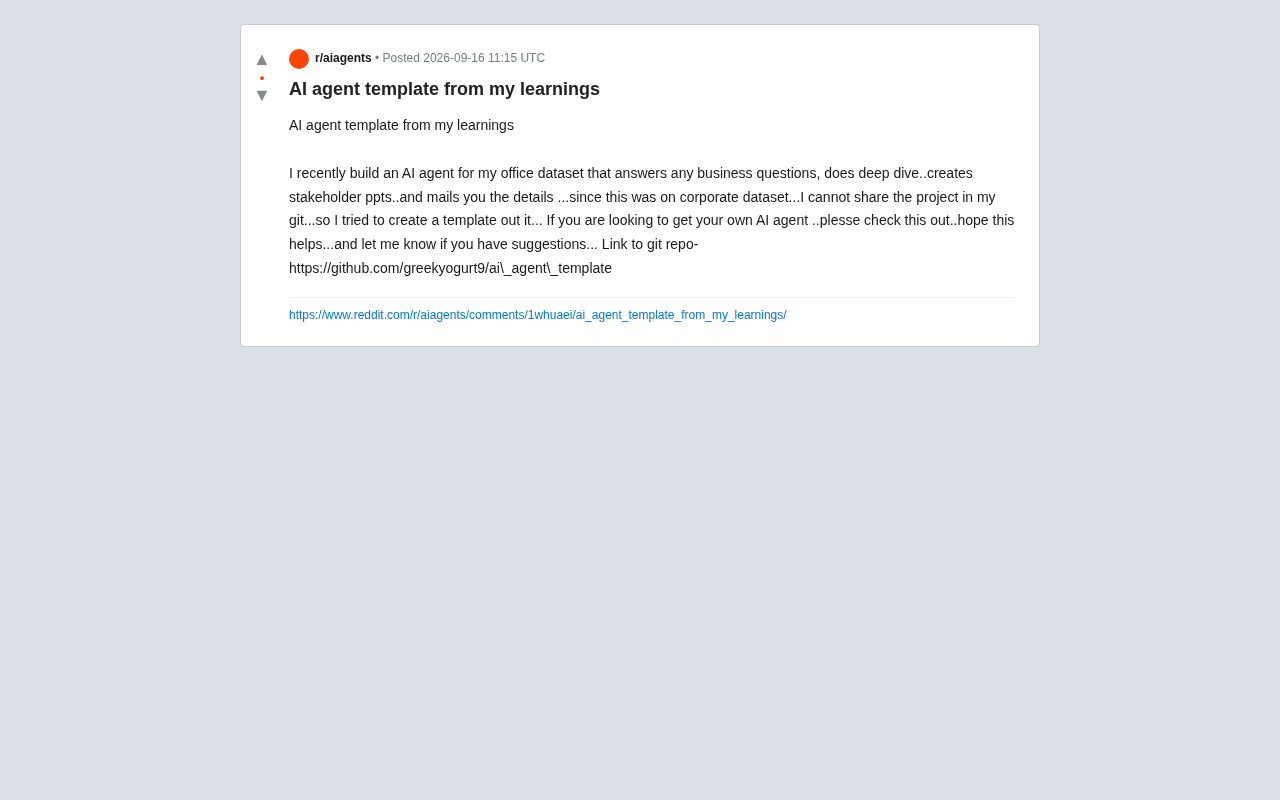
From Enterprise Practice to a Reusable Template: Lessons from Building an AI Agent
A developer shares an open-source AI Agent template built from an enterprise project, covering natural language data Q&A, analysis, auto-generated PPTs, and email distribution.

Nintendo's Open-World Design Evolution: Breaking Down Fire Emblem Fortune's Weave
Nintendo brings the open-world design philosophy of Breath of the Wild to Fire Emblem with the massive Switch 2 title Fortune's Weave. Here's what it means.

AI-Generated Food Photos Are Ruining Menus: How the Uncanny Valley Kills Appetite
AI-generated food images are flooding restaurant menus and delivery apps, but uncanny details kill appetite instead of sparking it. Here's why the uncanny valley effect hurts brands.