OMI OpenCode in Practice: A Detailed Guide to the Free Open-Source Multi-Agent AI Coding Framework

OMI OpenCode upgrades open-source AI coding tools into a multi-agent collaborative development team
The OMI OpenCode framework addresses OpenCode's lack of multi-agent orchestration, basic tool support, and unstable long-context handling by introducing the SysForce orchestrator. It enables parallel sub-agent collaboration, todo enforcement with recovery hooks, enhanced tools like AST Grep and full LSP refactoring, and intelligent context management. Supporting multi-model dispatch strategies that match different models to different task types, with both free and paid options, it represents a significant step in AI coding tools evolving from single assistants to autonomous collaborative teams.
Introduction: The Potential and Limitations of OpenCode
OpenCode is one of the best open-source AI coding agents available today. Running directly in the terminal, it has won over many developers with features like LSP integration and multi-agent sessions. LSP (Language Server Protocol) is an open protocol proposed by Microsoft that standardizes communication between editors/IDEs and language servers, enabling code completion, go-to-definition, error diagnostics, and other features to be reused across editors. However, in actual use, OpenCode still has several notable shortcomings:
- Lack of advanced agent orchestration capabilities: It cannot delegate tasks to specialized sub-agents or coordinate complex workflows. Multi-Agent Orchestration is a cutting-edge paradigm in AI system design. The core idea is to break down complex tasks and assign them to multiple specialized agents, with a central orchestrator coordinating their execution order, data passing, and error recovery—similar to how microservice architecture maps onto the AI domain.
- Basic tool support: It only provides read-only LSP support—meaning it can read code structure information but cannot perform rename, extract function, or other refactoring operations—lacking full code refactoring capabilities.
- Unstable long-context handling: Agents tend to get stuck, burning through tokens without making meaningful progress. Tokens are the basic units that large language models use to process text—roughly 1-2 tokens per English word, and about 1.5-2 tokens per Chinese character. API calls are billed by token count, and each model has a context window limit (e.g., Claude's 200K tokens).
These issues cause significant waste of time and tokens in daily development, making it difficult for multi-agent workflows to deliver their true value.
What is OMI OpenCode: Upgrading OpenCode into an AI Development Team
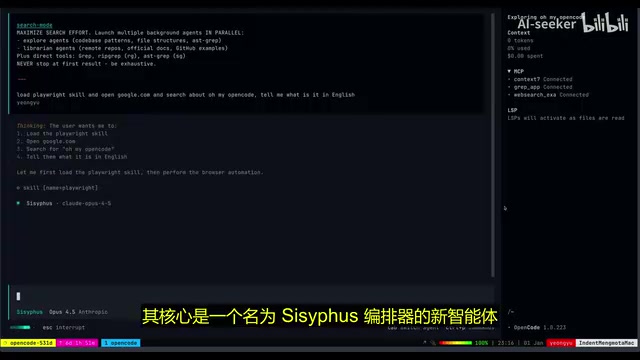
OMI OpenCode was created specifically to address these pain points. Its core concept is straightforward—transform OpenCode from a single agent into a collaborative AI development team.
SysForce Orchestrator: The Core of Multi-Agent Collaboration
OMI OpenCode introduces an orchestrator called SysForce as the system's core, bringing several key capabilities:
- Parallel sub-agents: Supports running multiple specialized agents simultaneously in the background without interference
- Todo enforcement: Ensures tasks are not abandoned midway through recovery hooks. Recovery Hooks are a fault-tolerance design pattern in software engineering—checkpoints are injected at critical points during program execution, allowing tasks to resume from the nearest checkpoint rather than starting over when interrupted by errors. This mechanism is particularly important in AI agent scenarios—LLM API calls can fail due to network timeouts, rate limits, or invalid outputs caused by model hallucinations. OMI OpenCode's todo enforcement mechanism combined with recovery hooks ensures that each subtask has clear completion state tracking. Even if an agent fails, the system can automatically retry or switch strategies rather than letting the entire workflow stall.
- Enhanced tool integration: Includes AST Grep, full LSP refactoring, and smarter execution control. AST Grep is a code search and transformation tool based on Abstract Syntax Trees. Unlike traditional text-based regex matching, it understands code syntax structure and can precisely match specific code patterns without being confused by formatting differences, comments, or variable naming. For example, you can use it to find all try-catch blocks with unhandled exceptions, or batch-replace a certain function call pattern. Integrating AST Grep into an AI coding agent means the agent can perform structural code analysis and precise refactoring rather than simple string replacement, dramatically improving the safety and accuracy of code modifications.
- Efficient context management: Automatically handles context injection and trimming, effectively preventing token waste. When agents handle complex projects, code files, conversation history, and tool outputs can quickly fill up the context window, causing costs to skyrocket and model performance to degrade from information overload. OMI OpenCode's automatic context management is essentially an intelligent information compression strategy—retaining only the most relevant context for the current task, removing redundant information, and maximizing the model's effective reasoning capability within a limited window.
Multi-Model Intelligent Dispatch Strategy
OMI OpenCode supports flexible multi-model integration, allowing you to configure the most suitable model for different agents based on task type:
- SysForce (Main Orchestrator): Powered by Claude Opus 4/3.5, responsible for architecture design, code review, and strategy formulation. Claude Opus is Anthropic's flagship large language model, excelling in complex reasoning, long-text comprehension, and code generation—ideal for orchestration tasks requiring a global perspective and deep thinking.
- Librarian (Research Agent): Powered by Claude Sonic 4.5 or Gemini Flash, focused on multi-repository analysis and documentation lookup. These models are optimized for speed and cost, suitable for large-scale information retrieval and quick summarization scenarios.
- Frontend Developer (Frontend Agent): Uses models like Gemini that excel at UI generation for frontend development. Google's Gemini series models have advantages in multimodal understanding and structured output, enabling better comprehension of design intent and generation of corresponding frontend code.
- Validator (Validation Agent): Responsible for code validation and quality assurance
The core value of this multi-model dispatch strategy lies in "using the right model for the right job"—top-tier models handle core decisions while lightweight models handle auxiliary tasks, ensuring output quality while controlling overall costs.

OMI OpenCode Installation and Configuration Tutorial
Getting started is very simple—just one command to complete the installation:
npx omi-opencode
During installation, you'll need to verify model providers and set API keys for the different orchestration agents. Once configured, simply type opencode in the terminal to launch the entire framework.
It's worth mentioning that OpenCode offers a free option using GLM-4.7, which works quite well in practice. GLM-4.7 is an open-source large language model from Zhipu AI, the latest iteration of their GLM series. Zhipu AI provides developers with a certain quota of free API calls, making it a viable choice for zero-cost AI development. MiniMax is another Chinese AI company that offers a free API tier. While these free models have gaps compared to top commercial models like Claude Opus in complex reasoning and code generation, they already have practical value for moderately complex programming tasks. If you're not ready to pay yet, you can absolutely build a zero-cost AI coding workflow using GLM-4.7 or MiniMax. This tiered free+paid strategy allows developers to validate the workflow with free models first, confirm the value, and then upgrade to paid plans—lowering the barrier to trying new tools.
Practical Demo: Building an AI Benchmark Website with Multi-Agent Collaboration
Task Distribution and Multi-Agent Collaboration Process
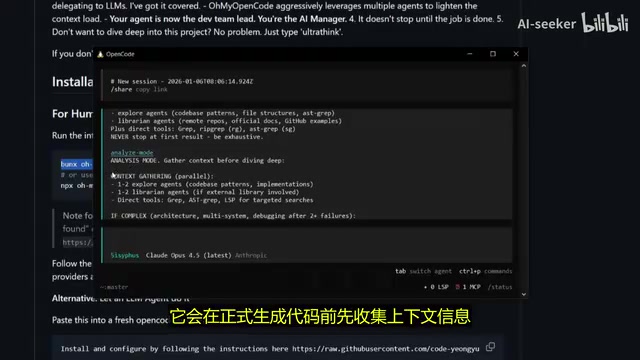
In this demo, we had the SysForce main orchestrator agent build an AI model benchmark website. The entire process clearly demonstrates the practical effects of multi-agent collaboration:
- Planning Phase: SysForce creates a task list and enables search mode to maximize information gathering. This phase is similar to requirements analysis and technical design in software engineering—the orchestrator decomposes high-level goals into executable subtasks and determines which specialized agent each subtask should be assigned to.
- Research Phase: The Librarian agent searches codebases and research materials in parallel. Parallel execution is a key advantage of multi-agent architecture—multiple research tasks can proceed simultaneously rather than waiting in sequence, significantly reducing total time for projects requiring extensive information gathering.
- Analysis Phase: Complete context information is gathered before generating code. This "understand first, then act" strategy avoids the common "blind generation" problem in AI coding, where models generate code that doesn't align with project architecture or business logic due to insufficient context.
- Coding Phase: Coder and Frontend Developer collaborate to generate code
- Validation Phase: The Validator autonomously refactors and verifies the output quality of each step. The automated validation step is essentially a built-in Code Review process in the AI workflow, ensuring each step's output meets quality standards before proceeding to the next.
Actual Cost and Final Results
The final results are quite impressive:
- Using the Opus model as the main orchestrator, the total project cost was only $2.92. For reference, Claude Opus API pricing is $15 per million input tokens and $75 per million output tokens. A total cost of $2.92 means the entire multi-agent workflow was very efficient in token usage, thanks to optimized context management and model dispatch strategies.
- Successfully built a complete application featuring model listings, benchmark data comparisons, leaderboards, and an AI news research section
- The generated code is clean and fully functional, including pre-built extension interfaces
Core Advantages of OMI OpenCode
In actual use, OMI OpenCode has several particularly outstanding characteristics:
- Persistent loop mechanism: It doesn't easily give up on tasks—when failures occur, it uses associated tools to retry repeatedly until achieving stable results. This design borrows from retry strategies and circuit breaker patterns in distributed systems, which is especially important in the AI agent domain since LLM outputs are probabilistic—the same prompt may produce results of varying quality across multiple executions.
- Autonomous code refactoring: Automatically refactors after each step is completed, ensuring clean and error-free output code
- Pre-configured MCP support: Comes with optimally configured tools and plugin combinations, ready to use out of the box. MCP (Model Context Protocol) is an open protocol released by Anthropic in late 2024, designed to standardize connections between AI models and external tools/data sources—similar to a USB-C port for AI, allowing different AI applications to connect to file systems, databases, APIs, and other resources through a unified protocol. MCP uses a client-server architecture where AI applications act as clients making requests, and MCP servers encapsulate specific tool capabilities. OMI OpenCode's pre-configured MCP support means it has built-in optimized tool connection configurations, so developers can let agents access needed resources without manually writing tool invocation logic.
- Real-time process preview: You can monitor code generation progress, context information, and token costs in real time
Free Plan vs. Paid Plan Comparison
| Plan | Model Selection | Orchestration Capability | Use Cases |
|---|---|---|---|
| Free | GLM-4.7 / MiniMax | Basic single agent | Simple tasks, learning experience |
| Paid | Opus + Sonic + Gemini | Full multi-agent orchestration | Complex projects, production environments |
For most developers, the recommended onboarding path is: first familiarize yourself with OMI OpenCode's workflow and command system using free models, understand the division of labor among agents, then switch to the paid model combination for best results on actual projects. While the free plan has limitations in orchestration capabilities, it's sufficient for evaluating whether this tool suits your development scenarios.
Conclusion: A New Benchmark for Open-Source AI Coding Tools
OMI OpenCode injects enterprise-grade multi-agent orchestration capabilities into the open-source OpenCode through specification-driven enhancement plugins and MCP integration. It frees developers from constantly monitoring AI agent execution, truly achieving task delegation and autonomous completion.
From a technology evolution perspective, OMI OpenCode represents an important step in the transformation of AI coding tools from "single conversational assistants" to "autonomous collaborative teams." Traditional AI coding assistants (like GitHub Copilot, Cursor) primarily provide help at the code completion and single-turn conversation level, while multi-agent frameworks like OMI OpenCode attempt to take over more complete development processes—from requirements understanding and architecture design to code implementation and quality verification.
For programmers seeking development efficiency, this solution represents the pinnacle of current open-source AI coding tools—offering both free models for zero-cost exploration and paid plans for optimal results. Whether you're an independent developer or a team lead, OMI OpenCode is worth taking the time to try.
Related articles
 Product Reviews
The Programmer's Desk Setup Guide: Building a Workspace That Feels Like Home
Discover how programmers build productive, comfortable workspaces. From multi-monitor setups to ergonomic design, explore the desk philosophy that drives focus and flow.
 Product Reviews
Qoder vs Cursor Real-World Comparison: Which $20/Month AI IDE Is Better?
Hands-on comparison of Qoder vs Cursor AI IDEs: Agent autonomy, human interaction count, and architecture decisions. Qoder needed only 2 interactions vs Cursor's 8.
 Product Reviews
Cursor Cloud Agent Demo: Eliminating Bottlenecks Across the Entire Software Development Lifecycle
Deep analysis of Cursor's Cloud Agent demo showing how cloud VMs, automated test artifacts, and a full-chain control plane systematically eliminate human bottlenecks across the software development lifecycle.