Omi Work Launches: The AI Workspace That Finds Customers for You

Omi Work orchestrates long tasks with sub-agents and extends its capability claims from "building" to "customer acquisition."
Omi Work is an AI workspace that debuted at #15 on Product Hunt, positioned as an "AI colleague" for the hardest, longest tasks. Its core differentiator is task orchestration: the user gives a goal, the system presents an execution plan for confirmation, then splits the task across multiple sub-agents working in parallel, supporting web search, external app connections, and background execution after the tab closes, ultimately delivering documents, spreadsheets with formulas, and slide decks. It also offers ready-made teammates, scheduled tasks, and voice mode, with team editions including role-based permissions, SSO, and audit logs. The tagline extends from "can build anything" to "finds your next 100 customers," but acquisition results are unproven and questions like sub-agent result aggregation and billing remain open.
From "Can Build Anything" to "Can Help You Find Customers": Omi Work's Ambition
Omi Work, which debuted at #15 on Product Hunt, has a rather blunt tagline: "Omi can build anything. Now it finds your next 100 customers." The first half is a declaration of capability; the second half points directly to a more concrete—and much harder for AI to deliver—promise: finding your next hundred customers.
Omi Work positions itself as "an AI workspace built for the hardest, longest-running tasks." It bundles together goal decomposition, sub-agent division of labor, web search, app connections, continuous background execution, and delivery of documents and spreadsheets—attempting to answer one question: when AI is no longer just an assistant in a chat box, but a "colleague" that can take on long-term tasks, what should the product form look like?
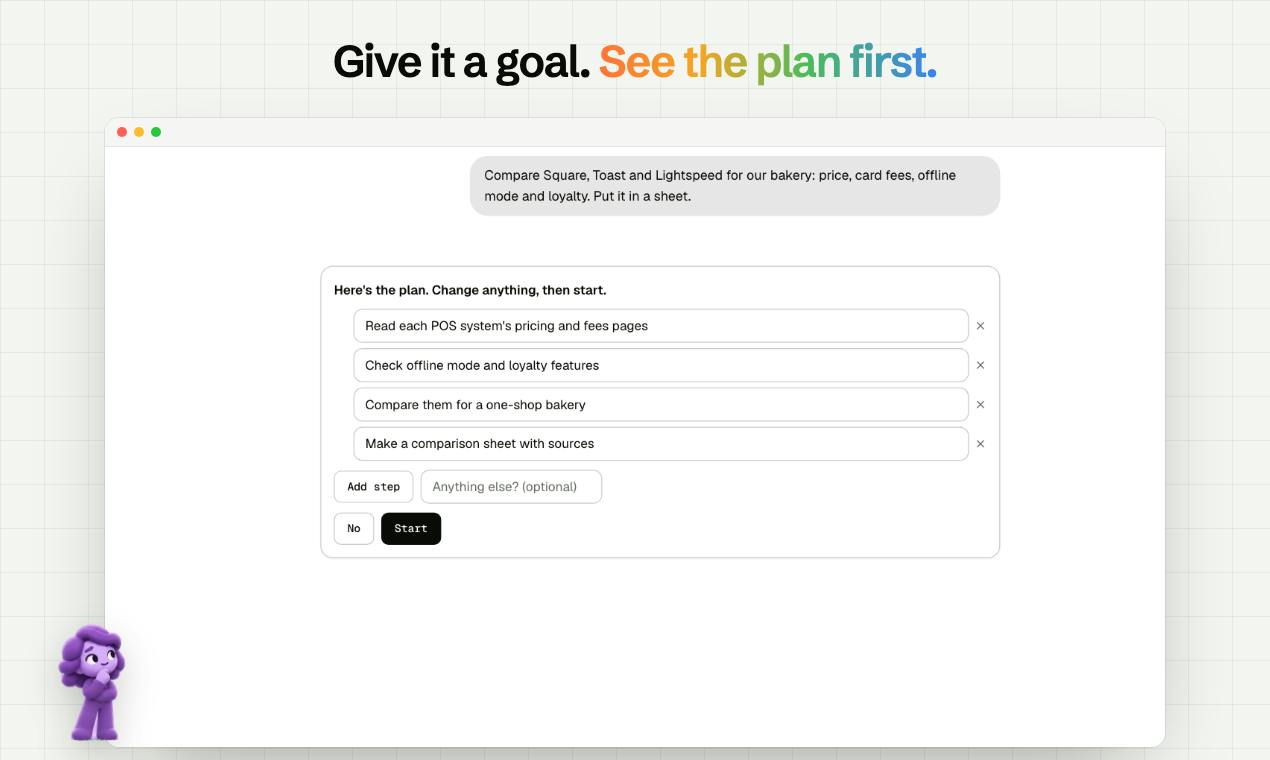
Task Execution Pipeline: Present a Plan First, Then Split It Across Sub-agents
The most distinctive aspect of Omi Work is how it orchestrates tasks. According to the official description, users only need to provide a goal, and the system first presents an execution plan rather than immediately starting to generate content. This "see the plan first" design effectively moves control to the front end—users can judge whether the AI has understood correctly before deciding whether to let it run.
Once the plan is confirmed, the large task is split across multiple sub-agents that work in parallel. These sub-agents can search the web, invoke apps the user has connected, and keep running even after you close the browser tab. The final output takes the form of documents, spreadsheets with formulas, and slide decks—landing directly at the level of office deliverables rather than remaining in a conversation log.
The value of this pipeline lies in the phrase "long tasks." Most AI assistants excel at single-turn Q&A or short-range generation, but once a task spans a longer horizon and requires multi-step retrieval and repeated tool calls, they tend to lose context or stall midway. By making sub-agent decomposition and continuous background execution its selling points, Omi Work is targeting precisely this gap.
Sub-agent is a division-of-labor pattern in agent architecture: a main orchestrator agent is responsible for understanding the goal and formulating a plan, then dispatching subtasks to multiple sub-agents with independent contexts and tool permissions that execute in parallel. Compared with continuous generation by a single model, sub-agents each maintain their own context window, which avoids the context overflow and instruction dilution common in long tasks; the orchestrator only needs to aggregate the structured outputs of each sub-agent rather than carrying the entire intermediate process throughout. This pattern also introduces new engineering challenges, such as dependency ordering among subtasks, result deduplication and conflict resolution, and constraints on individual sub-agents invoking tools beyond their authority.
Ready-made "Teammates" and Team-level Capabilities
Beyond task orchestration, Omi Work also offers several design choices that lower the barrier to entry: ready-made "team members" (teammates), scheduled tasks, and voice mode. Ready-made teammates can be understood as agent templates with preset roles and workflows, letting users who don't want to configure from scratch get started quickly; scheduled tasks allow repetitive work to run automatically on a recurring basis.
For team scenarios, Omi Work provides role-based permissions, SSO single sign-on, and audit logs. This combination typically appears in enterprise-grade SaaS products, indicating that the product targets not just individual users but also aims to enter organizations' internal collaboration workflows. Audit logs are especially critical—when AI agents perform operations on behalf of people, traceability is a hard requirement in enterprise procurement.
On the business model side, the company says it's free to start with no credit card required, lowering the cost of trial and error. However, the materials do not disclose the specific pricing or feature boundaries of subsequent paid tiers.
SSO (Single Sign-On) and audit logs are two foundational compliance capabilities when enterprises procure SaaS. SSO lets employees log in using the company's unified identity system, with authentication handled by an identity provider (such as Okta or Azure AD), so companies can centrally revoke access when an employee leaves or changes roles, avoiding scattered accounts. Audit logs record "who performed what operation, when, and with what permissions," which is especially critical in scenarios where AI agents execute tasks on someone's behalf: when an agent calls external apps, reads or writes data, or triggers outbound outreach, logs are the only basis for after-the-fact accountability and compliance review. The two usually work together with role-based permissions (RBAC) to form the minimum trust baseline for enterprise-grade products.
From Building to Customer Acquisition: The Product Pivot Behind the Tagline
Back to that tagline. "Can build anything" is the capability perception Omi had already established, while "now it finds your next 100 customers" introduces a new value dimension: customer acquisition.
This pivot is worth pondering. Building-type capabilities solve the problem of "making it," while customer acquisition solves the problem of "selling it"—and the latter actually places higher demands on AI: it needs to understand the target customer profile, execute multi-channel search and outreach, and be accountable for results. Omi Work's web search and app connection capabilities objectively provide the infrastructure for such tasks. But the materials themselves do not provide specific data or case studies on acquisition outcomes, so how well this promise is actually delivered still needs to be verified through real use.
From a product evolution perspective, putting "building" and "customer acquisition" in the same workspace means Omi wants to cover the complete path from idea to revenue. This is a fiercely competitive track with blurred boundaries, and whether it succeeds depends on the stability and delivery quality of agents in long tasks.
AI-driven lead generation refers to using agents to automatically complete target customer profile construction, lead collection, multi-channel outreach, and follow-up. Its technical prerequisites include web retrieval to obtain public company and contact information, connecting to CRM or email systems to execute outreach, and iterating screening strategies based on reply results. The difficulty lies not in any single step but in "accountability for results": lead quality is hard to assess automatically, outreach involves anti-spam and data compliance (such as GDPR restrictions on processing personal data), and effectiveness depends heavily on industry and data source differences. As a result, most products currently offer assistance with lead discovery and initial screening rather than an end-to-end acquisition promise.
What's Worth Watching and Open Questions
With 77 upvotes, 5 comments, and a #15 ranking, Omi Work has gained some attention in its early launch period, but the scale of community discussion is still moderate—not yet enough to form a verdict on its reputation.
Several points bear watching: how results from decomposed sub-agents are aggregated and deduplicated; the specific scope of app connections and how data permissions are managed; how time and resource consumption are billed for tasks that keep running after the tab is closed; and whether the promise to "find your next 100 customers" is backed by a reproducible methodology. The answers to these questions will determine whether Omi Work is a handy task-orchestration tool or an AI workspace that truly changes how we work.
One-line Summary
Omi Work orchestrates long tasks with sub-agents and extends its capability claims from "building" to "customer acquisition."
Paragraph Summary
Omi Work is an AI workspace that debuted at #15 on Product Hunt, positioned as an "AI colleague" that takes on the hardest, longest-running tasks. Its core differentiator is task orchestration: after the user provides a goal, the system first presents an execution plan for confirmation, then splits the large task across multiple sub-agents working in parallel, supporting web search, connections to external apps, and continuous background execution after the tab is closed, ultimately delivering documents, spreadsheets with formulas, and slide decks. The product also offers ready-made teammates, scheduled tasks, and voice mode, while the team edition includes role-based permissions, SSO, and audit logs. The tagline extends from "can build anything" to "finds your next 100 customers," but there is no data yet to substantiate acquisition results, and questions such as sub-agent result aggregation and billing remain to be seen.
Related articles

Prompt Engineering for Beginners: From Writing Prompts to Engineering Thinking
Starting from the essence and four functions of prompts, this article systematically explains the six-step process, four success criteria, learning value, and practical limitations of prompt engineering to help you build a complete understanding.

Anthropic Launches Nasdaq IPO: AI Giant's Listing and Risk Disclosures
Anthropic officially launches its Nasdaq IPO under ticker ANT, with market valuation expected to potentially exceed SpaceX's record. The prospectus devotes nearly 100 pages to AI risks, while first-half revenue grew over 14x but net losses widened sharply, reigniting the AI bubble debate.

Rust cURL Clone Uses 4,832 unsafe Blocks—Is the Memory Safety Myth Broken?
A Rust cURL clone uses 4,832 unsafe keywords, challenging Rust's memory safety narrative. We analyze what unsafe really means, compare Fil-C, and examine rewrite motives.