omlx: High-Performance LLM Inference Server Built for Apple Silicon

omlx delivers high-performance local LLM inference on Apple Silicon with continuous batching and SSD caching.
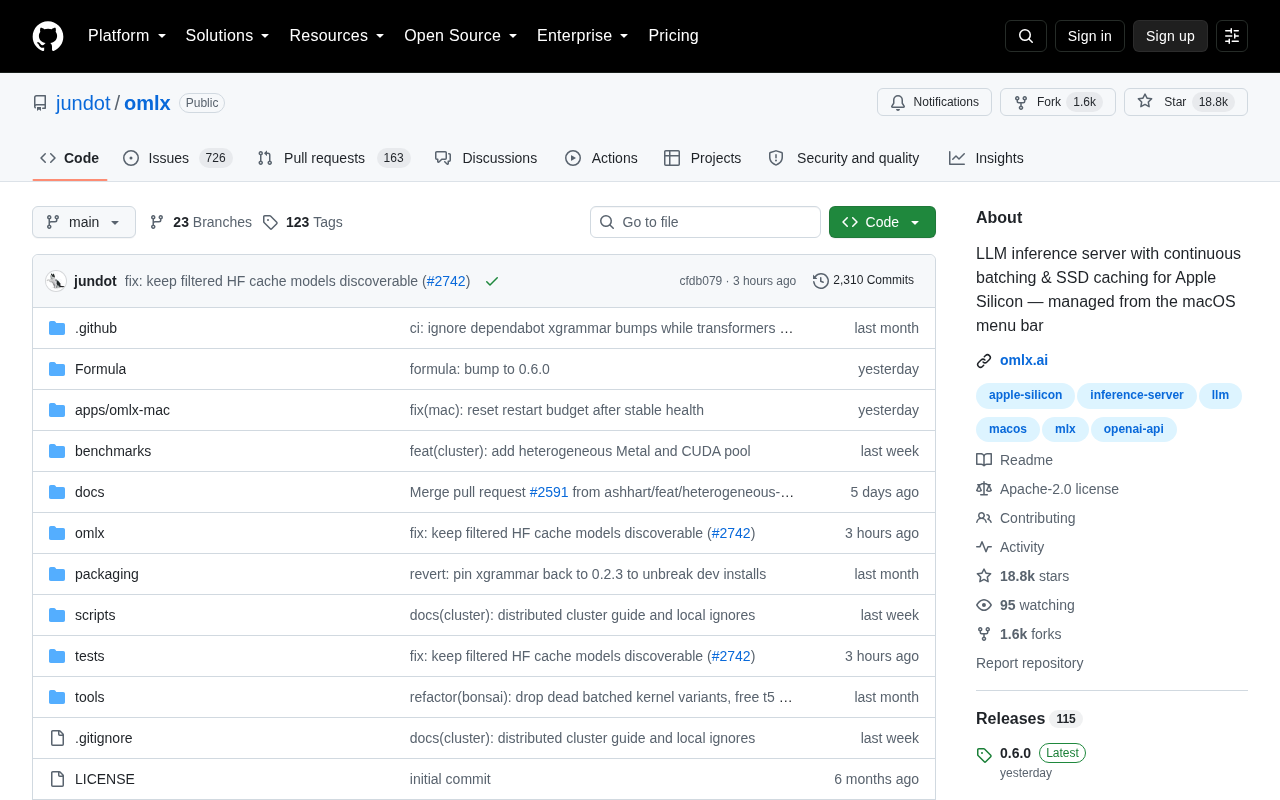
omlx is an open-source LLM inference server built specifically for Apple Silicon, leveraging the unified memory architecture for optimal performance. Its key innovations include continuous batching for improved concurrent throughput, SSD caching to overcome memory limitations, and native macOS menu bar management for ease of use. With over 18,800 GitHub stars, it fills the gap between professional inference servers and user-friendly desktop tools in the local LLM ecosystem.
Project Overview
Running large language models (LLMs) locally is becoming the choice of more and more developers and privacy-conscious users. While Apple Silicon demonstrates unique advantages in AI inference thanks to its unified memory architecture, it has long lacked a sufficiently efficient and user-friendly server-side solution. The open-source project omlx (maintained by developer jundot) was created precisely to fill this gap.
Apple Silicon's unified memory architecture means that the CPU, GPU, and Neural Engine (NPU) share a single physical memory pool, eliminating the need for data copying between different processors. In traditional x86 + discrete GPU architectures, model weights need to be copied from system memory to video memory (VRAM), a process limited by PCIe bandwidth (typically 16-64 GB/s). Apple Silicon's memory bandwidth can reach 200-800 GB/s (e.g., M4 Max achieves 546 GB/s), and since data doesn't need to be transferred, token generation speed during inference performs excellently in memory bandwidth-bound scenarios. This gives Macs a unique advantage in performance per watt and memory bandwidth utilization when running LLMs, even though their absolute compute power doesn't match high-end discrete GPUs.
The project positions itself as an "LLM inference server for Apple Silicon," with core features including continuous batching, SSD caching, and direct management from the macOS menu bar. Written in Python, the project has already garnered over 18,800 stars and 1,600 forks on GitHub, with 60 new stars per day, indicating strong community interest.
Core Technical Highlights
Continuous Batching: Dramatically Improving Concurrent Throughput
Continuous batching is a key optimization technique in modern LLM inference services. Traditional static batching requires waiting for an entire batch of requests to complete before processing the next, easily causing GPU/NPU resource waste through idle time. Continuous batching allows new requests to be inserted immediately after individual requests complete, significantly improving overall throughput in multi-user, high-concurrency scenarios.
From a technical perspective, continuous batching (also known as dynamic batching or inflight batching) was first systematically proposed in the Orca paper (2022). In LLM inference, different requests vary enormously in input length and generation length—one request might only need to generate 10 tokens, while another needs 2,000. Under static batching, short requests must wait for the longest request in the same batch to finish, leaving compute resources idle. Continuous batching uses iteration-level scheduling, checking after each decoding step whether any requests have completed. If so, it immediately releases their compute slots and inserts new requests from the waiting queue. Mainstream inference engines like vLLM, TensorRT-LLM, and TGI have all implemented this technique, which can improve GPU utilization by 2-8x. omlx brings this enterprise-grade optimization to the Apple Silicon platform.
For individual developers, this means that even on a single Mac, you can more efficiently serve multiple concurrent conversations or application requests, fully extracting the compute power of Apple Silicon chips.
SSD Caching: Breaking Through Mac Memory Capacity Bottlenecks
While Apple Silicon's unified memory excels in bandwidth, its capacity is often limited—especially when running large parameter models, where memory easily becomes a bottleneck. The SSD caching mechanism introduced by omlx allows offloading partial model weights or KV caches to high-speed solid-state drives, enabling larger models or longer context support within limited memory.
Understanding this design requires knowledge of KV cache memory overhead: during Transformer autoregressive generation, the model needs to store Key and Value tensors for all previously generated tokens to avoid recomputing attention. For a 70B parameter model, a single request's KV cache at 128K context length can consume tens of gigabytes of memory. The SSD caching approach temporarily swaps inactive KV cache pages (or less frequently accessed layer weights) out to NVMe SSDs. Apple Silicon Macs are equipped with NVMe SSDs capable of 5-7 GB/s read speeds—far below memory bandwidth, but through prefetch scheduling and tiered management, effective usable capacity can be significantly expanded within an acceptable performance penalty range. Similar approaches have been explored in research like FlexGen and PowerInfer.
This design philosophy shares common ground with llama.cpp's memory mapping and some cloud inference frameworks' tiered caching strategies, but has been specifically optimized for Mac's local hardware.
macOS Menu Bar Management: Lowering the Barrier to Entry
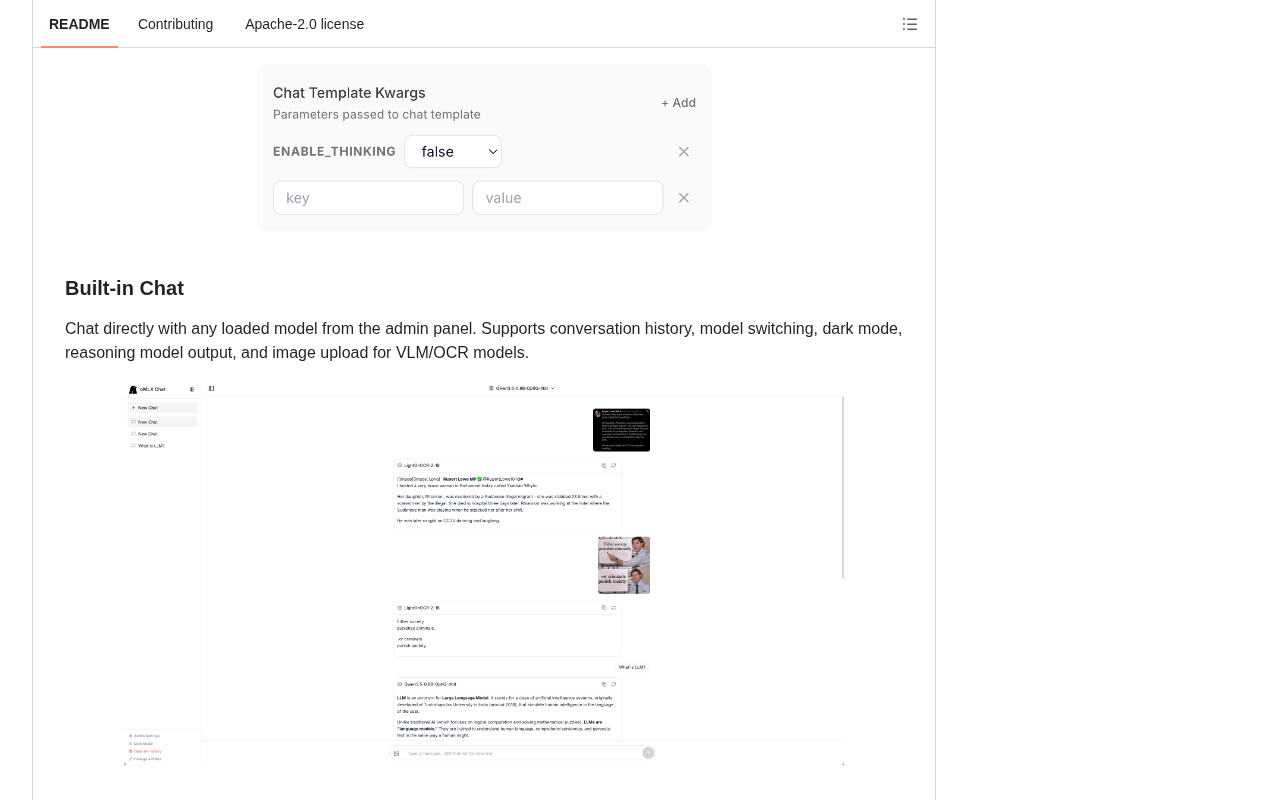
Unlike many inference frameworks that require command-line operation, omlx provides the ability to manage services directly from the macOS menu bar. Users can start, stop, or monitor model services without frequently switching to the terminal. This "native Mac app" style interaction experience significantly lowers the barrier to entry for non-technical users.
Target Users and Typical Use Cases
omlx has a clearly defined target user base:
- Mac developers: Looking to quickly set up local LLM services for application development and prototype validation.
- Privacy-conscious users: Unwilling to upload data to the cloud, preferring fully local inference solutions.
- AI enthusiasts: Seeking to explore the maximum potential of open-source models on their own hardware.
The demand for local inference stems not only from personal privacy preferences but also from deeper compliance drivers. Regulations like GDPR (EU General Data Protection Regulation) and HIPAA (Health Insurance Portability and Accountability Act) impose strict restrictions on cross-border transmission and third-party processing of sensitive data. When enterprises handle medical records, legal documents, or financial data, local inference avoids data leaving controlled environments. Additionally, local deployment eliminates dependency on cloud service providers—no need to worry about API service outages, pricing changes, or vendor lock-in. As LLMs become widely adopted in RAG (Retrieval-Augmented Generation) and Agent scenarios, local inference servers are shifting from an "optional" to a "required" component in many use cases.
As M-series chips (M1/M2/M3/M4) continue to improve in performance, Macs have gradually become an important platform for local AI inference. omlx fills precisely the gap between "professional inference server" and "easy-to-use desktop tool."
Ecosystem Position and Competitive Analysis: omlx vs Ollama vs LM Studio
In the Apple Silicon local LLM ecosystem, several mature solutions already exist, including Ollama, LM Studio, and MLX (Apple's official framework). omlx's differentiation is primarily reflected in:
- Server-oriented positioning: Compared to tools geared toward single-machine interaction, omlx emphasizes its role as an inference server with concurrency and throughput optimization.
- SSD caching innovation: Provides an engineered solution for Mac's memory limitation pain point.
- Native management experience: Menu bar integration makes service management more aligned with Mac user habits.
It's worth noting that MLX is a deep learning framework open-sourced by Apple's machine learning research team in December 2023, designed specifically for Apple Silicon. It draws from NumPy and PyTorch's API design philosophy but is deeply optimized at the underlying level for Metal GPU and unified memory, supporting lazy evaluation and dynamic graphs. The MLX ecosystem has already spawned tools like mlx-lm (text model inference) and mlx-vlm (vision-language models). The "mlx" in omlx's name suggests it may be built on or compatible with the MLX framework, thereby leveraging Apple's official optimizations for Metal Performance Shaders and ANE (Apple Neural Engine). This framework choice enables omlx to fully exploit Apple Silicon's hardware characteristics rather than simply porting CUDA-based solutions.
It should be noted that projects like Ollama have already established massive model libraries and community ecosystems. If omlx wants to further expand its influence, beyond technical advantages, it will need sustained investment in model compatibility, documentation quality, and community operations.
Summary
omlx represents a microcosm of local LLM inference tools evolving toward "high-performance, user-friendly, and service-oriented" solutions. It capitalizes on Apple Silicon's unified memory architecture advantages while using SSD caching to address memory capacity limitations, and lowers the barrier to entry through the distinctly Mac-style menu bar approach.
For users looking to deploy local LLM services on Mac, omlx is undoubtedly an open-source option worth watching and trying. Its rapidly growing star count also confirms the community's sustained demand for efficient local inference solutions. As the Apple Silicon ecosystem matures, tools like this may become a crucial component of personal AI infrastructure.
Related articles

Chain of Thought Isn't Just for AI: How Humans Can Use CoT to Improve Thinking Quality
Chain of Thought isn't just a prompt trick for large models. Starting from a Hacker News discussion, this article analyzes why CoT works for human thinking too, breaks down actionable ways to transfer it, and highlights the key differences between human CoT and machine CoT.
Cloudflare Teams Up with OpenAI: Closi…
Cloudflare Teams Up with OpenAI: Closing the Loop from Vulnerability Discovery to Defense with AI
Cloudflare uses OpenAI Daybreak to investigate security vulnerabilities and generate reviewable remediation plans, while developers use Codex to boost coding efficiency and quality.

Orca Multi-Agent Orchestration in Practice: A Guide to Parallel Collaboration with Claude and Codex
Orca is Stable AI's free open-source agent workbench supporting 34 agents like Claude Code and Codex in parallel. Learn its Git worktree isolation, multi-model orchestration, and mobile management.