OmniVerifier-C1: From Binary Judgments to Graded Scoring — How Visual Verifiers Are Reshaping Generative World Models

OmniVerifier-C1 replaces binary judgments with decomposed graded verification, providing continuous fine-grained feedback and validating its effectiveness in world modeling tasks.
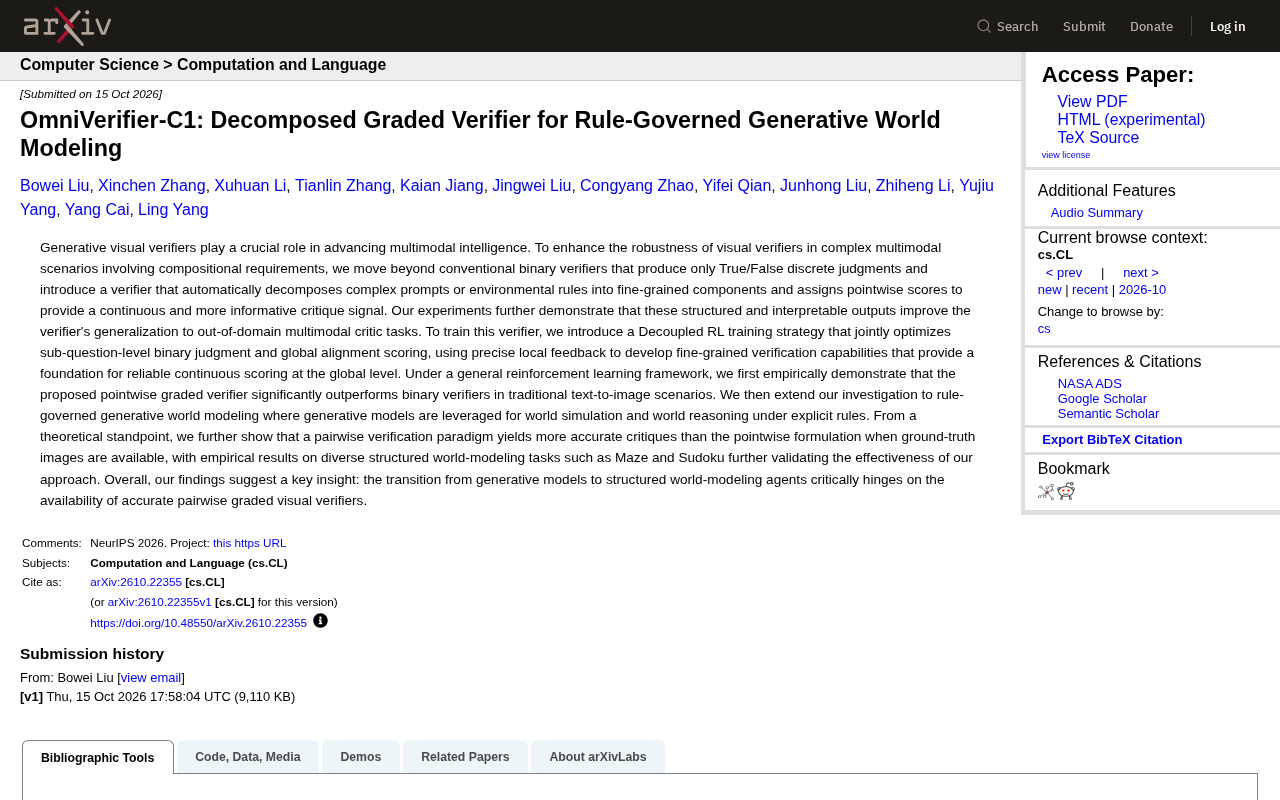
OmniVerifier-C1 addresses the coarse-grained problem of traditional multimodal verifiers that only output True/False by proposing a decomposed graded verification framework: it automatically breaks complex prompts or environment rules into fine-grained sub-questions and gives each a pointwise continuous score, forming a more informative and interpretable critique signal. To train this ability, the authors designed a decoupled reinforcement learning strategy that separately optimizes sub-question-level binary judgments and global alignment scoring. Experiments show that in text-to-image scenarios the pointwise graded verifier significantly outperforms binary verifiers, and the framework is also effective on rule-driven generative world modeling tasks such as Maze and Sudoku. The paper also theoretically analyzes pointwise versus pairwise verification, noting that pairwise verification is more accurate when ground-truth images are available and emphasizing that accurate pairwise graded visual verifiers are a key bottleneck for structured world modeling agents.
Generative Visual Verifiers are becoming a key component of multimodal intelligence. Traditional verifiers only output discrete True/False judgments, which often fall short when faced with compositional requirements. OmniVerifier-C1 proposes a decomposed, graded verification framework that automatically breaks down complex prompts or environment rules into fine-grained sub-questions and provides pointwise continuous scores, thereby offering more informative feedback signals.
Limitations of Binary Verifiers and the Introduction of Graded Verification
In multimodal scenarios, verifiers need to determine whether generated results satisfy multiple compositional requirements in a prompt. Traditional binary verifiers only give True/False — once a generated result partially satisfies and partially fails, the verifier cannot tell the model "what's right, what's wrong, and by how much." This coarse-grained signal directly limits the optimization efficiency of the reinforcement learning stage.
The core change in OmniVerifier-C1 is: automatically decompose complex prompts or environment rules into several independently judgeable fine-grained components, give a pointwise score to each component, and ultimately form a continuous, interpretable critique signal. Compared with a single boolean value, this structured output not only has higher information density but also enables the verifier to show better generalization ability on out-of-domain multimodal critique tasks.
Verifier in multimodal and generative AI usually refers to an independent model or module used to evaluate whether generated results satisfy given conditions, commonly seen in "generation-verification" two-stage pipelines or in the human feedback links of reinforcement learning (RLHF/RLVF). Traditional verifiers are mostly implemented as classifiers, outputting True/False or a scalar reward, with the training objective of judging whether an entire result is acceptable. The problem with this design is that a prompt often contains multiple constraints such as color, quantity, spatial relations, and style, and the generated result may only satisfy some of them. Binary judgment compresses this information into a single bit, and the model cannot learn from it "which item is wrong and to what degree." A graded verifier expands the evaluation result into multiple sub-scores, making the reward signal denser and making it easier to locate the source of errors, which is also why it has an advantage in reinforcement learning optimization.
Decoupled Reinforcement Learning Training Strategy
To enable the verifier to possess both abilities — "decomposing sub-questions" and "global scoring" — direct end-to-end training is not easy. The authors propose a decoupled RL training strategy (Decoupled RL), splitting the optimization objective into two parts: sub-question-level binary judgments and global alignment scoring.
Local feedback is used to cultivate fine-grained verification ability, while global alignment scoring is built on top of local judgments, providing the basis for reliable continuous scoring. The entire process still runs under a general reinforcement learning framework. Experiments show that in traditional text-to-image scenarios, this pointwise graded verifier significantly outperforms binary verifiers — which also indirectly shows that the granularity of the verification signal itself is a key variable affecting generation quality.
Decoupled Training's core idea is: when a model needs to master multiple abilities simultaneously, forcibly training with a single end-to-end objective easily causes abilities to interfere with each other. A common approach is to first split the overall objective into several independently supervised sub-objectives, train them separately or optimize them alternately, and then integrate them through a shared module or post-processing step. The decoupled RL in this paper is exactly this idea: sub-question-level binary judgment can be seen as a relatively simple classification task, suitable for direct optimization with local feedback; while global alignment scoring needs to synthesize the judgment results of all sub-questions and is closer to a ranking or regression task. Separate optimization allows the verifier to first learn "item-by-item checking" and then learn "overall scoring," avoiding the global objective masking local errors and also reducing training instability.
Rule-Governed Generative World Modeling
The paper further extends the verifier to "rule-governed generative world modeling." Under this setting, the generative model is no longer just drawing images, but is used for world simulation and world reasoning, and must obey explicit rules.
Such tasks place higher demands on the verifier: it must not only judge visual plausibility but also check whether the generated result satisfies rule constraints. The researchers validated this on structured world modeling tasks such as Maze and Sudoku, and the results show that the graded verification framework is equally effective on these tasks.
The key difference between rule-governed generative world modeling and traditional image generation lies in the source and form of "constraints." In ordinary text-to-image tasks, prompts often only describe visual content, and constraints are soft and negotiable; while in world modeling tasks, rules are explicit and hard, for example, a maze must be connected, and each row and column in Sudoku must not repeat numbers. The goal of such tasks is not just to generate images that "look like" something, but to generate states that satisfy rules and can be used for subsequent reasoning or simulation. Therefore, the verifier must simultaneously check two levels: visual plausibility (whether it looks like a real maze/Sudoku) and rule consistency (whether it is legal). This also explains why structured tasks such as Maze and Sudoku are suitable as testbeds — their rules are clear and automatically judgeable, allowing objective measurement of the verifier's fine-grained judgment ability.
Pointwise vs Pairwise Verification: Theoretical Insights
In addition to pointwise graded scoring, the authors also analyze the pairwise verification paradigm from a theoretical perspective. The conclusion is: when ground-truth images are available, pairwise verification can provide more accurate critique signals than the pointwise form. This conclusion is supported by empirical results on multiple structured world modeling tasks.
This finding points to a deeper judgment: moving from generative models to structured world modeling agents, one of the key bottlenecks is whether one possesses an accurate pairwise graded visual verifier. In other words, the verifier is not just an evaluation tool; it itself is becoming a component of world model capability.
Pointwise Verification and Pairwise Verification are two different scoring paradigms. Pointwise verification scores each generated result independently, for example, giving an image a score of 7 without depending on other samples; pairwise verification looks at two candidates at the same time (or one generated result and one ground-truth result) and judges which is better or closer to the truth. The advantage of pointwise scoring is that the output can be directly used as a reward, but absolute scores are difficult to calibrate, and the model can easily learn to "game the score"; pairwise comparison only requires relative judgment and is usually more stable, especially when human or ground-truth images are available as references. The theoretical analysis in this paper points out that when ground-truth images are available, pairwise verification can provide more accurate critique signals, which means that in structured world modeling, how to build high-quality pairwise verifiers may be more important than simply improving pointwise scoring.
Key Points
- Fine-grained decomposition: Automatically decompose complex prompts or environment rules into independently scorable sub-questions, replacing traditional True/False binary output.
- Continuous scoring signal: Pointwise graded scoring provides richer, interpretable critique signals and improves out-of-domain generalization ability.
- Decoupled RL training: Jointly optimize sub-question-level binary judgments and global alignment scoring, using local feedback to support global continuous scoring.
- Rule-based world modeling verification: Validated the framework's effectiveness on structured tasks such as Maze and Sudoku.
- Theoretical advantage of pairwise verification: When ground-truth images are available, pairwise verification is more accurate than pointwise verification, highlighting a key dependency for structured world modeling agents.
One-line Summary
OmniVerifier-C1 replaces binary judgments with decomposed graded verification, provides continuous fine-grained feedback, and validates its effectiveness in world modeling tasks.
Paragraph Summary
To address the coarse-grained problem that traditional multimodal verifiers only output True/False, OmniVerifier-C1 proposes a decomposed graded verification framework: it automatically breaks down complex prompts or environment rules into fine-grained sub-questions and gives each sub-question a pointwise continuous score, forming a more informative and interpretable critique signal. To train this ability, the authors designed a decoupled reinforcement learning strategy that separately optimizes sub-question-level binary judgments and global alignment scoring. Experiments show that in text-to-image scenarios, the pointwise graded verifier significantly outperforms binary verifiers; on rule-driven generative world modeling tasks such as Maze and Sudoku, the framework is equally effective. The paper also theoretically analyzes the differences between pointwise and pairwise verification, points out that pairwise verification is more accurate when ground-truth images are available, and emphasizes that accurate pairwise graded visual verifiers are one of the key bottlenecks for structured world modeling agents.
Related articles

Chain of Thought Isn't Just for AI: How Humans Can Use CoT to Improve Thinking Quality
Chain of Thought isn't just a prompt trick for large models. Starting from a Hacker News discussion, this article analyzes why CoT works for human thinking too, breaks down actionable ways to transfer it, and highlights the key differences between human CoT and machine CoT.
Cloudflare Teams Up with OpenAI: Closi…
Cloudflare Teams Up with OpenAI: Closing the Loop from Vulnerability Discovery to Defense with AI
Cloudflare uses OpenAI Daybreak to investigate security vulnerabilities and generate reviewable remediation plans, while developers use Codex to boost coding efficiency and quality.

Orca Multi-Agent Orchestration in Practice: A Guide to Parallel Collaboration with Claude and Codex
Orca is Stable AI's free open-source agent workbench supporting 34 agents like Claude Code and Codex in parallel. Learn its Git worktree isolation, multi-model orchestration, and mobile management.