On Anthropic's IPO Day, Rival Says Companies Can Skip Expensive Models

Fireworks AI uses Anthropic's IPO to argue that open-source models can replace expensive closed-source models in most enterprise scenarios.
On Anthropic's IPO day, competitor Fireworks AI's co-founder publicly championed open-source models, arguing most enterprises don't need expensive frontier closed-source models since open-source solutions are good enough and significantly cheaper in most scenarios. The article notes this reflects the real trend toward hybrid approaches and ties to Fireworks AI's own commercial interests in the open-source ecosystem. Fireworks AI also acknowledged losing some customer trust due to security vulnerabilities, underscoring security compliance in vendor selection. The article offers a decision framework: tier by task complexity, evaluate total cost of ownership, and factor in vendor security records—concluding that enterprises combining solutions flexibly will be the ultimate beneficiaries.
On the day of Anthropic's IPO, the co-founder of its competitor Fireworks AI publicly championed open-source models, arguing that most enterprises don't need to rely on expensive frontier closed-source models and can achieve more cost-effective AI capabilities through open-source solutions. This statement drew widespread attention in the AI industry and reflects the open-source versus closed-source debate entering a new phase.
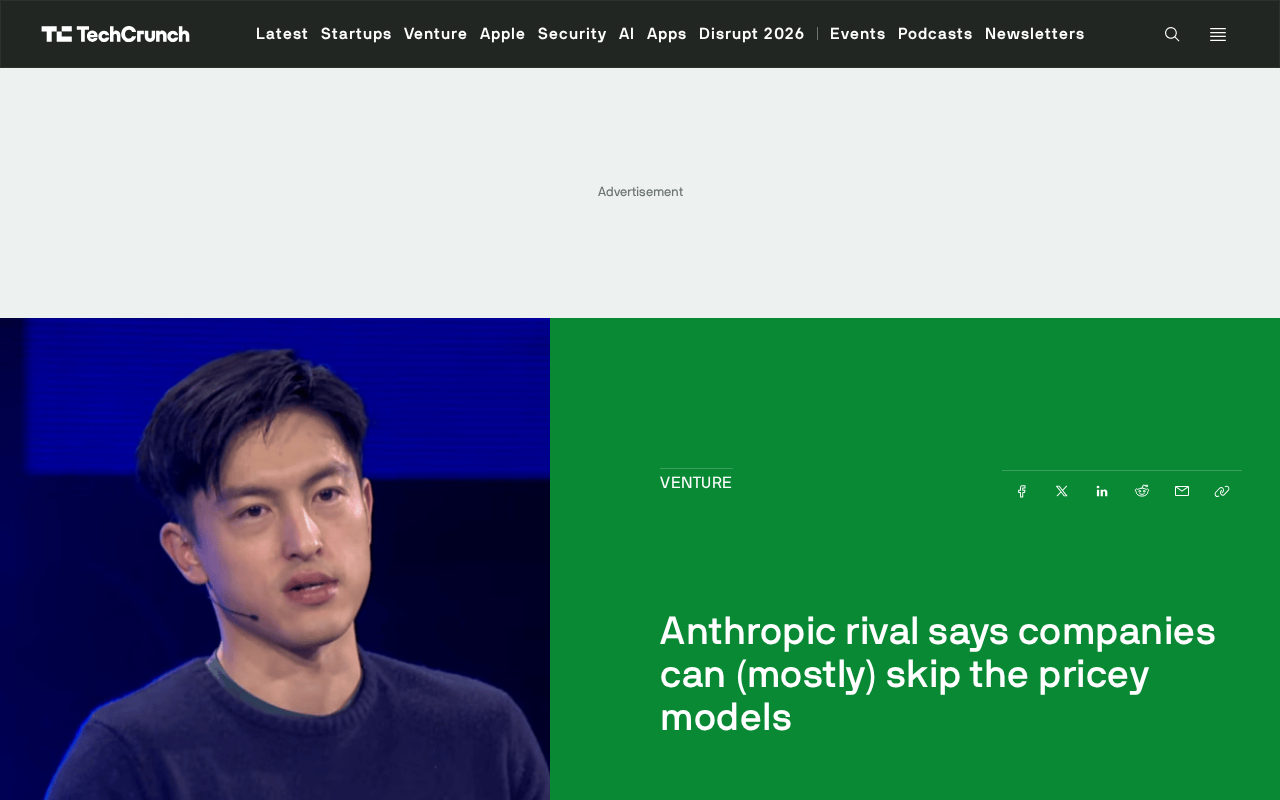
Open-Source Models Become a New Choice for Enterprises
The Fireworks AI co-founder's core point was clear: when building AI applications, companies don't necessarily need to pay for the most expensive proprietary models. Open-source models are already good enough in most scenarios, yet significantly cheaper. This means enterprises can shift budget from model API fees toward product refinement and data accumulation.
This assessment aligns with actual trends in the current AI market. More and more enterprises are beginning to evaluate hybrid approaches—using frontier models for core high-value scenarios while adopting open-source models for large volumes of routine tasks to reduce costs and improve efficiency. As a platform providing model inference and training services, Fireworks AI's commercial interests are deeply tied to the prosperity of the open-source ecosystem, so this statement is both a technical judgment and a market positioning move.
The difference between open-source models and open-weight models is often conflated, but it's worth clarifying in selection discussions. Strictly speaking, "open-source models" not only disclose weights and inference code but also training data and training scripts, and allow free redistribution; whereas most models commonly referred to in the industry, such as Llama and Mistral, only disclose weights, with training data and processes remaining opaque—making "open-weight models" a more accurate term. This distinction directly affects enterprise controllability assessments: open-weight models can be privately deployed, fine-tuned, and have their inference behavior audited, but the training process cannot be reproduced, making it difficult to fully investigate biases and compliance risks stemming from training data. When treating "open source" as a cost-reduction option, enterprises should confirm what level of openness the vendor provides, and whether the license permits commercial use or imposes limits on user scale or output purposes.
Trust Crisis: The Cost of Security Vulnerabilities
It's worth noting that while advocating the open-source path, Fireworks AI also acknowledged that the company had lost some customer trust due to security vulnerability incidents. The co-founder responded to this, but the original information did not disclose specific details of the vulnerabilities or the scope of impact.
For any AI infrastructure provider, the impact of security incidents is far-reaching. When choosing model service providers, enterprises consider security compliance and data protection as key decision factors alongside price and performance. Fireworks AI's willingness to address this issue publicly at least shows it recognizes that trust rebuilding is a long-term undertaking.
The Route Debate Under the Competitive Landscape
As a representative of frontier closed-source models, Anthropic's IPO is regarded as an important milestone in AI commercialization. Fireworks AI's choice to speak out on the same day is a meaningful timing decision. The open-source camp hopes to use the industry's focal event to send a signal to the market: closed-source models are not the only answer.
From an industry perspective, open-source and closed-source models are not in a simple substitutive relationship. Closed-source models still have advantages in complex reasoning and multimodal understanding tasks, while open-source models excel in cost, controllability, and customization. What enterprises truly need is to establish a flexible model selection strategy rather than betting on a single vendor.
The inference service layer is key to understanding Fireworks AI's commercial positioning. To turn a trained model into a callable API, it must go through engineering optimizations in the inference engine such as batch scheduling, memory management, quantization compression, and auto-scaling—this layer directly determines the cost per token and latency. The core value of platforms like Fireworks AI and Together AI is using proprietary inference engines to push the calling price of open-weight models down to near or even below the level of closed-source APIs, while also providing fine-tuning and private deployment capabilities. This also explains why it strongly supports the open-source path: the more prosperous and diverse open-weight models become, the greater the demand for neutral inference platforms; and if the market is monopolized by a few closed-source APIs, the space for such platforms would be significantly compressed.
How Enterprises Should Decide
For enterprises planning AI implementation, Fireworks AI's statement offers several dimensions for consideration. First is task tiering: stratify business scenarios by complexity, using frontier models for high-value complex tasks and open-source models for massive routine tasks. Second is total cost of ownership: not just the per-call price, but also integration, operations, and talent costs. Finally, the security bottom line: regardless of whether open-source or closed-source is chosen, the vendor's security record and response capabilities should be included in the assessment.
Open-source models are still rapidly maturing, while closed-source models continue to iterate. The ultimate beneficiaries of this route debate will be enterprises that can rationally assess their own needs and flexibly combine technical solutions.
Total cost of ownership (TCO) is often simplified in model selection to a comparison of "price per million tokens," but the real cost structure is far more complex. Building or privately deploying open-weight models includes, beyond GPU compute, inference engine tuning, model version upgrades, monitoring and alerting, fault redundancy, and corresponding engineering labor; adopting closed-source APIs transfers these operational burdens to the vendor, at the cost of higher unit prices, data needing to leave the premises or jurisdiction, and lock-in risk from vendor price changes or model deprecation. A reasonable approach is to estimate the crossover point between fixed and variable costs of the two paths based on annual call volume: scenarios with small call volumes and high demand volatility favor APIs, while scenarios with large, stable call volumes and sensitive data make private deployment more cost-effective.
One-line Summary
On the occasion of Anthropic's IPO, Fireworks AI argues that enterprises can replace expensive closed-source models with open-source models in most scenarios.
Paragraph Summary
On the day of Anthropic's IPO, the co-founder of its competitor Fireworks AI publicly championed open-source models, arguing that most enterprises don't need to rely on expensive frontier closed-source models, and that open-source solutions are already good enough in most scenarios at significantly lower cost. The article notes that this statement reflects the real trend of enterprises shifting to hybrid approaches and is also tied to Fireworks AI's own commercial interests in the open-source ecosystem. Meanwhile, Fireworks AI acknowledged having lost some customer trust due to security vulnerabilities, highlighting the importance of security compliance in selection. The article concludes with a decision framework for enterprises: tier selection by task complexity, comprehensively evaluate total cost of ownership, and factor vendor security records into consideration—arguing that enterprises that flexibly combine solutions will be the ultimate beneficiaries of the route debate.
Related articles

From 0 to 1: Vibe Coding an AI Knowledge Base — A Practical Retrospective and Tech Stack Breakdown
A retrospective on building the AI knowledge base OilBook from scratch with Vibe Coding: Next.js+Neon stack, Oil Dev Skill workflow, Stripe paywall security, interview-style writing, AI-flavor control, and Vercel deployment.

GLM-5.4 Hands-On: Native Vision Meets a New Vibe Coding Workflow
Hands-on with Zhipu GLM-5.4: native vision tested across a 3D product demo, pure-code video generation, and remote-control Vibe Coding, compared with GPT-6.2 and Gemini Neon.

AI and Humans Claim to Prove the Riemann Hypothesis: Machine-Verified, Yet Nobody Can Understand It
Anthropic mathematician and AI Claude claim to prove the Riemann Hypothesis with 17 million lines of Lean code, machine-verified but unreadable by humans. This article analyzes the event, the zero proportion record from 41.6% to 67.2%, and the gap between machine verification and human understanding.