On-Device Piano Continuation: A 125M Small Model Enables Local Real-Time AI Music Autocomplete

A 125M-parameter model enables real-time on-device piano autocomplete without cloud dependency.
A developer trained a 125M-parameter model for real-time on-device piano autocomplete, demonstrating that lightweight models can handle creative tasks locally. By treating music as token sequences, the model achieves low-latency continuation without cloud inference, offering privacy and offline capability. The project exemplifies the Edge AI trend where specialized small models outperform large ones for vertical tasks.
A Fascinating Experiment in On-Device AI Music
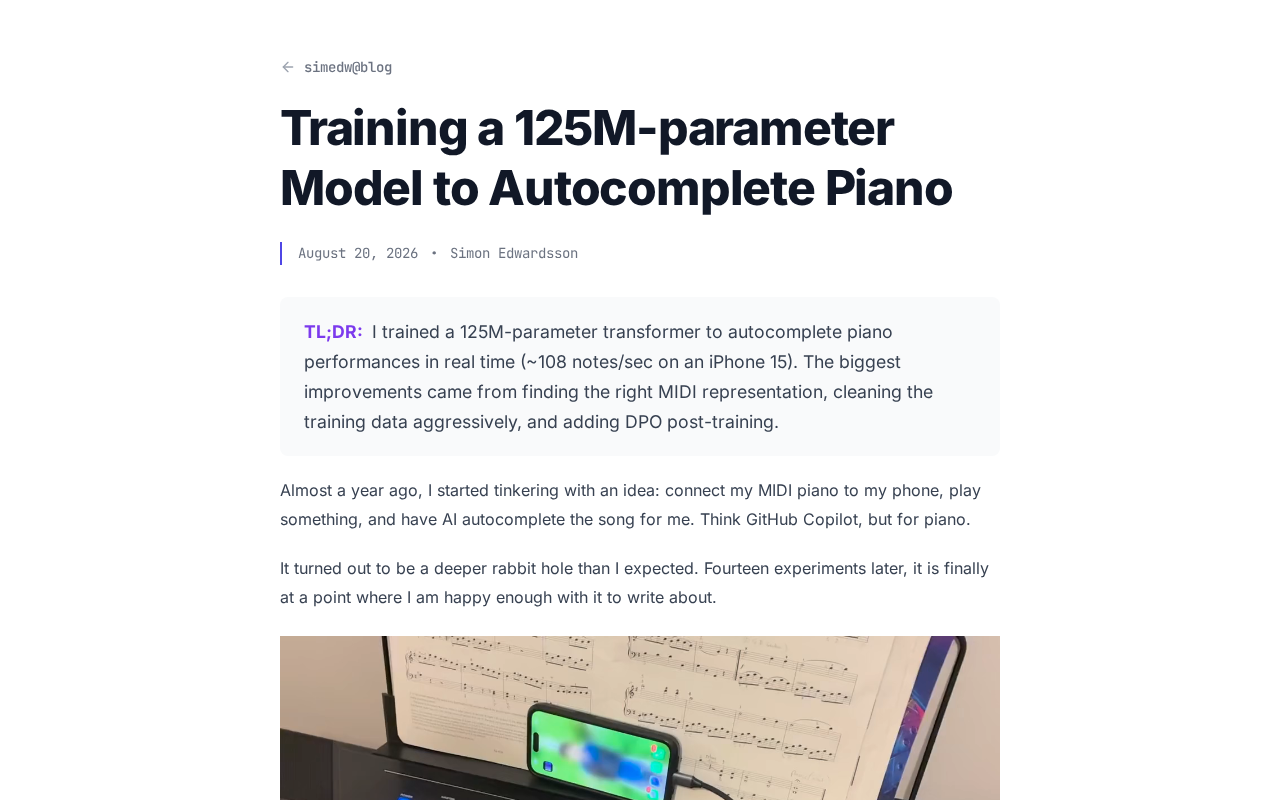
In an era where everyone is chasing hundred-billion-parameter large models, a developer shared a contrarian project on Hacker News: they trained a model with only 125 million parameters (125M) that can perform real-time "autocomplete" for piano performances locally on-device.
This Show HN post received 50 upvotes and 9 comments. While the engagement wasn't explosive, the approach it represents—using lightweight models to accomplish meaningful creative tasks on edge devices—deserves attention. It proves that not every interesting AI application needs to rely on the cloud and massive computing power.
What Is "Piano Autocomplete"
The concept of "autocomplete piano" is analogous to the autocomplete features we're familiar with when writing code or typing text. After a performer plays a few notes or a melodic phrase, the model predicts and generates subsequent musical passages. This is essentially a sequence prediction task—identical in principle to how language models predict the next token, except here the "tokens" are musical events like notes, durations, and dynamics.
From a technical perspective, piano performance can be encoded as MIDI-like symbolic sequences (pitch, onset time, duration, velocity, etc.). MIDI (Musical Instrument Digital Interface) is a digital music communication protocol established in 1983 that doesn't record sound waves themselves but rather performance actions: which key is pressed (pitch, 0-127), how hard it's pressed (velocity, 0-127), how long it's held, and when it's released. This symbolic representation makes music data naturally suited for sequence modeling. In the deep learning era, researchers typically encode MIDI events further into discrete token sequences. Common approaches include the Performance RNN encoding proposed by Google's Magenta team (which quantizes time into fixed steps) and the REMI representation (which introduces beat and bar position information). The choice of encoding scheme directly impacts whether the model can effectively learn music's hierarchical structure.
Once these events are serialized, Transformer architectures can process music just like text, learning melodic contours, harmonic progressions, and rhythmic patterns. Since Vaswani et al. proposed the Transformer architecture in "Attention Is All You Need" in 2017, it quickly expanded from NLP into the music domain. Google's Music Transformer in 2018 was the first to introduce Relative Positional Encoding to music generation, solving the problem of modeling repetitive structures in long sequences. OpenAI's MuseNet in 2019 demonstrated a multi-instrument, multi-style generation system. A common finding across these works is that self-attention mechanisms are particularly adept at capturing long-range structural dependencies in music—such as a phrase recurring 16 bars later. However, these early systems typically had massive parameter counts and couldn't run in real-time on consumer devices, which is precisely the bottleneck this project attempts to break through.
Why Choose the "Small" Size of 125M
In today's AI context, 125M parameters qualifies as "tiny." For comparison, GPT-2's smallest version happens to be exactly 124M parameters—featuring 12 Transformer layers, 768-dimensional hidden layers, and 12 attention heads. GPT-2 was released by OpenAI in 2019 in four scale variants: 124M, 355M, 774M, and 1.5B parameters. Although the 124M version was already considered capable of generating coherent text at the time, it seems insignificant compared to today's models with hundreds of billions of parameters. However, it's worth noting that GPT-2 124M can still perform excellently in specific domains (such as code completion and structured text generation) after fine-tuning. This tells us that when the task domain is sufficiently clear and the data distribution is sufficiently concentrated, the capacity requirements drop dramatically. For the relatively closed symbolic system of piano music, 125M parameters may already be sufficient to encode a wealth of harmonic rules and melodic patterns.
The developer deliberately chose this scale with the core objective of enabling on-device deployment.
Three Key Advantages of On-Device Execution
Compressing a model to run on local devices delivers significant practical value:
- Low Latency: Music continuation demands extremely high real-time performance. Any delay exceeding a hundred milliseconds disrupts the fluidity of performance. Music psychology research shows that the human perceptual threshold for rhythmic deviation is approximately 20-50 milliseconds—beyond this range, it's perceived as "off-beat." Even in the more relaxed scenario of accompaniment completion, delays exceeding 100 milliseconds seriously impact the performer's improvisational experience. With cloud inference, even if server response time is extremely fast, network round-trip time (RTT) alone is typically 30-100 milliseconds under ideal conditions. Adding model inference time and audio buffering, total latency easily exceeds 200 milliseconds. Local inference eliminates network round-trips, enabling near-instantaneous response—every millisecond of latency saved makes a perceptible difference in the musical context.
- Privacy Protection: Performance data never needs to be uploaded to any server; creative content remains entirely on the user's device.
- Offline Availability: No internet connection required, providing AI-assisted creative capabilities anytime, anywhere.
For music—a domain that emphasizes improvisation and real-time interaction—these three points are precisely the weaknesses that "large model + cloud" approaches struggle to address simultaneously. A model with 125M parameters can run smoothly within the computational capacity of modern laptops, tablets, and even smartphones.
The "Good Enough" Philosophy of Small Models: Bigger Isn't Always Better for Vertical Tasks
This project embodies an important engineering judgment: for specific vertical tasks, bigger models aren't necessarily better.
Piano continuation is a highly structured, clearly defined domain task. Music theory itself has rich internal patterns—modes, chord progressions, and rhythmic figures all contain learnable patterns. Compared to general-purpose language models that need to master all human knowledge, a model focused on musical symbol sequences can capture sufficient patterns with far fewer parameters.
The Critical Role of Data Quality and Music Representation
For models like this, training data quality and music representation often matter more than parameter count in determining final performance. Encoding piano performances as compact yet informationally complete event sequences, paired with appropriate tokenization schemes, enables small models to efficiently learn musical structure. This is a path validated by numerous symbolic music generation studies (such as Google's Music Transformer and OpenAI's MuseNet).
It's worth noting that on-device deployment often requires additional optimization techniques, such as quantization and knowledge distillation, to further reduce memory footprint and inference overhead, ensuring usability on resource-constrained devices. Specifically, quantization is the most common technique—compressing 32-bit floating-point parameters to 8-bit or even 4-bit integers can shrink model size by 4-8x while significantly accelerating inference. Knowledge distillation improves performance by having the small model mimic the output distribution of a larger model. At the deployment level, frameworks like ONNX Runtime, TensorFlow Lite, Apple Core ML, and GGML provide optimized inference engines for different hardware (CPU, GPU, NPU). Modern devices' neural processing units (such as Apple's Neural Engine and Qualcomm's Hexagon DSP) enable lightweight models to achieve millisecond-level inference at extremely low power consumption—critical for music applications that require sustained low-latency responses.
The Revival of Edge Intelligence and Specialized Small Models
From a broader perspective, this project reflects an important subplot in AI development: the revival of Edge AI and specialized small models.
While the entire industry is obsessed with scaling model size, more and more developers are realizing that many real-world scenarios don't need "universal super-intelligence" but rather fast, private, offline-capable, and cost-effective specialized capabilities. Scenarios like music creation assistance, code completion, and local document processing can all benefit from lightweight on-device models.
Edge AI isn't a niche experiment but a rapidly growing industry direction. According to market research firms, the global Edge AI market is projected to grow from approximately $15 billion in 2023 to over $60 billion by 2028. Factors driving this trend include data privacy regulations (such as GDPR and China's Personal Information Protection Law) requiring data localization, the demand for real-time responses in the 5G era, and chip manufacturers (Apple, Qualcomm, MediaTek, Intel) continuously integrating AI accelerators into consumer-grade chips. Apple Intelligence's on-device strategy, Google's Gemini Nano, and Samsung Galaxy AI all confirm major companies' commitment to on-device AI capabilities. In this context, a 125M-parameter music model isn't a technical compromise but rather aligns with the industry's evolution from pure cloud to cloud-edge collaboration.
For independent developers and creators, projects like this are quite inspiring:
- You don't need GPU clusters to train practical generative models;
- A clearly defined vertical task + carefully designed data representation is often more effective than blindly scaling parameters;
- On-device deployment is becoming an important direction for differentiated product experiences.
Conclusion
A 125M-parameter piano continuation model may not become an industry-changing blockbuster product, but it's an elegant technical demonstration—using a precisely right-sized model to solve a specific and beautiful problem. Amid the noise of the large model arms race, this kind of "small but beautiful" practice reminds us: AI's value lies not only in scale but in whether it can truly integrate into our everyday creative lives.
Related articles

Workbuddy for Absolute Beginners: How a Desktop AI Agent Fits Into Real Workflows
A beginner's guide to the Workbuddy desktop AI agent: installation, claiming credits, file management, and building automated workflows—compared with CodeX for fit and cost, helping professionals shift from AI question-askers to AI managers.

OpenAI's New Agent Stack: Computer Use, Decisions API, and Ultra-Fast Workflows
OpenAI Dev Day unveiled a new agent stack: Computer Use outperforms humans, Decisions API delivers ultra-low-latency classification via Luna, Agents API opens the same Computer Use capabilities, and GPT-6.1 Sol costs only one-seventh of Astra. Core updates, benchmark data, and developer insights.

Liang Wenfeng Open-Sources DeepInfo Inference Framework, Takes On U.S. Ban
DeepSeek open-sources its DeepInfo inference framework after its models, featuring GPU/CPU cross-pipelining, small-model prediction with large-model verification, and full Huawei Ascend and NVIDIA chip support—facing the U.S. federal ban head-on. This article analyzes its significance for AI deployment and open-source strategy.