One API: A Complete Guide to the Open-Source Gateway System for Unified Management of 30+ LLMs
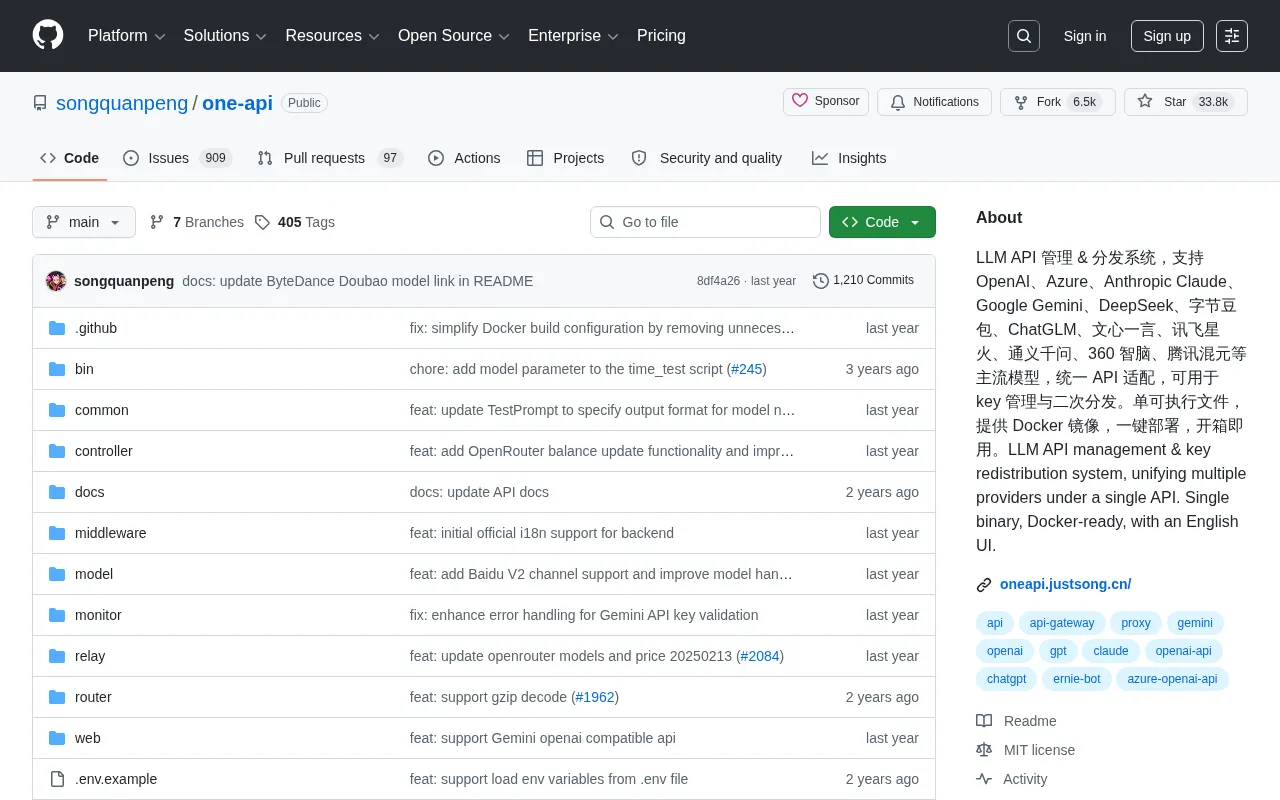
One API: An open-source gateway for unified management and distribution of multiple LLM provider APIs.
One API is a GitHub project with 32,000+ stars that adapts APIs from mainstream LLMs—including OpenAI, Claude, Gemini, and DeepSeek—into a unified OpenAI-compatible format, allowing downstream applications to call any model through a single interface. It offers API Key redistribution, quota management, load balancing, automatic failover, and one-click Docker deployment, making it ideal for enterprise AI platforms and multi-model management scenarios.
In today's era of flourishing large language models, developers often need to integrate with multiple LLM service providers simultaneously—OpenAI, Claude, Gemini, DeepSeek, Qwen... Each platform has different API formats, authentication methods, and billing logic. How can you efficiently manage all these API Keys while providing a unified interface to downstream services? One API, an open-source project with over 32,000 stars on GitHub, offers an elegant solution.
Project Overview: One Entry Point to All LLMs
One API is an LLM API management and distribution system created by developer songquanpeng. Its core philosophy is straightforward: adapt the APIs of all mainstream LLMs into an OpenAI-compatible format, enabling downstream applications to seamlessly switch between and call different model services through a single interface.
The "OpenAI-compatible format" here refers to OpenAI's Chat Completions API—an interface that has become the de facto standard for LLM invocation. Its request format transmits a messages array in JSON structure, containing role (system/user/assistant) and content fields, while responses return model-generated content in either streaming or non-streaming mode.
The streaming response mechanism uses the SSE (Server-Sent Events) protocol under the hood—a unidirectional real-time communication mechanism based on HTTP that allows servers to continuously push data streams to clients. In LLM scenarios, SSE enables model-generated text to appear token by token in a "typewriter effect" rather than waiting for the complete response before displaying it all at once. Compared to WebSocket, SSE is more lightweight, natively supports HTTP/2 multiplexing, and has built-in support for reconnection after disconnection. Each SSE data frame starts with a data: prefix, and in OpenAI's specification, each frame carries a JSON delta object, with a data: [DONE] signal sent when the stream ends. This design dramatically improves user experience and is the fundamental reason why virtually all mainstream LLM APIs now use SSE for streaming. Since OpenAI was the first company to commercialize LLM APIs at scale, nearly all popular development frameworks, SDKs, and frontend applications prioritize compatibility with this format. This means any middleware that can convert its own API into an OpenAI-compatible format immediately gains support from the entire ecosystem, without requiring downstream developers to make any changes. This is the underlying logic behind One API's adaptation layer design.
Currently, model providers supported by One API include but are not limited to:
- International mainstream: OpenAI (GPT series), Azure OpenAI, Anthropic Claude, Google Gemini
- Leading Chinese providers: DeepSeekAd, ByteDance Doubao, Baidu ERNIE Bot, Alibaba Qwen, iFlytek Spark, Zhipu ChatGLM, Tencent Hunyuan, 360 Zhinao
The project is written in JavaScript and has earned 32,851 stars and over 6,200 forks on GitHub, making it one of the most popular open-source solutions in the LLM API gateway space.
Core Feature Analysis
Unified API Adaptation Layer: One Interface to Call All LLMs
The most critical value of One API lies in its adaptation layer design. Regardless of which model provider is connected on the backend, the externally exposed interface always maintains OpenAI-compatible API format. This means any client, SDK, or application framework that supports the OpenAI API (such as LangChain, ChatGPT-Next-Web, etc.) can call any model behind One API simply by changing the API address and Key.
From an architectural perspective, One API essentially adopts the classic API Gateway design pattern. API Gateways were first widely adopted by companies like Netflix and Amazon in large-scale distributed systems. The core idea is to place a unified entry point between clients and backend services, handling cross-cutting concerns such as request routing, protocol conversion, authentication, rate limiting, circuit breaking, and logging. In the traditional web services domain, Kong, Nginx, and AWS API Gateway are typical representatives. One API transplants this mature architectural pattern to the LLM domain—the multiple model providers on the backend are equivalent to different microservices, and One API acts as the gateway to uniformly manage traffic distribution and protocol adaptation.
The benefits of this design are very practical—developers no longer need to write separate adapter code for each provider, nor worry about API format changes from one provider causing system-wide code modifications. The engineering complexity of multi-model integration is significantly reduced.
It's worth noting that LangChain is currently one of the most popular LLM application development frameworks, providing advanced abstractions such as Chains, Agents, and Retrieval-Augmented Generation (RAG). LangChain defaults to using OpenAI's API format as its base interface while also providing independent integration modules for Anthropic, Google, and other providers. However, in practice, frequently switching between different provider integration modules increases code complexity. With One API, developers only need to use LangChain's OpenAI integration module and modify base_url to point to the One API instance, transparently calling any backend model. Similarly, popular open-source projects like ChatGPT-Next-Web, LobeChat, and Dify all natively support custom OpenAI API endpoints, forming a natural ecosystem synergy with One API.
Key Management and Redistribution: Fine-Grained API Usage Control
One API provides a comprehensive API Key management mechanism that allows administrators to:
- Centrally manage original API Keys from multiple providers, preventing Keys from being scattered across different locations
- Generate redistribution Keys to allocate to team members or downstream users
- Set quotas and permissions to control the model scope and usage limits for each distributed Key
- Monitor usage with real-time tracking of each Key's invocation history and consumption data
Secure API Key management is one of the core concerns for enterprises using LLM services. Directly distributing original API Keys to developers poses serious security risks: Keys may be accidentally committed to Git repositories, leaked into logging systems, or taken by departing employees. One API's redistribution mechanism essentially implements a layer of proxy authentication—original Keys are stored only on the One API server side, while downstream users hold tokens generated by One API. These tokens can be revoked at any time, with configurable expiration times and usage quotas. This design draws from the token delegation model in OAuth 2.0, achieving fine-grained access control without exposing original credentials. Meanwhile, all requests passing through One API are logged, providing a complete data trail for post-hoc security auditing and cost tracing.
On the cost allocation front, One API also solves an easily overlooked technical challenge: different providers define and measure Tokens differently. OpenAI uses the tiktoken tokenizer, while Chinese-language models typically have different character-to-token conversion ratios (for example, one Chinese character equals approximately 0.6 tokens in the GPT series, while some Chinese models count characters directly). When recording usage, One API converts everything to standardized token counts and supports configurable billing multipliers per channel, making cross-provider cost comparison and allocation possible. For enterprise financial management that needs to apportion AI costs across business departments, this is an indispensable foundational capability.
This mechanism is particularly useful in enterprise AI capability sharing scenarios—the IT department centrally purchases API quotas from various model providers and distributes them to business teams through One API, ensuring both the security of original Keys and fine-grained cost control.
Minimalist Deployment: One Docker Command Gets It Done
On the deployment side, One API delivers truly out-of-the-box usability:
- Single executable: No complex dependency environment needed; download and run
- Docker image: Official Docker image available; deploy with a single command
- Web management interface: Built-in UI in Chinese and English, supporting visual configuration and management
Individual developers can start using it by launching a local instance; teams and enterprises can quickly set up highly available production environments through Docker Compose or Kubernetes.
Typical Use Cases
Scenario 1: Multi-Model Routing and Automatic Failover
When the same model is configured with multiple Keys or multiple providers, One API can automatically perform load balancing and failover. For example, when an OpenAI Key triggers a rate limit, the system automatically switches to an Azure OpenAI backup channel, ensuring uninterrupted service. For production environments with high availability requirements, this capability is critical.
From a technical implementation perspective, load balancing in LLM API scenarios faces some unique challenges: different providers have varying rate limit strategies. For instance, OpenAI applies dual limits of TPM (Tokens Per Minute) and RPM (Requests Per Minute), while some Chinese providers charge by QPS (Queries Per Second). One API achieves failover by maintaining a channel priority queue and health check mechanism—when a channel returns a 429 (rate limited) or 5xx (server error) status code, the system automatically marks that channel as temporarily unavailable and forwards subsequent requests to the next available channel.
This mechanism draws from the classic Circuit Breaker pattern in the microservices domain: under normal conditions, the circuit breaker is "closed" and requests pass through normally; when the error rate exceeds a threshold, the circuit breaker "opens" and subsequent requests fail fast or are rerouted, preventing cascading failures; after a cooling period, the circuit breaker enters a "half-open" state, allowing a small number of probe requests through to determine if the service has recovered. One API's channel health management system also continuously tracks response latency and estimated remaining quota for each provider channel, intelligently distributing traffic among multiple healthy channels by priority and weight, ensuring overall service continuity even when a single provider experiences issues.
Scenario 2: Core Component of Enterprise AI Platforms
Enterprises can use One API as the infrastructure for their internal AI capability platform. Various business systems call LLM capabilities through a unified OpenAI-compatible interface, while the IT department handles model selection, cost control, and security auditing through the admin dashboard, achieving centralized management of AI capabilities.
The AI platform is an emerging architectural concept in enterprise digital transformation, with the core goal of abstracting AI capabilities scattered across business lines into shared services, avoiding redundant development and resource waste. A typical enterprise AI platform usually comprises three layers: the underlying model service layer (responsible for model access and management), the middle capability orchestration layer (handling prompt engineering, RAG pipelines, and workflow orchestration), and the upper application access layer (providing standardized APIs and SDKs to business systems). One API perfectly fills the role of the model service layer, serving as the foundational infrastructure that connects upstream AI applications with downstream model providers.
Related articles
 Product Reviews
The Programmer's Desk Setup Guide: Building a Workspace That Feels Like Home
Discover how programmers build productive, comfortable workspaces. From multi-monitor setups to ergonomic design, explore the desk philosophy that drives focus and flow.
 Product Reviews
Qoder vs Cursor Real-World Comparison: Which $20/Month AI IDE Is Better?
Hands-on comparison of Qoder vs Cursor AI IDEs: Agent autonomy, human interaction count, and architecture decisions. Qoder needed only 2 interactions vs Cursor's 8.
 Product Reviews
Cursor Cloud Agent Demo: Eliminating Bottlenecks Across the Entire Software Development Lifecycle
Deep analysis of Cursor's Cloud Agent demo showing how cloud VMs, automated test artifacts, and a full-chain control plane systematically eliminate human bottlenecks across the software development lifecycle.