One API: Open-Source Gateway for Unified Management of 30+ LLM APIs, 30K+ GitHub Stars
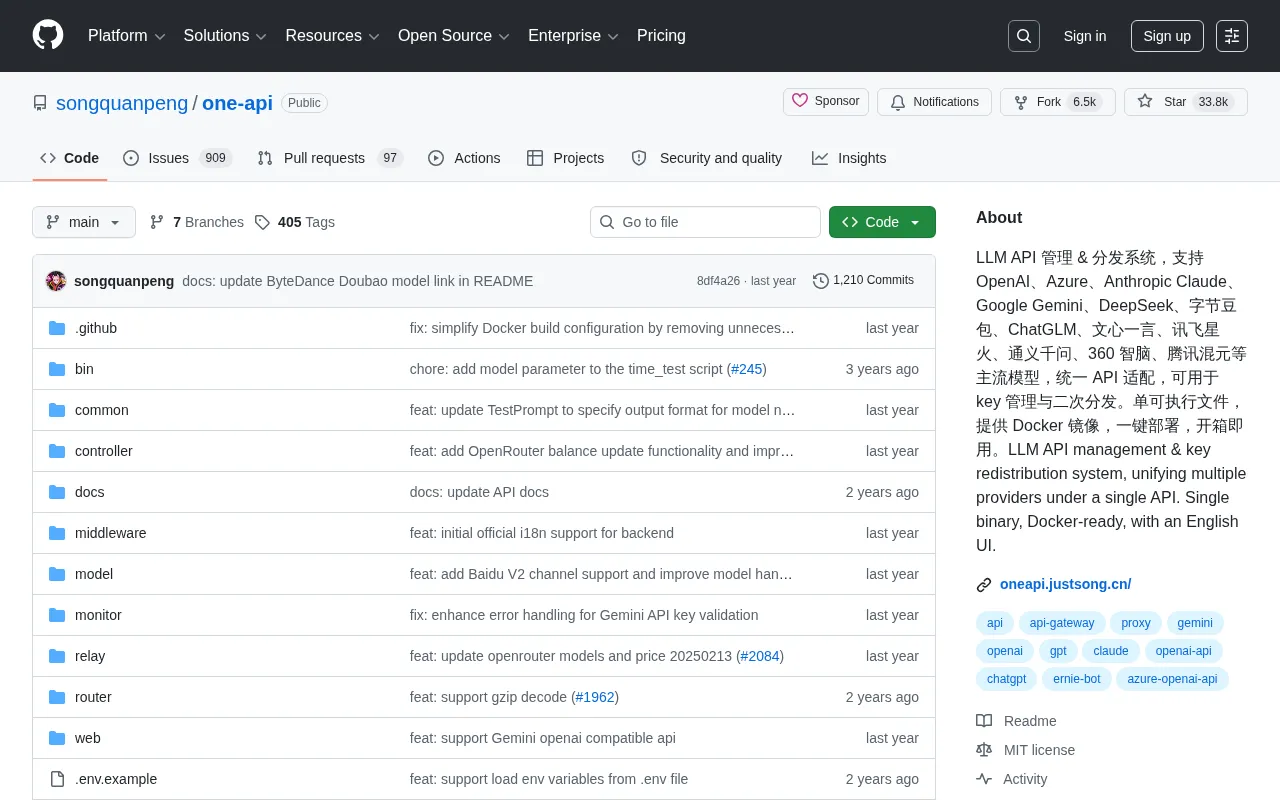
One API: An open-source distribution system for unified management of multiple LLM APIs
One API is an open-source project with over 32,800 GitHub Stars, designed to solve the pain points developers face when integrating multiple LLM providers (such as OpenAI, Claude, Gemini, DeepSeek, etc.) — including inconsistent API formats, varying authentication methods, and complex management — by providing a unified entry point for multi-model distribution.
In today's era of flourishing large language models, developers often face a thorny problem: different LLM providers have different API formats, different authentication methods, and different billing logic. When your project needs to integrate multiple models like OpenAI, Claude, Gemini, and DeepSeek simultaneously, managing all those API keys and adapting to different interfaces becomes a nightmare.
One API is an open-source project built to solve exactly this pain point. It has earned over 32,800 Stars on GitHub, making it one of the most popular open-source solutions in the LLM API management space.
What Is One API? Understanding Its Core Purpose in One Sentence
One API is an open-source LLM API management and distribution system. Its core philosophy is "unified entry point, multi-model distribution".
Related articles
 Product Reviews
The Programmer's Desk Setup Guide: Building a Workspace That Feels Like Home
Discover how programmers build productive, comfortable workspaces. From multi-monitor setups to ergonomic design, explore the desk philosophy that drives focus and flow.
 Product Reviews
Qoder vs Cursor Real-World Comparison: Which $20/Month AI IDE Is Better?
Hands-on comparison of Qoder vs Cursor AI IDEs: Agent autonomy, human interaction count, and architecture decisions. Qoder needed only 2 interactions vs Cursor's 8.
 Product Reviews
Cursor Cloud Agent Demo: Eliminating Bottlenecks Across the Entire Software Development Lifecycle
Deep analysis of Cursor's Cloud Agent demo showing how cloud VMs, automated test artifacts, and a full-chain control plane systematically eliminate human bottlenecks across the software development lifecycle.