One-Click ML Model Deployment: Is Going from Notebook to API Endpoint Actually Feasible?

Analyzing whether a CLI tool that turns Jupyter ML models into HTTPS API endpoints fills a real deployment gap.
A developer posted on Reddit asking whether anyone would use a single CLI command to turn a Jupyter Notebook ML model into an HTTPS API endpoint — no Docker, no cloud setup required. The post highlights a persistent engineering gap: MLflow focuses on lifecycle management, Streamlit targets demo UIs, and cloud platforms have steep learning curves, leaving "quick callable endpoint" as an unmet need. The tool's value lies in reducing friction for prototyping, teaching, and small teams, but concurrency, auth, and monitoring remain hard ceilings for any "one-click" promise.
A Real Question from the Developer Community
On Reddit, an early-stage developer posed a thought-provoking question: would anyone actually use a "one-click" approach to turn a machine learning model in a Jupyter Notebook directly into an HTTPS API endpoint?
The developer is building a CLI tool with a straightforward premise — run a single command inside a Notebook, and you get a working model API endpoint, no Docker configuration, no cloud setup required. They openly admitted to being in the early validation stage, trying to figure out whether this solves a real problem or is just a pseudo-need that's already been addressed.
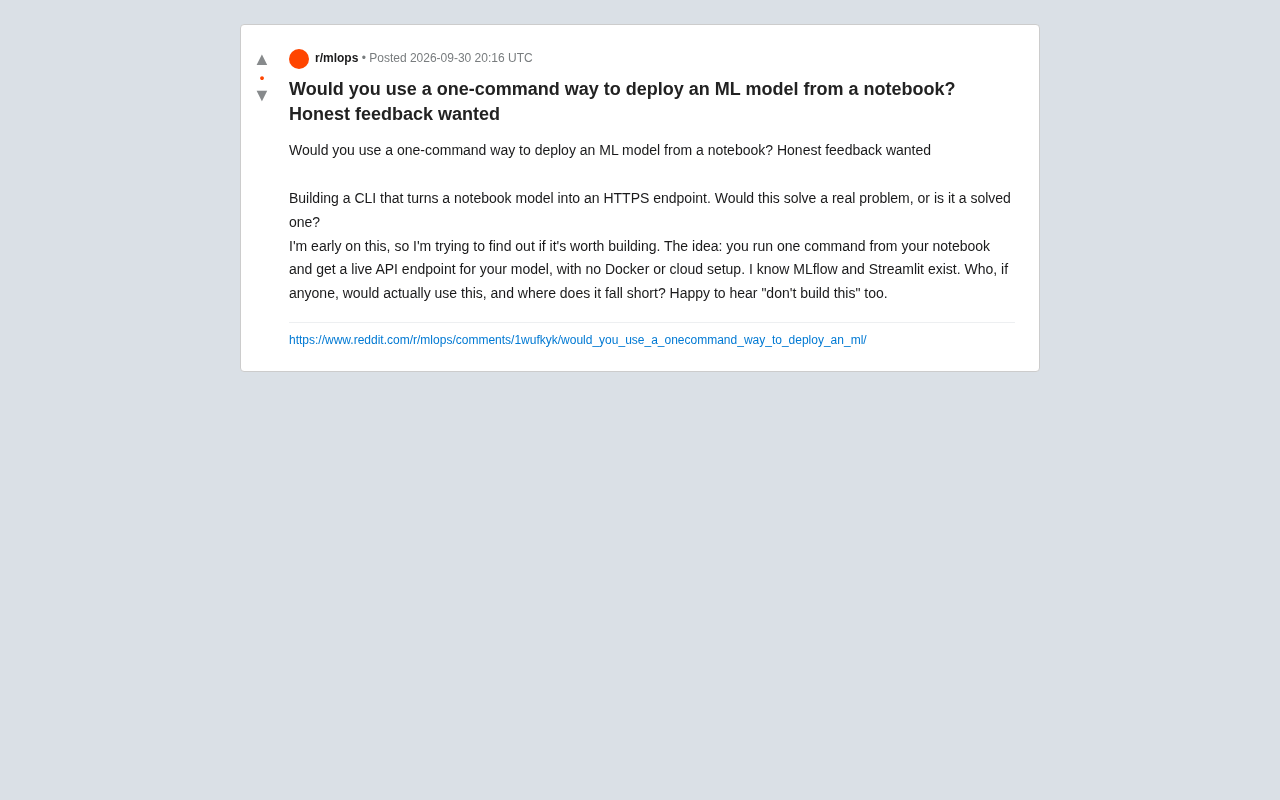
They even proactively mentioned existing solutions like MLflow and Streamlit, and sincerely noted: "Even if you tell me 'don't build this,' I'm happy to hear it." This pragmatic attitude cuts right to a persistent pain point in the ML engineering space.
Why Is Model Deployment Still So Difficult?
For many data scientists and ML researchers, training a model and deploying one are two completely separate worlds. The former can be accomplished with a few lines of code in a Notebook; the latter often requires clearing a steep engineering hurdle.
The Barriers of Existing Solutions
The typical path from Notebook to production generally involves: serializing the model, writing API service code (e.g., FastAPI or Flask), building a Docker image, configuring cloud services, and setting up networking and authentication. Any one of these steps can stop a researcher who isn't familiar with DevOps cold.
Even mature tools each have their own focus:
- MLflow excels at full model lifecycle management and tracking, but actually exposing a production-grade endpoint still requires additional deployment configuration.
- Streamlit is geared toward quickly building interactive demo apps — essentially a UI for humans to view, not an API for programs to call.
- Managed cloud services (like SageMaker or Vertex AI) are powerful, but the learning curve and cost are not friendly to individual developers.
In other words, the seemingly simple need to "train a model and immediately get a callable API" still has gaps in practice.
FastAPI and Flask are the two most common API frameworks in the Python ecosystem. Flask has a longer history and a minimalist style, well-suited for quickly spinning up lightweight services. FastAPI leverages Python type annotations to auto-generate documentation and natively supports async processing, making it more performant for ML inference service scenarios. Both require developers to manually write routing logic, serialization/deserialization code, and handle authentication middleware — which represents a significant mental context switch for data scientists accustomed to writing exploratory code in Notebooks.
Docker is the de facto standard containerization tool for engineering deployments. By packaging an application and its dependencies into an image, it solves the "works on my machine" environment consistency problem. But for researchers without an engineering background, understanding image layers, writing Dockerfiles, and managing image registries creates additional learning overhead — and is one of the most common sticking points on the path from Notebook to production.
The Value and Limits of "One-Click Deployment"
The real appeal of this idea lies in reducing friction. For prototype validation, internal tools, and educational demos, developers often just want to quickly get an endpoint that a frontend or teammate can call — without learning an entire cloud infrastructure stack to do it.
Who Is Most Likely to Use It
- Independent developers and small teams who need to quickly share a model with collaborators for testing
- Data science education contexts, helping students intuitively grasp the concept of "model as a service"
- Hackathons or rapid MVP validation, where time is tight and production-grade stability isn't the goal
Where It Might Break Down
The real challenges often emerge after the "one click." Production environments demand concurrent request handling, version management, monitoring and alerting, security authentication, and cost control — exactly the complexity that tools need to abstract away but can never fully hide. Once a user's needs go beyond demo-level, the promise of "zero configuration" will hit a ceiling.
Security is also impossible to ignore: exposing a Notebook model as a public HTTPS endpoint with one click raises immediate questions about authentication, rate limiting, and data privacy. How these are handled directly determines whether the tool can graduate from "toy" to "actually usable."
"Concurrent request handling" is one of the most significant dividing lines between production environments and demo environments. Inference code in a Notebook is typically executed in a single-threaded, single-request fashion, while a real API endpoint may face dozens or even hundreds of simultaneous requests. Without configuring async processing, request queuing, or multi-process/multi-replica mechanisms, the service will time out or crash under even moderate load. These issues almost never surface during local testing — they only blow up when real traffic hits. This is the fundamental reason why a "one-click deployment" tool that lacks underlying concurrency design will struggle to break through the demo ceiling.
Takeaways for Developers
This Reddit post itself actually provides an excellent product validation example. Before diving into large-scale development, posing questions to your target user group and honestly seeking feedback reduces the cost of failure far more than building in isolation.
For similar tool ideas, the key question in deciding whether it's worth building isn't "do existing solutions already exist?" — it's whether you can meaningfully improve the experience in a specific, concrete scenario. The existence of MLflow and Streamlit doesn't mean this niche need is perfectly met. On the contrary, their respective positioning gaps are exactly where a new tool finds its opportunity.
If this CLI can compress the time from "experiment to callable endpoint" from hours to seconds, while offering a reasonable incremental path toward security and scalability, it could genuinely fill a real gap. But if it's just another lightweight wrapper with overlapping functionality, the community voices saying "don't build this" are worth taking seriously.
Related articles

ChatGPT Space Launches: Team Collaboration and New Pages Features Explained
ChatGPT Space is OpenAI's new team collaboration feature with Pages, real-time collaboration, and Slack/Google Drive sync. We break down its privacy design, multi-platform integration, and the full workflow from conversation to document.

Migrating Apache Spark UDFs to GPU Acceleration with AI Agents
NVIDIA developer blog explains how AI Agents rewrite Apache Spark UDFs for GPU acceleration, covering migration criteria, agent rewriting and verification workflows, plus pitfalls like result consistency and CPU-GPU transfer overhead.

Zed Editor v0.40.4-rc2 Released: Usage Credits Now Available Without Upgrading
Zed editor releases v0.40.4-rc2, allowing users to use usage credits for AI features without upgrading to a paid plan, lowering the trial barrier.