One Coding Prompt Burned 70% of My Quota? An AI Coding Assistant Flash Model Disaster
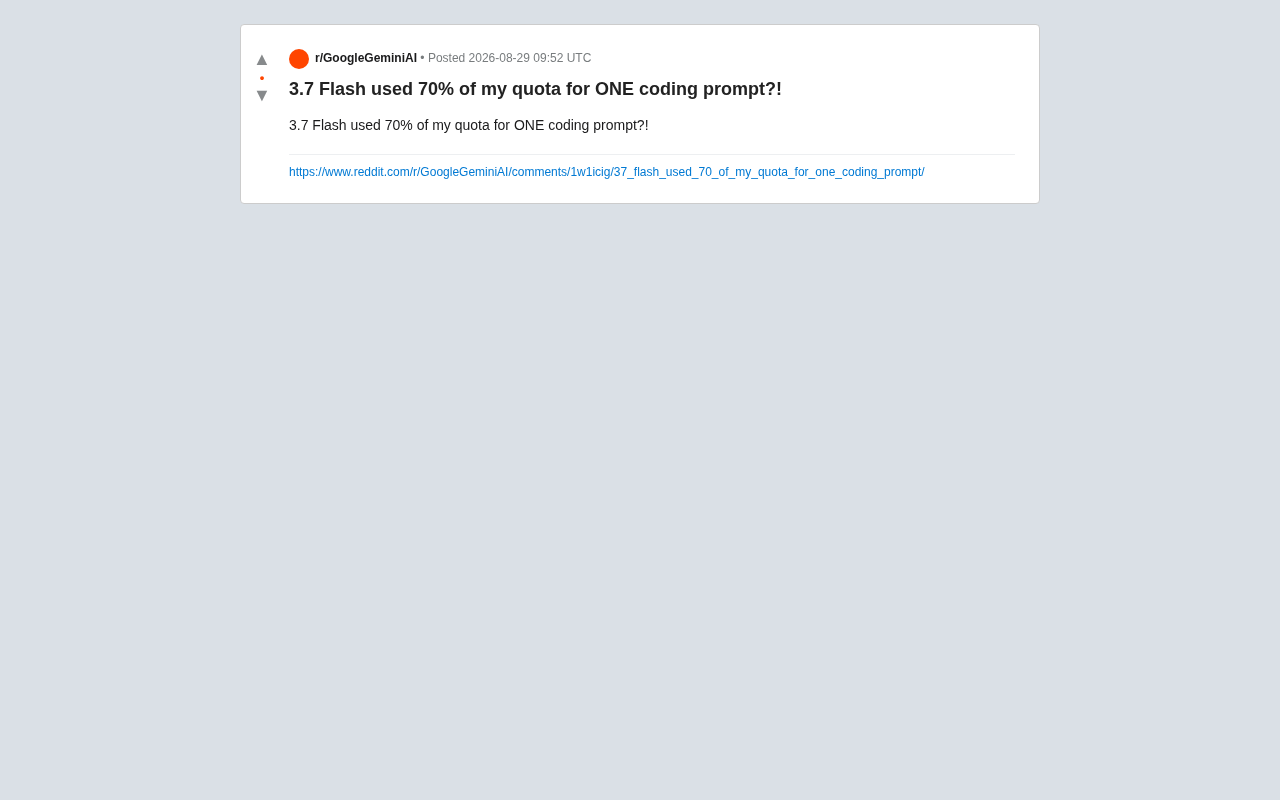
One AI coding prompt consumed 70% of a developer's quota — here's why and how to avoid it.
A developer discovered that a single prompt to an AI coding assistant's Flash model consumed 70% of their quota. This article examines the root causes — including hidden context window inflation, costly output tokens, reasoning chain overhead, and misleading "Flash" naming — and provides practical strategies like managing context size, understanding billing rules, and using tiered local-plus-cloud model approaches to control AI coding costs.
One Request Wipes Out 70% of Your Quota: A Developer's Real Frustration
Recently, a developer took to Reddit to vent about their experience with an AI coding assistant (the "3.7 Flash" model mentioned in the post). After submitting just one coding prompt, they had consumed 70% of their quota. This number shocked many fellow developers who rely on AI-assisted programming — after all, most people assume a single code completion or Q&A request should use only a tiny fraction of resources.
The post quickly sparked heated community discussion. On the surface, it might seem like an isolated "billing horror story," but a deeper analysis reveals that it reflects widespread pain points in today's AI coding tools around billing transparency, context management, and model behavior. This article breaks down the possible causes behind this phenomenon and offers practical advice for developers to avoid similar pitfalls.
Why Would a Single Request Consume So Much Quota?
The Hidden Cost of Context Windows
Modern large language models are typically billed based on token count, and tokens include not just your input prompt but the entire context the model "sees." It's worth first understanding what tokens are: they're the basic units LLMs use to process text, and they don't simply correspond to individual words or characters. In English, one token roughly equals 4 characters or 0.75 words; in Chinese, a single character is typically encoded as 1–2 tokens. The tokenizer used by the model (such as BPE, SentencePiece, etc.) splits input text into a token sequence, and different models may use different tokenization strategies, resulting in varying token counts for the same text. Current mainstream API pricing typically distinguishes between input tokens and output tokens, and output tokens are often priced 2–4x higher than input tokens — a key reason why generating long responses significantly drives up costs.
In coding scenarios, AI assistants often automatically bundle the following content and send it to the model:
- The complete code file currently open
- Related dependency files or referenced modules
- Previous conversation history
- Partial project structure information
Modern AI coding assistants (such as GitHub Copilot, Cursor, Windsurf, etc.) don't just send the single line of instruction the user typed. They typically employ RAG (Retrieval-Augmented Generation) or similar mechanisms to automatically retrieve relevant code snippets, type definitions, function signatures, and other information from the project, assembling them into a complete prompt. This process is called "Context Injection." For example, Cursor analyzes the import relationships in the current file and automatically pulls key code from referenced modules; some tools also inject the project's directory structure, README, configuration files, and more. These automatic behaviors are nearly invisible to users but can inflate the actual token count from the few dozen the user perceives to tens of thousands or even over a hundred thousand.
This means that even if you only typed "help me fix this bug," the actual tokens sent to the model could number in the tens of thousands.
It's worth noting that the context window — the maximum number of tokens a model can process in a single inference — has experienced explosive growth in recent years. Early GPT-3.5 had a context window of just 4K tokens, while today's frontier models have expanded to 128K or even 1 million tokens. The larger the window, the more information the model can "see," but computational costs grow super-linearly — the self-attention mechanism in the Transformer architecture makes computational complexity proportional to the square of the sequence length (O(n²)). Although optimization techniques like FlashAttention have reduced actual overhead, resource consumption for long-context inference remains far higher than short-context scenarios. If a Flash model bills based on a large context window, a seemingly simple request could devour a massive chunk of quota.
The Compounding Cost of Long Outputs and Reasoning Chains
Beyond input tokens, output tokens also count toward billing. When a model is asked to generate large blocks of code, complete refactoring plans, or even detailed explanations with reasoning steps, the output length can balloon dramatically.
Some next-generation models also incorporate Chain-of-Thought (CoT) mechanisms, performing extensive internal reasoning before returning an answer. The token consumption from this reasoning is also counted. Chain-of-Thought was originally proposed by Google in 2022 and has since evolved into more complex variants like Tree-of-Thought and the internal reasoning mechanisms in OpenAI's o1 series. In coding scenarios, CoT can significantly improve a model's ability to handle complex logic, but the trade-off is that the model generates large amounts of intermediate reasoning steps in its output (or in hidden reasoning processes). Some models' "thinking tokens" aren't directly shown to users but still count toward consumption. For example, a coding problem that requires 5,000 tokens to answer could actually consume 20,000–50,000 output tokens once the reasoning chain is included.
For a complex programming task, it's not uncommon for the total input plus output token count to exceed the hundred-thousand level.
The Cognitive Trap of the "Flash" Naming
Many models labeled as "Flash" or "Lite" are automatically assumed by users to be "lighter, cheaper, and more quota-efficient" versions. However, the psychological expectations created by this naming can diverge enormously from actual billing.
From an industry perspective, "Flash" and "Lite" typically refer to lighter versions of the same model family that have been distilled, pruned, or quantized. Take the Google Gemini series as an example: Gemini 1.5 Flash offers faster inference and a lower per-token price compared to the Pro version, but with capability trade-offs. However, "cheaper per-token pricing" doesn't equal "lower total cost" — if a Flash model supports the same large context window as Pro (e.g., 1 million tokens) and the user happens to send an extremely long context, a low unit price multiplied by a massive token count still produces a hefty bill. A similar cognitive mismatch appears in cloud computing: cheap on-demand instances that run continuously can end up costing far more than reserved instances.
The reason users feel like they've been burned largely comes down to a failure of expectation management:
- The naming implies low cost, but context inflation actually drives high consumption
- The quota deduction mechanism isn't transparent enough for users to estimate costs before submitting
- There's no real-time token consumption feedback, and by the time users notice, their quota is nearly depleted
This "black-box billing" experience is currently the most common source of user frustration with AI coding tools.
Practical Strategies for Developers to Control AI Coding Costs
Proactively Manage Context Size
The most effective approach is to control the size of the context sent to the model. When using coding assistants that support file-level context, consider:
- Select only relevant code snippets rather than entire files
- Regularly clear conversation history to avoid repeated billing for historical records
- Manually specify which files to reference for large projects instead of letting the tool auto-load everything
Many AI coding assistants offer fine-grained context management controls. For example, in Cursor you can use @file or @folder syntax to precisely specify the reference scope rather than letting the tool automatically index the entire codebase. Making good use of these features can dramatically reduce token consumption while maintaining answer quality.
Carefully Study Billing Rules and Usage Dashboards
Before fully relying on any AI coding tool, it's advisable to carefully read its billing documentation to understand whether charges are based on request count, token volume, or subscription quota deductions. Also, take advantage of the platform's usage monitoring dashboard to catch abnormal consumption early and avoid the embarrassment of discovering your quota is depleted only at the end of the month.
Pay particular attention to these details: whether input and output tokens are priced separately, whether thinking-chain tokens count toward consumption, whether there are discounts for context caching (prompt caching), and whether quota is shared across different model versions. These seemingly trivial rules are often the key variables that determine actual costs.
Use Models Tiered by Task Complexity
For simple tasks like code completion and formatting adjustments, choose genuinely lightweight models or local solutions; reserve high-consumption powerful models only for complex architecture design and large-scale refactoring. Matching tasks to appropriate models can significantly reduce overall usage costs.
On the local solution front, using tools like Ollama and LM Studio, developers can run coding-optimized open-source models like CodeLlama, DeepSeek-Coder, and StarCoder2 locally. These models run on local hardware with no token billing concerns, and data never leaves the machine, addressing privacy and security needs. Combined with VS Code plugins (such as Continue), you can achieve an IDE-integrated experience similar to commercial AI coding assistants. While local models can't match frontier closed-source models for complex architecture-level tasks, they're more than sufficient for daily lightweight assistance. A tiered strategy of "local models for daily tasks + cloud-based powerful models for hard problems" is currently the most cost-effective approach.
Conclusion: Billing Transparency Is a Must-Answer Question for AI Coding Tools
This developer's experience of "burning 70% of quota with a single prompt" may have been a personal complaint, but it precisely hits on a systemic issue across the AI coding tools industry. As more and more developers incorporate AI assistants into their daily workflows, billing transparency, consumption predictability, and consistency between naming and actual performance will become critical factors determining product reputation.
For vendors, providing clear real-time usage indicators and sensible context management strategies wins far more user trust than an enticing "Flash" label. Going further, the industry may need to establish standardized mechanisms similar to cloud computing's "billing alerts" — giving users clear cost estimates before they're about to send high-cost requests, rather than letting them discover after the fact that their quota has been consumed. For developers, understanding the underlying logic of token-based billing, proactively managing context size, and establishing tiered usage strategies are the fundamental ways to avoid "billing horror stories."
Related articles

Test-Time Ablation: A Plug-and-Play Method for Improving the Faithfulness of LLM Explanations
A test-time method that improves LLM explanation faithfulness by removing unmentioned concepts from inputs — no model retraining needed, ideal for high-stakes AI decisions.

The VERGE Framework: Verification-Enhanced AI for Precise Symptom Extraction from Clinical Notes
VERGE is a verification-enhanced agentic workflow using RAG and bounded verification loops to extract red-flag symptoms from clinical notes, achieving 0.849 precision with only 1.5% requiring human review.

HarvestBench: The First Benchmark to Quantify AI's Willingness to Avoid Harming Animals
HarvestBench is the first benchmark quantifying AI side-effect avoidance as real cost. Testing 9 LLMs in farm simulations reveals kill rates from 0.4% to 98.8%, with moral behavior highly dependent on briefing instructions.