The VERGE Framework: Verification-Enhanced AI for Precise Symptom Extraction from Clinical Notes
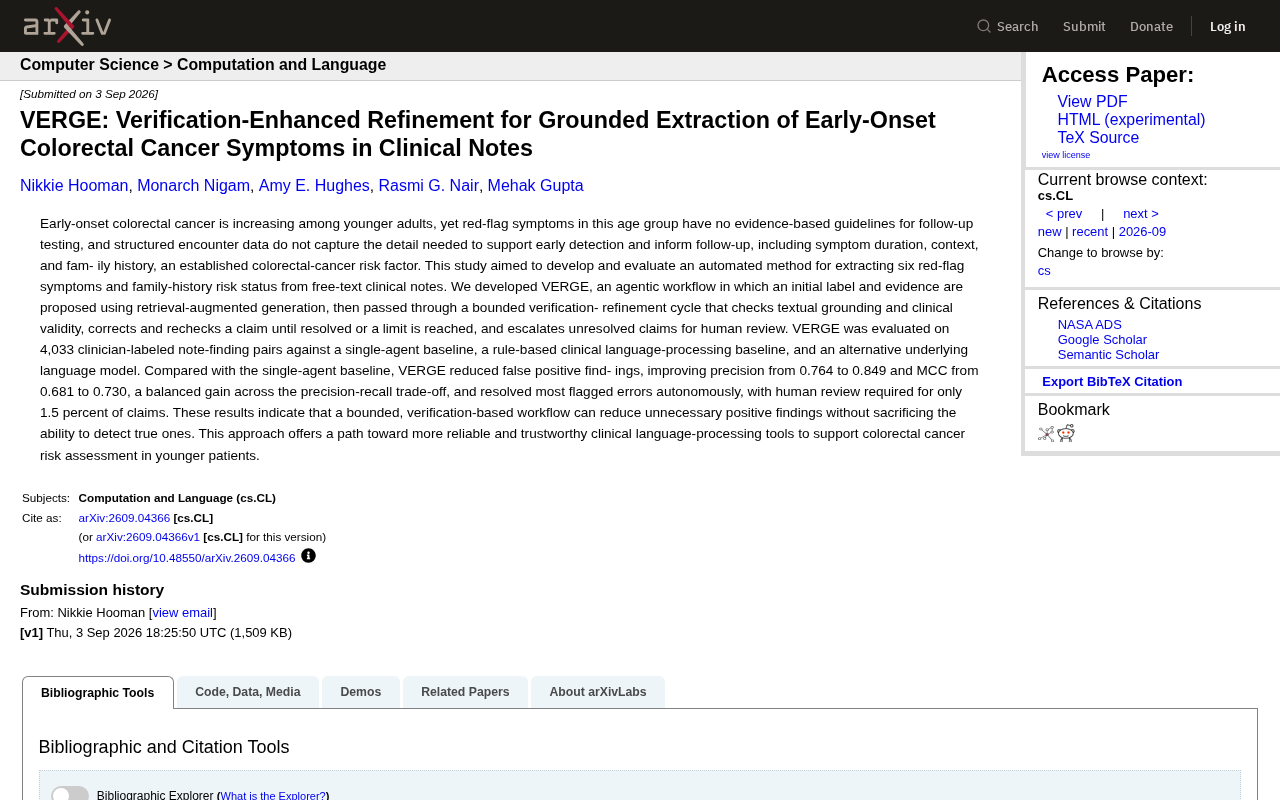
VERGE uses verification-enhanced AI to accurately extract cancer risk symptoms from clinical notes.
VERGE (Verification-Enhanced Refinement for Grounded Extraction) is an agentic workflow that combines retrieval-augmented generation with bounded verification-refinement loops to extract red-flag symptoms and family history from unstructured clinical notes for early-onset colorectal cancer risk assessment. Tested on 4,033 clinician-annotated pairs, it raised precision to 0.849 and MCC to 0.730, with only 1.5% of assertions requiring human review.
Early-Onset Colorectal Cancer: The Young Population Overlooked by Clinical Data
Colorectal cancer is increasingly striking younger adults — a trend that has drawn significant attention from the medical community. Early-Onset Colorectal Cancer (EOCRC) typically refers to colorectal cancer diagnosed in individuals under age 50. Over the past several decades, epidemiological studies worldwide have consistently shown that while colorectal cancer incidence in people over 50 has steadily declined thanks to widespread screening, rates among those under 50 have been rising markedly. Data from the American Cancer Society indicate that since the mid-1990s, colorectal cancer incidence in the 20–49 age group has increased by approximately 1–2% per year. This trend prompted the U.S. Preventive Services Task Force (USPSTF) to lower the recommended screening starting age from 50 to 45 in 2021. However, many early-onset cases occur in individuals under 45 — still outside the scope of routine screening — meaning patients are often diagnosed only after symptoms appear, frequently at more advanced stages.
Yet for this age group, there is still no evidence-based follow-up testing guideline for "red-flag symptoms." These red-flag symptoms for colorectal cancer include rectal bleeding, changes in bowel habits (such as persistent diarrhea or constipation), abdominal pain, unexplained weight loss, anemia, and abdominal masses. In younger patients, these symptoms are often misdiagnosed as benign conditions like irritable bowel syndrome (IBS) or hemorrhoids, leading to diagnostic delays. Making matters worse, structured encounter data in hospital systems frequently fail to capture the critical details needed to support early detection.
These critical details include symptom duration, the specific context in which symptoms occur, and family history — the latter being a well-established risk factor for colorectal cancer. Data in clinical records systems generally falls into two categories: structured data (such as ICD-10 diagnostic codes, lab values, medication records, etc., stored in standardized fields) and unstructured data (such as clinic notes, admission records, and operative reports written as free text by physicians). It is estimated that approximately 80% of clinical information in electronic health records (EHRs) exists as unstructured text. Traditional data analytics and clinical decision support systems rely primarily on structured data, leaving a wealth of clinical detail embedded in free text — such as the specific language patients use to describe symptoms, the number of days symptoms have persisted, or the exact age at which a family member was diagnosed with cancer — largely untapped for systematic use. It is against this backdrop that a recent study published on arXiv proposed an automated extraction method called VERGE, designed to precisely extract six red-flag symptoms and family history risk status from unstructured clinical notes.
VERGE's Core Mechanism: A Verification-Enhanced Agentic Workflow
From Single-Pass Extraction to a "Propose-Verify-Refine" Loop
VERGE stands for Verification-Enhanced Refinement for Grounded Extraction. At its core, it is an agentic workflow rather than a single, one-shot call to a large language model. This design philosophy represents an important direction for AI applications in high-stakes professional domains.
Agentic workflows are an architectural paradigm that has emerged in recent years for large language model applications. Unlike the traditional "single input, single output" call pattern, agentic workflows decompose complex tasks into multiple steps, each executed by one or more AI agents. These agents can collaborate, review each other's outputs, and dynamically adjust subsequent actions based on intermediate results. This approach borrows from the multi-stage pipeline concept in software engineering, giving AI systems stronger autonomous planning and self-correction capabilities.
The workflow can be broken down into several key stages: First, the system uses Retrieval-Augmented Generation (RAG) technology to propose initial labels and supporting evidence for each symptom. RAG is a technical framework that combines information retrieval with text generation: before generating a response, the system retrieves the most relevant passages from an external knowledge base or document collection, then provides this retrieved content as context to the large language model, enabling it to produce more grounded output with less "fabrication." In VERGE, RAG ensures that when the model labels each symptom, it can point to specific passages in the clinical notes as evidence, rather than relying solely on parametric knowledge for inference. These preliminary conclusions are then fed into a bounded verification-refinement cycle.
How the Verification Loop Ensures Reliable Clinical Extraction
This verification loop is the core differentiator between VERGE and ordinary extraction tools. The loop employs a "bounded" design, meaning the number of iterations has a preset upper limit, preventing the system from falling into an infinite self-checking loop — reflecting a dual commitment to robustness and efficiency in engineering practice.
In each iteration, the loop checks two things: First, textual grounding — whether the model's conclusions are genuinely supported by the source text. This is akin to requiring students to "cite their sources" on an exam, effectively curbing the hallucination tendencies of large language models. Second, clinical validity — whether the conclusions are medically logical, such as whether a symptom's timeline is plausible or whether a particular combination of symptoms could clinically coexist. This dual verification mechanism ensures that the system gates output quality not only at the linguistic level but also at the professional knowledge level.
When a problematic assertion is identified, the Refiner automatically generates a correction and resubmits it for verification, repeating this process until the issue is resolved or the preset iteration limit is reached. For contentious assertions that remain unresolved after the loop concludes, the system escalates them to human review. This mechanism of "AI-led autonomous processing with human backup" ensures both efficiency and the safety baseline that medical scenarios demand.
Experimental Results: Dual Improvements in Precision and Efficiency
Rigorous Comparison Against Multiple Baselines
The research team evaluated VERGE on 4,033 clinician-annotated "note-finding" pairs. To comprehensively validate its effectiveness, the experimental setup included three comparison groups: a single-agent baseline, a rule-based clinical language processing baseline, and alternative approaches using different underlying language models.
This multi-dimensional comparison design makes the results more convincing — it demonstrates VERGE's advantages not only over simple AI methods but also validates its improvement over traditional rule-based systems.
Significant Improvements in Key Performance Metrics
The experimental data showed compelling results. Compared to the single-agent baseline, VERGE effectively reduced false positive findings:
- Precision improved from 0.764 to 0.849
- Matthews Correlation Coefficient (MCC) improved from 0.681 to 0.730
The Matthews Correlation Coefficient (MCC) is a comprehensive metric particularly well-suited for evaluating binary or multi-class classification tasks, with values ranging from -1 to +1. An MCC of +1 indicates perfect prediction, MCC of 0 indicates prediction performance equivalent to random guessing, and MCC of -1 indicates completely inverse prediction. Compared to precision, recall, and F1 score, a key advantage of MCC is that it simultaneously considers all four confusion matrix elements — true positives, true negatives, false positives, and false negatives — and therefore exhibits better evaluation stability on imbalanced datasets (a common scenario in clinical settings, since most patients do not carry any given red-flag signal). VERGE's MCC improvement from 0.681 to 0.730 indicates that the system's overall judgment capability improved substantively across all classification dimensions, rather than shifting in just one direction. This means VERGE achieved a synergistic optimization of both precision and recall, rather than trading one for the other.
Even more noteworthy is the efficiency metric: VERGE autonomously resolved the vast majority of flagged errors, with only 1.5% of assertions requiring human review. For healthcare institutions, this percentage means clinicians can focus their efforts on the truly challenging minority of cases rather than being exhausted by processing massive volumes of automated output.
Deep Dive: Why Verification Mechanisms Are Critical for Medical AI
The Trustworthiness Challenge of LLMs in High-Stakes Scenarios
The significance of VERGE extends far beyond this specific colorectal cancer application. It actually addresses a core pain point in current AI deployment: in high-stakes domains like healthcare and law, hallucinations and unreliable outputs from large language models are unacceptable.
LLM "hallucination" refers to the model generating content that appears fluent and logically coherent but is factually incorrect or lacks supporting evidence. In general conversational settings, hallucinations may be merely a minor nuisance; but in healthcare, a fabricated symptom record or invented family history could directly influence clinical decisions, leading to misdiagnosis or missed diagnoses. Current academic strategies for combating hallucinations include: prompt engineering (instructing the model to "answer only based on the given text"), RAG (providing external evidence to constrain generation), post-hoc verification (using independent modules to check the factuality of outputs), and uncertainty quantification (having the model express confidence levels in its own outputs).
Traditional approaches either rely on brittle rule-based systems (which struggle with the complexity of natural language) or directly trust a single-pass LLM output (with no reliability guarantees). VERGE's "bounded verification" paradigm offers a third path: by having AI check its own work and requiring every conclusion to have explicit textual evidence, it systematically reduces error rates. By combining RAG with multi-round verification and establishing a human escalation mechanism, VERGE effectively integrates multiple anti-hallucination strategies into a layered defense system. This design philosophy is becoming a best-practice direction in medical AI, because no single technique can completely eliminate hallucinations — only systematic, multi-layered safeguards can reduce risk to clinically acceptable levels.
The Clinical Value of Reducing False Positives in Cancer Screening
In cancer risk assessment, false positives are no trivial matter. In the context of cancer screening and risk assessment, a false positive refers to incorrectly flagging a condition or symptom as present when it actually is not. The clinical consequences of false positives are multifaceted: First, they may trigger unnecessary invasive procedures such as colonoscopy, which, while generally safe, still carries rare but serious complication risks such as perforation. Second, false alarms impose significant psychological burden on patients, including anxiety, insomnia, and decreased quality of life. Third, from a health economics perspective, large numbers of false positives consume limited healthcare resources (endoscopy suite time, specialist appointment slots, etc.), crowding out opportunities for patients who genuinely need examination. In population-level screening programs, even a few percentage points of reduction in the false positive rate can yield enormous cumulative societal benefits. VERGE's improvement in precision from 0.764 to 0.849 — without compromising true positive detection capability — directly addresses a real need in clinical practice.
Conclusion: Toward Trustworthy Clinical NLP Tools
VERGE's research demonstrates that a bounded, verification-based agentic workflow can reduce unnecessary positive findings while maintaining detection capability for genuine cases. This provides a practical and viable path toward building more reliable and trustworthy clinical natural language processing tools, particularly in the area of colorectal cancer risk assessment for younger patients — a field in urgent need of improvement.
As early-onset colorectal cancer incidence continues to rise, tools capable of automatically and accurately identifying risk signals from massive volumes of clinical notes will play an increasingly important role in early screening and intervention. The "verification-enhanced" approach demonstrated by VERGE may well become an important reference paradigm for applying AI across a broader range of medical scenarios.
Related articles

RawY2K: A Chrome Retro Theme Extension That Sends Any Webpage Back to the 90s with One Click
RawY2K is a Chrome extension that transforms any modern webpage into 90s Windows 98 and GeoCities retro style. Explore its features, the Y2K aesthetic revival, and product analysis.
Claude's Default Behavior of Appending Session Links to Git Commits Sparks Controversy
Claude AI appends Session URLs to Git commits and PRs by default, sparking developer debate over privacy, commit history pollution, and the power of defaults.
ASR Hallucination Explained: Why Speech Recognition Produces False Outputs
Dissecting the hallucination mechanism in ASR speech recognition systems. Research reveals the final encoder stage as the critical node for grounding failure, uncovering why speech recognition produces false outputs.