One Hour of Audio Transcribed in Just 13 Seconds on a MacBook Air

Local transcription of one hour of audio takes only about 13 seconds on a MacBook Air, reaching 277x real-time, marking speech-to-text's shift from cloud-paid to local free capability.
This article revolves around a Hacker News discussion thread: on a MacBook Air, one hour of audio takes only about 13 seconds to transcribe, at roughly 277x real-time. The article analyzes the technical significance behind this speed, pointing out that local inference capability has matured—thin-and-light laptops can also perform high-speed speech-to-text, thanks to optimizations in Apple Silicon's Neural Engine and inference frameworks. The speed improvement will change workflow habits in meeting notes, interview organization, and podcast production, turning transcription from a specialized task into an instantly available daily operation. At the same time, the article emphasizes that accuracy, Chinese language support, performance in noisy environments, and punctuation and paragraphing remain key to practical usability. Finally, it points out that speech transcription is shifting from a cloud-based paid service to a local free capability, and will be built into more applications in the future.
A Breakthrough in Transcription Speed: One Hour of Audio in 13 Seconds
On a MacBook Air, one hour of audio takes only about 13 seconds to transcribe. This figure comes from a discussion thread on Hacker News, with a title that gets straight to the point: "An hour of audio transcribed in about 13s on MacBook Air."
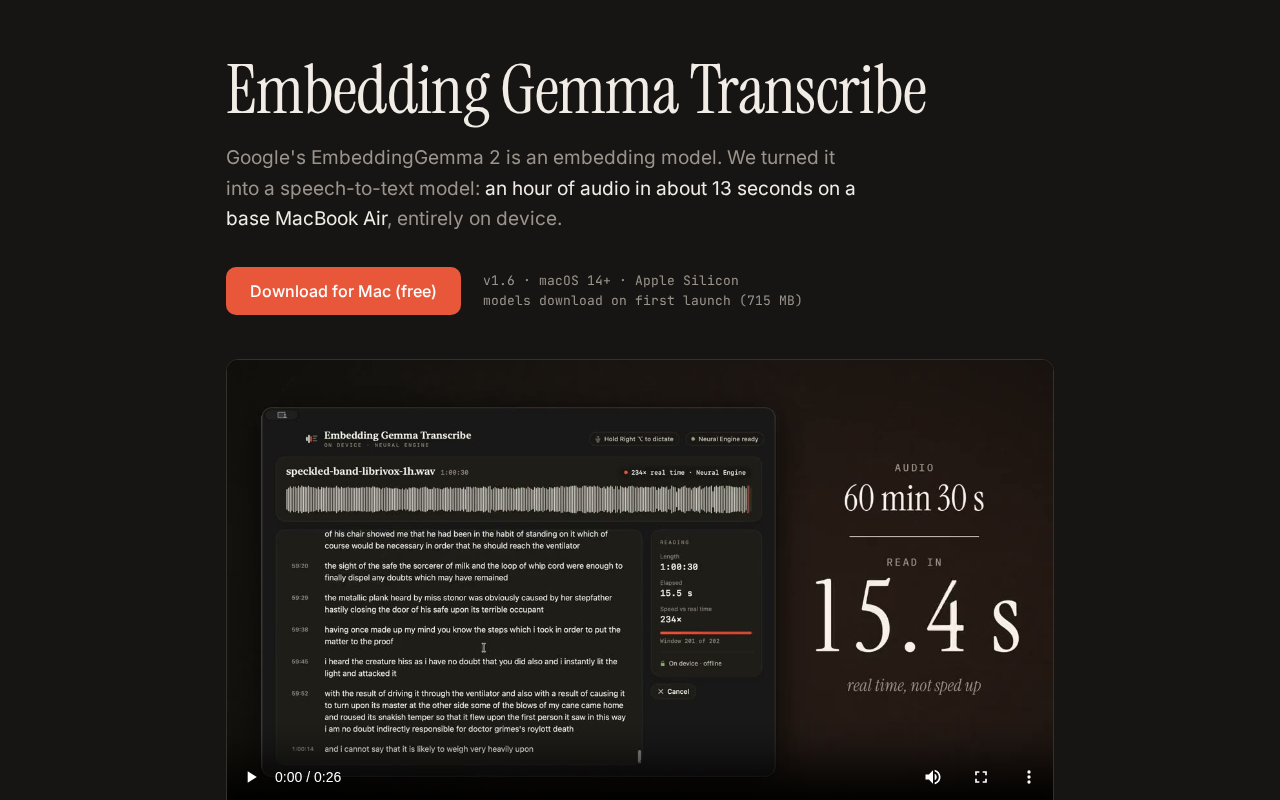
What does this speed mean? If we calculate based on 1 hour of audio = 3600 seconds, the transcription speed reaches about 277x real-time. In other words, the time it takes you to brew a cup of coffee is enough to process several hours of meeting recordings or podcast material.
For those who frequently need to organize interviews, meeting notes, or class recordings, this is no longer a question of "can it be done" but "how fast can it be done."
Why This Speed Is Worth Paying Attention To
The Maturity of Local Inference
In the past, high-quality speech-to-text typically relied on cloud services. Upload audio, wait for processing, download results—this workflow was not only time-consuming but also raised privacy concerns. Achieving transcription of one hour of audio in 13 seconds on a thin-and-light laptop like the MacBook Air shows that local inference capability has crossed a critical threshold.
The MacBook Air is not a performance flagship. It has no active cooling fan, and chip power consumption is strictly limited. Being able to achieve 277x real-time transcription speed on such a device is the combined result of chip architecture (such as Apple Silicon's Neural Engine) and inference framework optimization.
Neural Engine is a dedicated computing unit designed specifically for machine learning tasks within Apple Silicon chips. It was introduced starting with the A11 Bionic chip, and the M-series chips continue this architecture. It excels at handling core neural network operations such as matrix multiplication and convolution, with power consumption far lower than general-purpose CPU or GPU computing. For tasks like speech transcription that require repeatedly running encoder-decoder structures, the Neural Engine can provide significant energy efficiency advantages, which is also an important reason why the MacBook Air can still perform high-speed inference under its fanless design. Working alongside it is Metal, Apple's low-level graphics and compute API. Through frameworks like Metal Performance Shaders, developers can schedule inference tasks to run on the GPU or Neural Engine.
The Real Impact on Workflows
The speed improvement brings not just "time savings" but a change in the way you work. When transcription completes almost instantly, you can:
- Get the text transcript immediately after a meeting ends and verify key decisions on the spot
- Transcribe interview recordings while you chat and edit directly when you get back
- Batch process podcast material without waiting in line
This "instantly available" experience will lead more people to incorporate speech transcription into their daily workflows, rather than treating it as a "task" that requires special scheduling.
Technical Background and Discussion Focus
This post was published on Hacker News, and the comments section typically revolves around several directions: what model was used, what inference framework, whether quantization was applied, how much memory is used, and performance differences across different languages.
Although the original post is relatively brief, based on the conventions of community discussions, solutions that can achieve this speed typically involve:
- Model selection: The Whisper series or its optimized versions remain mainstream, but large models are not necessarily the only solution
- Inference acceleration: Metal acceleration, Core ML conversion, or inference backends optimized for Apple Silicon
- Precision trade-offs: Quantization (such as int8, int4) can significantly speed up processing with almost no loss in accuracy
Discussions of these technical details are often more valuable for reference than the number "13 seconds" itself, because they determine whether this solution can be reproduced and run stably.
Whisper is an open-source automatic speech recognition model released by OpenAI in 2022. It supports multilingual transcription and translation, offering multiple scales from tiny to large. Its architecture uses an encoder-decoder Transformer, with training data covering 680,000 hours of multilingual audio, and it performs relatively robustly in noisy environments and with accent variations. Common optimized versions in the community include faster-whisper (based on the CTranslate2 inference engine), whisper.cpp (a pure C/C++ implementation supporting Apple Silicon's Metal and Core ML), and others. Quantization is a common method of model compression, converting original 16-bit or 32-bit floating-point weights into 8-bit or even 4-bit integers, which can significantly reduce memory usage and improve inference speed at the cost of slight accuracy loss. On Whisper, int8 quantization typically has almost no impact on recognition accuracy, while int4 requires careful evaluation.
Beyond Speed: Accuracy Remains Key
No matter how fast transcription is, if accuracy is inadequate, its practical value is greatly diminished. One hour of audio transcribed in 13 seconds, but if there are errors everywhere, the time spent on post-editing may far exceed the transcription itself.
In actual use, several dimensions need attention:
Differences between Chinese and English. English transcription is typically more mature, while Chinese still faces challenges with proper nouns, accents, and mixed Chinese-English scenarios.
Performance in noisy environments. Background noise in meeting recordings and outdoor interviews, as well as overlapping speakers, are the litmus test for model robustness.
Punctuation and paragraphing. Good transcription is not just a pile of text; it also requires reasonable punctuation and paragraph division to be directly usable for reading or editing.
If this 13-second solution can maintain a usable level across these aspects, then it is not just a show-off benchmark but a truly deployable work tool.
Word Error Rate (WER) is the core metric for measuring speech transcription accuracy, calculated as the sum of substitutions, deletions, and insertions divided by the total number of words in the reference text. For clear English speech, the WER of the Whisper large model can be as low as below 5%, while for Chinese, due to word segmentation and homophone issues, WER is typically higher. For scenarios like meeting notes, a WER exceeding 15% may severely impact readability. Additionally, punctuation and paragraphing are not native strengths of Whisper; the text it outputs often lacks sentence breaks and requires post-processing models (such as rule-based or small-scale language models) to restore punctuation and paragraph structure.
Implications for Ordinary Users
Even if you don't write code or tinker with inference frameworks, this trend is worth noting: speech-to-text is shifting from a "cloud-based paid service" to a "local free capability."
As thin-and-light devices like the MacBook Air can easily handle high-speed transcription, more applications will directly build in transcription features in the future—note-taking software, meeting tools, and video editing software may all enable real-time subtitles and transcript generation by default.
For content creators, researchers, journalists, and students, this means the barrier to organizing audio material is further lowered. You don't need expensive equipment or subscription services; an everyday laptop can accomplish what previously required specialized tools.
What speed improvements ultimately change is habits. When transcription becomes as simple and quick as taking a screenshot, people will be more willing to record, organize, and share voice content.
One-line Summary
Local transcription of one hour of audio takes only about 13 seconds on a MacBook Air, reaching 277x real-time—marking speech-to-text's shift from cloud-paid to local free capability.
Paragraph Summary
This article revolves around a discussion thread on Hacker News: on a MacBook Air, one hour of audio takes only about 13 seconds to transcribe, at roughly 277x real-time. The article analyzes the technical significance behind this speed, pointing out that local inference capability has matured—thin-and-light laptops can also perform high-speed speech-to-text, thanks to optimizations in Apple Silicon's Neural Engine and inference frameworks. The speed improvement will change workflow habits in meeting notes, interview organization, and podcast production, turning transcription from a specialized task into an instantly available daily operation. At the same time, the article emphasizes that accuracy, Chinese language support, performance in noisy environments, and punctuation and paragraphing remain key to practical usability. Finally, it points out that speech transcription is shifting from a cloud-based paid service to a local free capability, and will be built into more applications in the future.
Related articles

How Big Can Stars Really Get? The Physical Limits of the Largest Stars
Red supergiants are the largest stars by volume, with radii up to 2,000 times the Sun, engulfing the inner solar system. But there is no precise upper limit on stellar size—models predict up to 15,000 solar radii. The most massive blue stars are far smaller than red supergiants—biggest and heaviest are two different things.

Apple HomeView Smart Display Full Feature Breakdown: Wall-Mount or Desktop, $299
Apple launches HomeView, a $299 smart display with wall-mount and desktop options, 12MP camera for facial recognition, smart home control, music playback, and recipe step-by-step cooking. Full breakdown of watch faces, apps, privacy, and cooking integration.

Where Did the Promised New Studio Go? Craft Computing Answers After Five Years
Craft Computing's host responds to viewer questions: the new studio promised five years ago was shelved as construction costs soared from $30,000 to $75,000, and was replaced by a 168-square-foot garage conversion.