One Month Without AI: A Developer's Detox Experiment and Reflections

A developer quit AI tools for a month — and the tech community had a lot of feelings about it.
A developer spent a full month using zero AI tools, then published their experience — triggering 169 upvotes and 209 comments on Hacker News. The experiment forced a question many developers avoid: have tools like Copilot and ChatGPT quietly eroded independent problem-solving and deep thinking? Feedback from such detoxes suggests time away from AI can rebuild technical mastery, restore focus, and clarify where AI actually helps versus hinders. The community remains divided — some call AI skepticism Luddite regression, others insist programming is cognitive training that can't be outsourced. The takeaway isn't whether to use AI, but how to use it without losing your own judgment.
What Happens When You Quit AI Cold Turkey?
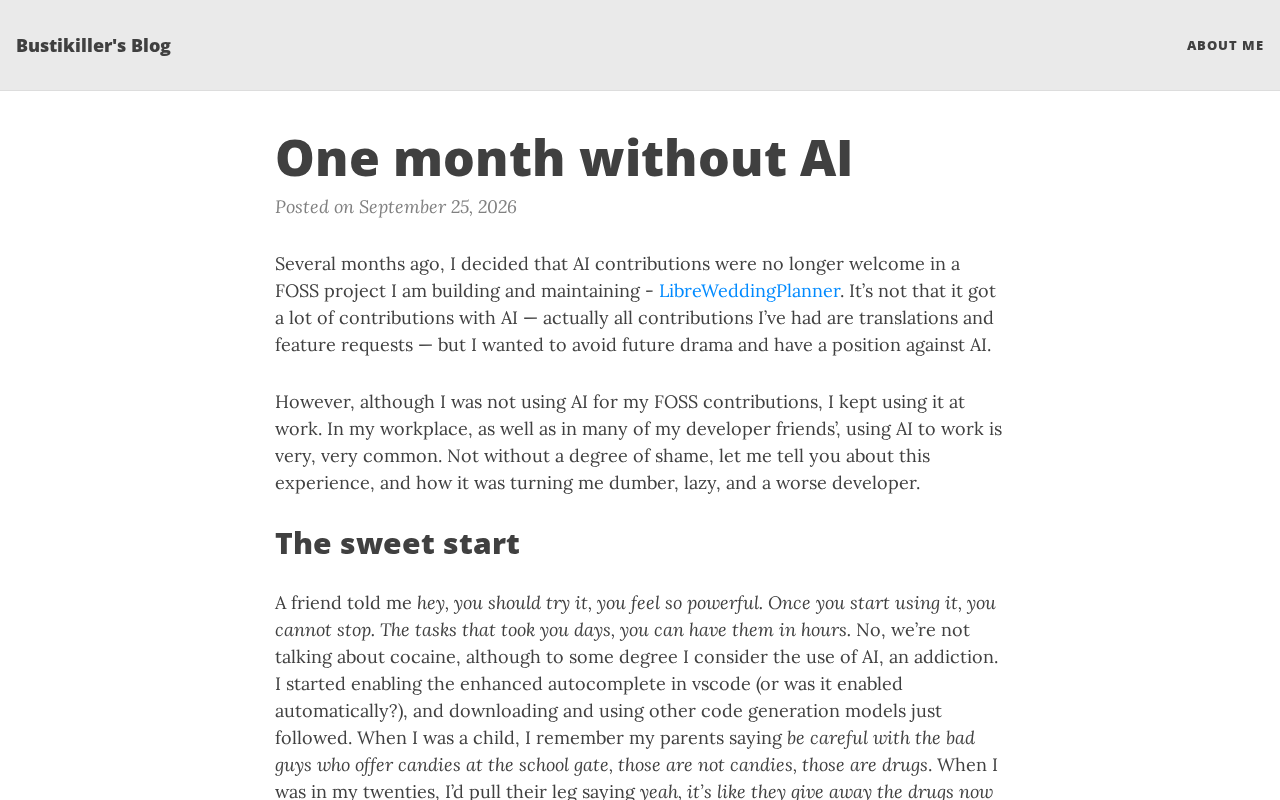
At a time when AI coding assistants are sweeping through developer workflows, one developer ran a counter-intuitive experiment: going an entire month without using any AI tools, returning to pure handwritten code and unaided thinking. The resulting post, One Month Without AI, published on their personal blog, earned 169 upvotes and over 209 comments on Hacker News — sparking a heated debate in the tech community about "AI dependency."
The experiment resonated because it touched on a question many developers are reluctant to confront: now that Copilot, ChatGPT, Claude, and similar tools have become everyday staples, have we quietly surrendered some of our core capabilities without even noticing?
Note: Since the source material includes only the article link and community discussion metadata, this piece analyzes the core themes raised by the experiment. Refer to the original article for specific details.
Why Would Anyone Voluntarily Give Up AI Tools?
The motivation for an AI detox typically comes from a few directions. First, there's concern about skill atrophy — when AI handles code completion, debugging, and documentation, developers may gradually lose the muscle memory for building things from scratch. Second, there's a deeper question about depth of thinking: AI answers are usually good enough, but does "good enough" erode our patience for exploring better solutions and understanding underlying principles?
The high engagement on Hacker News makes clear this isn't just one person's anxiety. 209 comments means a large number of developers weighed in with their own experiences — some agreeing that AI has weakened their ability to solve problems independently, others arguing that AI is simply a tool of the era, no different from IDEs or Stack Overflow in their time.
A note on "muscle memory" in programming: In a coding context, muscle memory refers to the automated cognitive patterns developers build through long, repeated practice — quickly sketching data structures in your head, writing idiomatic code without conscious effort, and intuitively zeroing in on problem areas while debugging. Cognitive science classifies these abilities as procedural memory: the more you use them, the stronger they get; the more you neglect them, the faster they fade. AI completion tools intervene precisely at these repetitive input points, depriving the underlying neural circuits of activation. Similar to physical skill regression, developers sometimes find that without prompts, syntax or API calls they once knew cold suddenly require deliberate recall — and that's the concrete form of the "skill atrophy" anxiety.
What a Detox Experiment Might Actually Give You
Based on the general feedback from this kind of experiment, stepping away from AI for a period tends to produce changes on several levels.
Reclaiming the Details
Without AI to do the heavy lifting, developers are forced back into documentation, source code, and their own memory for answers. The process is slower, but it rebuilds a sense of command over the technical details. Many report that manually reading API docs actually deepens their understanding of a system's design intent.
Restoring a Rhythm for Deep Thinking
AI's instant responses make it easy to fall into a "quick question, quick answer" loop, but complex problems often need time to reason through carefully. Without AI in the picture, the thinking process slows down — and that slower pace can make it easier to enter a state of deep focus.
Reassessing AI's Real Value
Interestingly, the conclusion of a detox experiment is rarely "AI is harmful." Instead, it tends to give people a clearer picture of where AI genuinely adds value and where it actually gets in the way. That sense of boundary is precisely what's hard to develop when you're in a state of constant reliance.
Where the Community Disagrees
The tech community is clearly divided on this topic.
One camp argues that resisting AI is a kind of Luddite regression. The whole point of a tool is to free up productivity — obsessing over "writing every line by hand" is mistaking the means for the end. Nobody feels guilty for using a compiler; AI is just another step up the abstraction ladder.
The other camp contends that programming is fundamentally different from typing or arithmetic — it's a form of cognitive training. When thinking gets outsourced, what degrades isn't just skill but judgment. Their concern: how can a developer who has never independently solved a hard problem evaluate whether the solution AI provides is actually correct?
These two positions aren't entirely at odds. The real question may be less about whether to use AI and more about how — whether you're using it as a lever that amplifies your own capabilities, or as a crutch that replaces thinking altogether.
A note on "Luddism": The term originates from a early 19th-century movement of British textile workers who smashed weaving machines out of fear that machinery would displace manual labor. Today, the tech community uses it as shorthand for resistance to new technology — typically as a pejorative. Linking AI skeptics to Luddism carries an implicit argument: technological progress is unstoppable, and any resistance is emotional and irrational. Critics, however, point out that the analogy doesn't quite hold — questioning AI's impact on cognitive ability is not the same as calling for the abolition of the technology. It's closer to a discussion of how to use it rather than whether to use it. The very battle over this label reflects a familiar rhetorical reflex in the tech community: voices that raise questions about limits tend to get branded as "anti-progress" first, allowing the substantive questions to be sidestepped entirely.
What This Means for Developers
This experiment has something to offer anyone who relies on AI tools. The real question it raises isn't "should I use AI?" — it's "how do I use AI without being shaped by it?"
One practical approach: deliberately preserve some "AI-free zones" — core algorithm design, critical architectural decisions — where you commit to thinking it through yourself before turning to a tool to validate. Let AI be a partner for verification and acceleration, not the starting point for your thinking.
Periodic detoxes are also a useful self-audit. Even just a week without AI assistance can help you honestly assess where your abilities actually stand without the assist.
The direction of technological change is irreversible, but how to stay balanced between efficiency and capability is a question every developer has to answer for themselves. This one-month experiment doesn't offer a definitive answer — it offers a mirror worth looking into, repeatedly.
Related articles

Black Forager Alexis Nelson: From Foraging to Publishing, Happy Snacking, Don't Die
Black Forager Alexis Nikole Nelson visits Talks at Google, sharing her journey from childhood plant walks with her mother to publishing the cookbook Happy Snacking, Don't Die!, revealing the racial and land history behind foraging's rise and fall in America.

How to Present Your Ideas Effectively: Three Types of Revelation Talks
Revelation talks are the most direct way to convey ideas. This article breaks down three types — Wonder Walk, Dynamic Demo, and DreamScape — with classic examples from David Gayo, Michael Pritchard, and Sylvia Earle.

Modern Web Guidance: Letting AI Write Native Declarative Dialog Popovers
Google's Modern Web Guidance makes AI coding assistants prefer native declarative dialog capabilities over repetitive JavaScript event listeners, measurably cutting boilerplate code.