One More Thing: The AI App That Turns Mindless Scrolling Into Bite-Sized Learning

One More Thing redirects the scroll habit into card-based learning with Duolingo-style gamification.
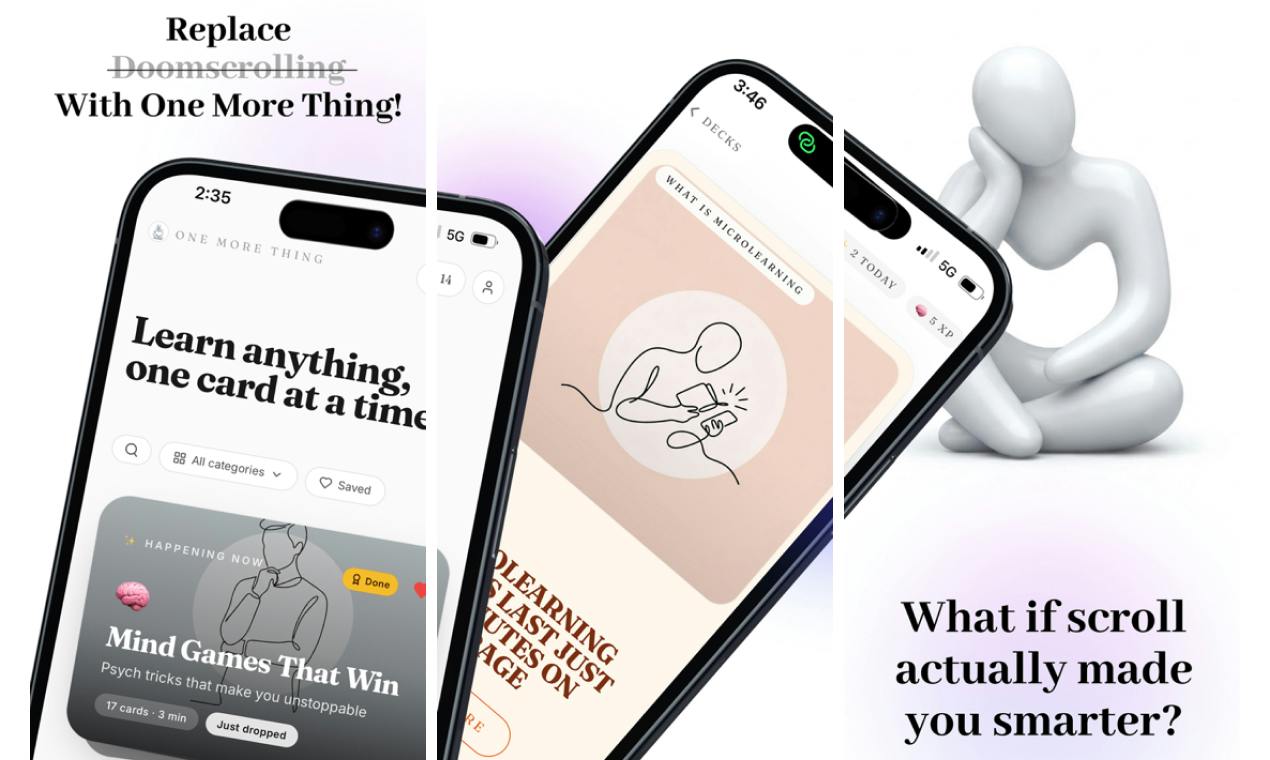
One More Thing is a card-based learning app that reframes "doomscrolling" as a knowledge-building habit. Its core logic: instead of fighting users' compulsive swiping, redirect it — swap the entertainment feed for swipeable knowledge decks covering psychology, history, science, finance, and more. Duolingo-style mechanics like XP, streaks, and badges drive retention. The key insight is zero switching cost: the gesture stays the same, only the content changes. As an early product, it faces real challenges around content quality and differentiation from established players like Blinkist, but its target pain point — information anxiety in the attention economy — has broad, universal appeal.
From Mindless Scrolling to Purposeful Learning
All those hours spent in endless scroll loops usually leave nothing behind. A Product Hunt app called One More Thing aims to transform this "doomscrolling" habit into a way to actually accumulate knowledge. Its tagline is refreshingly blunt: Scroll less. Know more.
Built by Gil Finkelstein, the app landed at #16 on Product Hunt's daily rankings and sits across three categories: Productivity, Education, and Artificial Intelligence. While its vote count isn't particularly impressive at this stage, the pain point it addresses — information anxiety in the attention economy — is nearly universal.
The term doomscrolling went mainstream around 2020, when pandemic-era audiences compulsively consumed anxiety-inducing news feeds — unable to stop despite knowing it wasn't doing them any good. There's neuroscience behind this behavior: social media and content feeds are engineered around the brain's "variable reward" mechanism. Every pull-to-refresh might surface something interesting, and that uncertainty triggers dopamine release, creating an addiction loop eerily similar to a slot machine. Researchers estimate that the average smartphone user scrolls the equivalent of dozens of meters per day — yet contributes virtually nothing to their knowledge base. This gap — behavior that's habitual but value-negative — is precisely the opening that products like One More Thing are designed to exploit.
Core Mechanic: Breaking Knowledge Into Cards
One More Thing's product logic is simple: package learning content into swipeable "learning decks." Instead of passively consuming whatever an algorithm feeds you, users actively choose a topic they want to explore and work through it one card at a time.
The subject range is broad — psychology, history, science, personal finance, culture, language learning, and all manner of trivia. Each topic is sliced into short chunks digestible in just a few minutes. The design clearly borrows from the interaction patterns of short-form video and content feeds: the swipe gesture stays exactly the same, but the destination shifts from entertainment to knowledge.
Gamification to Keep Users Coming Back
To make "learning" feel as addictive as scrolling, One More Thing layers in a full gamification stack:
- XP Points: Earn experience for completing learning content
- Streaks: Encourages daily return visits
- Badges: Achievement unlocks reinforce positive feedback loops
- Daily Discoveries: Fresh content every day to maintain novelty
This system is essentially Duolingo's progression model applied to general-interest learning. The problem it's solving is a familiar one: knowledge products typically lack immediate feedback, making it hard for users to stick around — and gamification is the standard playbook for fighting churn.
Duolingo is the most commercially successful case study in gamified learning. Its core design philosophy breaks language learning into ultra-short units, then manufactures a sense of completion through streaks, XP, and leaderboards. Duolingo's own data shows that the Streak feature is its single most powerful retention driver — the longer a user's streak, the less willing they are to break it. That said, gamification carries a known risk: the "shallow engagement trap," where users rush through tasks just to protect their streak without actually absorbing anything. Every product using this model faces the same underlying question: gamification can drive return visits, but whether those visits translate into real learning depends entirely on the quality and depth of the content itself.
Where the Positioning Value Lies
One More Thing didn't invent anything new — card-based learning, gamified incentives, and bite-sized content are all well-established patterns. Its insight is in repurposing existing behavioral momentum.
People can't quit scrolling. Rather than fighting that habit, why not redirect it? When the swipe gesture itself stays the same and only the content changes — from entertainment feed to knowledge card — the switching cost for users is essentially zero. That's also the cleverness behind the name "One More Thing" — it borrows the "just one more" impulse from doom scrolling and reframes it as "just one more thing to learn."
Given its AI category tag, the app likely uses AI to generate or organize knowledge cards across these diverse domains, powering content supply across psychology, history, science, and more. That said, the official description doesn't go into much detail about how AI is actually applied — something that would need hands-on testing to verify.
Worth Watching, But the Jury's Still Out
As an early-stage product, One More Thing has a clear direction and a genuine pain point. But the challenges are equally real: How does it guarantee content quality and accuracy across so many topics? Can gamification drive genuine long-term retention rather than just short-term novelty? And how does it carve out differentiation against established players like Blinkist and Duolingo?
For people who want to cut down on mindless scrolling but struggle to sit down for structured learning, tools that "convert fragmented time into knowledge gains" at least offer a low-barrier place to start. As the app itself puts it: There's always One More Thing — there's always something else worth knowing.
Blinkist is the most prominent competitor in the bite-sized knowledge space, condensing non-fiction books into 15-minute text or audio summaries for its 26+ million paying subscribers. It represents the mature form of this category: content curated by professional editorial teams, quality-controlled, but limited to published books. By comparison, One More Thing goes even lighter and more fragmented — targeting not people who "want to read but don't have time," but people who find even a Blinkist summary too long. The competition between these two products is fundamentally a different bet on the granularity of user attention. The tension is real: the finer the granularity and the more it resembles scrolling, the harder it is to maintain knowledge density. Finding the balance between "easy enough" and "actually useful" is the defining challenge this category will keep grappling with.
Related articles

Felix Rieseberg Personal Homepage
Felix Rieseberg's personal homepage sparks attention on Hacker News. This article covers the Slack engineer's technical background, the rise and fall of nativefier, and the value of a developer homepage as a tech calling card.

@ai-sdk/vue 3.0.306 Patch Release Syncs with [email protected] Update
@ai-sdk/vue 3.0.306 released, synced with [email protected]. A routine patch release for the Vercel AI SDK ecosystem with no public API changes; the Vue adapter layer stays version-aligned with the core package.

Gemini 4 Argon API Launches: The Era of Million-Token Output Begins
Google launches Gemini 4 Argon with sparse MoE architecture, up to 1M output tokens, and a 68.90% Vals Index score, available across API, AI Studio, and the Gemini app.