One Person, Twenty AI Agents: A Deep Dive into Grok Bot's Multi-Agent Collaboration in Practice

How one developer orchestrates 20 AI agents for a fully automated software engineering loop.
This article covers a live Grok Bot demo where a single developer uses a multi-agent system to let AI autonomously handle bug fixes, nightly code cleanup, PR submissions, and social media monitoring — with humans only stepping in for real decisions. The system is built on a "bots talk to bots" philosophy, using MCP to connect Slack and X into a closed loop from issue discovery to fix delivery. To overcome context management bottlenecks, the developer built a structured AI team (a Chief of Staff plus specialized engineer agents) and a P0 escalation mechanism for self-correction every five minutes. Three key methodologies emerge: treat AI like interns, abstract upward to reduce repetition, and always build a feedback loop.
From "One Person" to "An AI Engineering Team"
As automated programming matures, the question is no longer "can AI write code" — it's "can a single developer manage an entire AI engineering squad at once." In this live demo from the Grok Bot team, the presenter showcased a workflow that lets one developer orchestrate up to 20 AI agents: automatically fixing bugs, cleaning up messy code overnight, submitting PRs in the early hours, and monitoring social media for feedback — with humans only stepping in when a real decision is needed.
The core philosophy is straightforward: bots contacting with bots, humans only connect with humans when absolutely needed. This single sentence encapsulates the entire system's design ethos, and marks a shift in "AI programming" from "assistive tool" to a new paradigm of "organizational collaboration."
How Bots Pick Up Work and Deliver It on Their Own
The most mind-bending aspect of the demo was the fully closed-loop review and fix process. The presenter gave Grok Bot its own "review standards": PRs must include screenshots and must have real (not fabricated) tests. When someone @-mentions him on Slack, the bot automatically reads the message, determines whether it's a review request, kicks off code scanning and research skills, executes tasks directly in the repository via a cloud agent, and then sends a confirmation reply.
With first-party MCP integration with Slack, the system extends even further — the bot is configured to monitor X (Twitter) for bug reports mentioning Grok Bot. When it finds valuable feedback, it automatically spins up a task, verifies whether the reported issue still reproduces on the main branch, and if it does, fixes it and submits a PR.
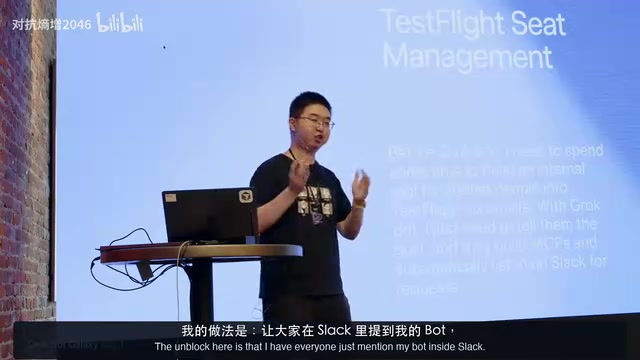
This "bot-to-bot" chain frees developers from tedious context-switching. Developers only get pinged when the bot hits an authentication step or when a human decision is genuinely required.
MCP (Model Context Protocol) is an open protocol introduced by Anthropic in late 2024, designed to standardize how AI models connect with external tools and data sources. Think of it as the "USB port" of the AI world — with a unified standard, models don't need custom integration logic for every service. First-party MCP integrations mean that platforms like Slack and GitHub officially provide connectors that comply with the protocol, allowing AI agents to directly read and write messages and trigger actions — rather than relying on fragile web scraping or unofficial API workarounds. This explains why cross-platform tasks like "bot monitors bug reports on X" can run reliably: each platform exposes its capabilities through a standardized interface, and agents simply call them by protocol, dramatically improving reliability and maintainability.
Nightly Code Cleanup: Handing Off "Messy Code" to the 3 AM AI
A year of shipping fast has a familiar side effect — sloppy code. The presenter's solution is practical: batch-clean everything while no one is committing at night, when the risk of conflicts is low and most changes are low-risk, like compressing bloated modules or deleting useless long comments.
His setup: every night at 3 AM, Grok Bot spins up a research-oriented cloud agent that scans the entire monorepo, identifying code quality issues, areas that should be modularized but aren't, redundant comments, and security audit gaps that are easy to overlook. By the time he wakes up, a batch of PRs is already waiting. Going further, the Cursor cloud agent can automatically merge these PRs based on predefined conditions — such as providing clear end-to-end verification proof.
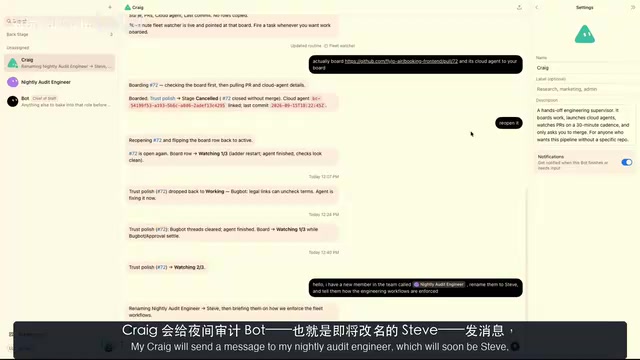
Building an Engineering Team by Having "Bots Manage Bots"
The most thought-provoking part of the demo was the organizational design. Rather than using one omnipotent bot, the presenter built a team of AI agents with clearly defined roles:
- Ling Xixi: Chief of Staff, responsible for routing requests
- Craig: UI engineering
- Steve: Developer experience (DevEx)
- Hogan: Infrastructure (infra)
Why not use a single bot? His reasoning is critical: even though these bots share the same underlying model and could theoretically handle any task, context management is the real bottleneck. Each bot has its own pipeline and context limit. Keeping them separate prevents context from blowing up during frequent task switches. Instructions given to Hogan persist in Hogan's memory, so when a new task arrives it can get straight to work based on existing context — keeping the entire "fleet" running faster.
Most of the time, humans only need to talk to the "Chief of Staff" — it knows who's doing what, routes requests to the appropriate engineer bot, and conserves its own context in the process.
Context Window is the maximum amount of text a large language model can "see" in a single inference pass; content beyond this limit gets truncated or forgotten. For long-running agents, this is the most practical engineering bottleneck: as task history, code snippets, and instructions accumulate, the model starts "forgetting things" and output quality drops sharply. Splitting the team into multiple specialized agents is essentially a context isolation strategy — each agent only holds memory relevant to its own responsibilities, preventing irrelevant information from consuming valuable window space. The "Chief of Staff" handles global routing rather than global memory, effectively shifting coordination costs from the model layer to the system architecture layer, so overall scalability is no longer constrained by a single context limit.
The P0 Escalation Mechanism: Making AI "Urgent" Without "Guessing"
A well-known pain point with collaborative AI is that long-horizon task chains are slow exactly when you need results fast. And when you tell an agent something is "urgent," it may skip steps or start guessing to move faster — which is precisely what you want to avoid, since engineering requires deterministic results.
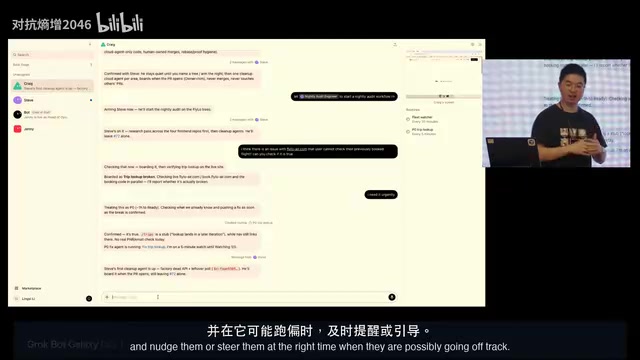
The presenter's solution is a P0 escalation workflow: Grok Bot checks cloud agent progress every 5 minutes, assessing whether it has drifted off target (for example, executing useless stalling operations like sleep 300, or being overly conservative). The moment it detects drift, the bot immediately interrupts and re-prompts based on the current state — no human intervention required, no manual prompt writing needed.
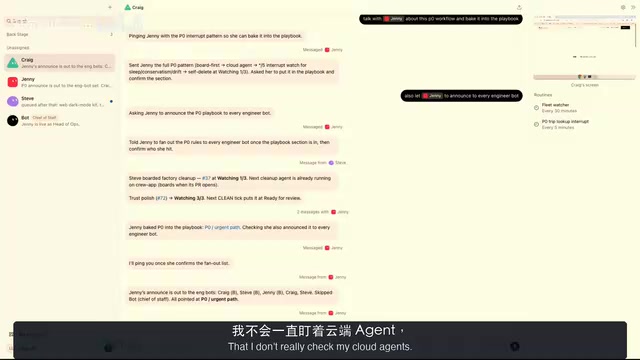
Better yet, this P0 definition doesn't need to be copy-pasted to all 20 bots. The presenter had Craig share this workflow with Jenny, who manages operations; Jenny writes it into the Notion playbook, which is then automatically broadcast to all engineer bots. You only need to "think it through once" — the rest of the handoff happens between bots. This closely mirrors how human organizations operate, just at the agent scale.
Long Horizon Task refers to tasks that require multiple steps, tool calls, or extended time windows to complete — and represents the core reliability challenge for current AI agents. The more steps involved, the higher the probability of error accumulation and goal drift. An early misjudgment can snowball into a completely wrong outcome a dozen steps later, and agents themselves often lack sufficient self-correction ability. This is also why simply "telling the agent to go faster" backfires: under time pressure, models tend to reduce verification steps, skip confirmation checkpoints, and substitute probabilistic guessing for deterministic execution. The value of the P0 mechanism isn't to "rush" the agent — it's to introduce an external supervision loop, using another agent as an independent observer to intervene and reset while the task is still recoverable, rather than discovering the drift only after the final output.
Three Reusable Methodologies
Beyond the impressive demo, the real value of this workflow lies in the general principles it distills:
Treat Them Like Interns
When you're not sure how to communicate with an agent, or it's underperforming, don't rush to tweak skills or write complex prompts. Have a conversation — treat it like a "talented but not yet up to speed intern." Once you explain clearly, they become remarkably capable.
Reduce Repetition — Abstract Up a Level
If you're sending the same prompt to an agent ten times, that's pure wasted time. Instead of "fixing symptoms," sync upward a level — abstract the requirement into a playbook or hand it to another bot to surface at the right moment. This is the essence of automated programming: don't repeat yourself.
Build a Complete Feedback Loop
Every engineering task must have a feedback loop so the agent can understand "success vs. failure" signals, and know whether to keep pushing or stop and merge. The simplest example is having the agent use computer use to interact directly with a website and verify results; hardware engineering likewise has signal feedback loops for judging good vs. bad outcomes.
Where Does the Human Fit In
If bots can do almost everything, what's left for humans? The presenter's answer is clear-eyed: humans still own product direction, dig into design details, handle the hard problems that bots can't crack — performance issues, planning next-generation architecture — and, crucially, teach the bots to say "no."
Bots are inherently "agreeable" and tend to accept all feedback by default. But products need boundaries. You have to tell them why you're doing something, what you shouldn't do, and the reasoning behind it. With a memory system, bots can retain these judgments and apply them to future decisions — without you having to repeat "not this" or "keep it simpler" over and over.
From "a tool that writes code" to "an AI engineering team that collaborates autonomously," this demo describes not just an efficiency gain, but a migration of the software development collaboration paradigm — humans retreat to the strategic layer, AI handles execution, and the way you manage them looks increasingly like managing a real team.
Related articles

DeepCell: One-Click AI Generation of Documents, Spreadsheets, and Slides
DeepCell tops Product Hunt with one-click generation of documents, spreadsheets, and slides, using the .deepcell format for linked updates, designed for System 2 tasks like modeling and sales reviews.

Doneas: 15-Minute Daily Accountability Calls That Keep Indie Developers From Procrastinating
Doneas is a daily accountability tool for indie developers: plan tasks on Monday, join a 15-minute call with five builders each day, and log deliveries on a public progress page. This article analyzes its core mechanics, effectiveness, and potential issues around retention and matching.

Fastlane 2.0: Fully Automated AI Ad Campaigns, From Creative to Optimization
Fastlane 2.0 is an AI ad automation tool: enter your website and it learns your brand, generates video and image ads, and runs and optimizes them on Meta, TikTok, Instagram, and YouTube.