One Roof: A Command Center for Multi-AI Agent Collaboration, Free and Open Source

One Roof uses a unified terminal interface, inbox, and morning report to let multiple coding agents work together under human control.
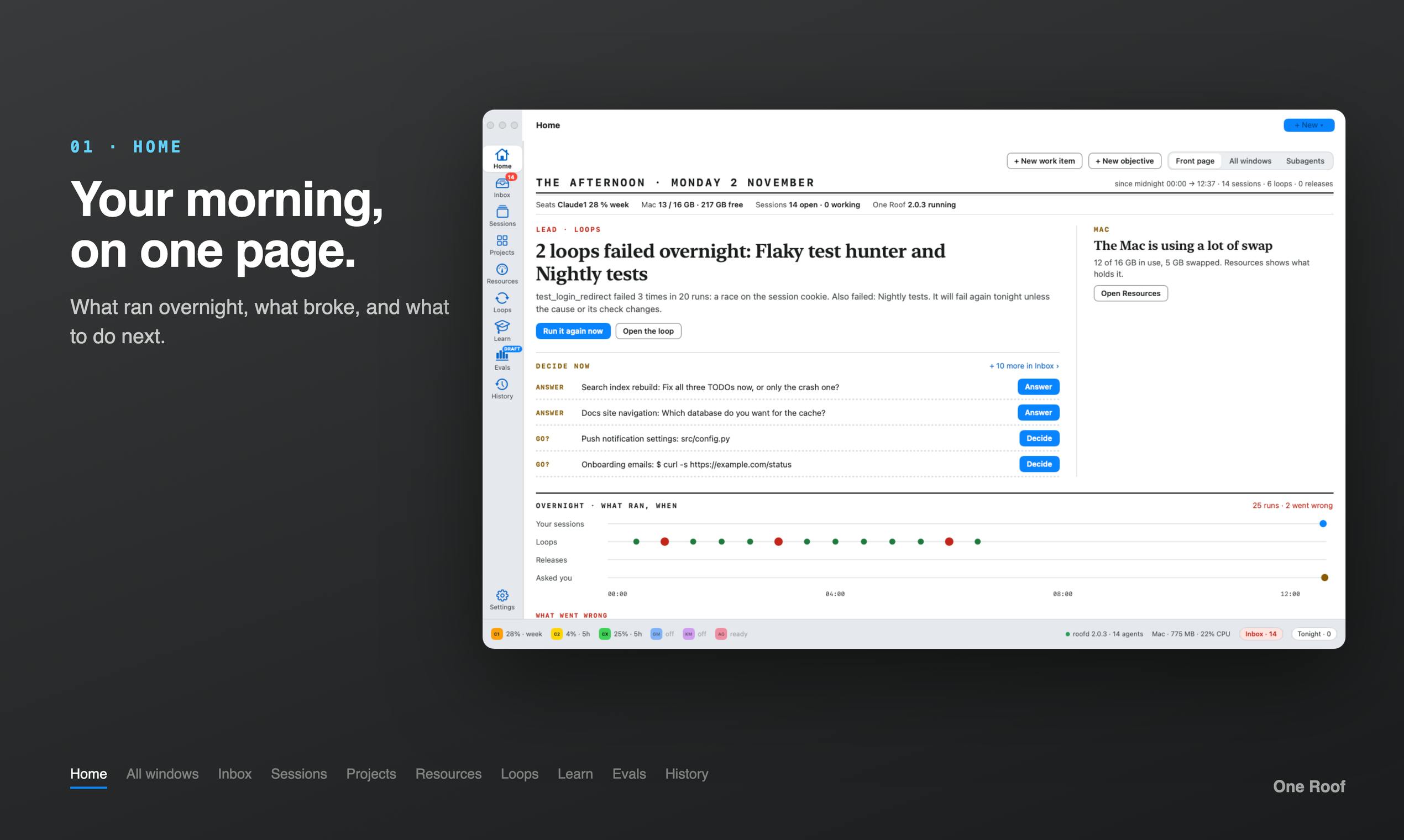
One Roof is a free, open-source developer tool designed to solve the loss-of-control problem when using multiple coding agents in parallel. It centralizes real terminal sessions from agents like Claude Code, Codex, Gemini CLI, Kimi, and Antigravity into one interface, aggregates all requests requiring human confirmation through a unified inbox, and summarizes overnight agent activity in a morning report page. Unlike automated orchestration tools, One Roof positions itself as a human-in-the-loop orchestration layer, preserving each agent's independence and giving coordination decisions to the human. This design offers high controllability and suits development tasks requiring judgment, but requires users to invest attention in decision-making. The project is currently in an early exposure stage, suited to developers already using multiple agents in parallel.
In the Era of Multi-Agent Coding, What's Missing Isn't Models but a Console
When coding agents like Claude Code, Codex, Gemini CLI, Kimi, and Antigravity are all available at once, the new question developers face isn't "which one to use" but "how to make them work together without losing control." One Roof, launched on Product Hunt, attempts to answer this: gather all agents' terminal sessions into a single interface, manage the requests they send to you through a unified inbox, and summarize what happened overnight in a morning report. The project is free and open source, and has currently garnered 68 upvotes.
Core Design: You Are Always the Decision-Maker
One Roof's positioning is clear—it's not another autonomous agent framework, but a human-in-the-loop orchestration layer. Its tagline, "A new way to build with agents. You stay in charge," directly states its value proposition: agents execute, you decide.
Specifically, it offers three key capabilities:
- Real terminal sessions: Not simulated chat windows, but real command-line terminals running multiple agents in parallel. This means you can directly observe what each agent is actually doing, rather than just reading its generated summaries.
- Unified inbox: When any agent needs your confirmation, selection, or input, the request is aggregated into the same Inbox. You don't need to switch between multiple windows hunting for "where things got stuck."
- Morning report page: What agents did overnight, what changes they made, what problems they encountered—open one page in the morning and you're up to speed.
This design responds to a real pain point: when multiple agents run in parallel, human attention becomes the bottleneck. One Roof doesn't try to eliminate this bottleneck but to centralize and manage it.
Human-in-the-loop is a design paradigm in automation and artificial intelligence where the system actively pauses at key decision points and returns control to a human, rather than completing the entire process fully autonomously. It sits between "fully manual operation" and "fully autonomous agents": agents can perform searches, edits, run commands, and other actions, but must request confirmation when committing changes, choosing between options, or encountering ambiguity. This pattern is especially important in coding agent scenarios because code changes are irreversible and carry security risks. One Roof elevates human-in-the-loop from an interaction habit of a single agent to a cross-agent orchestration principle, making the human a shared decision node for multiple parallel agents rather than a passive bystander.
How It Differs from Existing Solutions
There are already some multi-agent orchestration tools on the market, but most take the "automated pipeline" route—defining roles and workflows and letting agents hand off to each other automatically. One Roof makes the opposite choice: preserve each agent's independence and give coordination authority to the human.
The benefit of this orientation is high controllability, suited to development tasks that require judgment; the cost is that users still need to invest attention in making decisions. From a product positioning standpoint, it's more like "tmux + notification center for the agent era" than "CI/CD for the agent era."
Interestingly, One Roof supports CLI agents from multiple vendors simultaneously, including Anthropic's Claude Code, OpenAI's Codex, Google's Gemini CLI, Moonshot's Kimi, and Antigravity. This cross-vendor compatibility is a pragmatic choice in today's fragmented agent ecosystem.
Multi-agent orchestration refers to having multiple agents automatically collaborate on complex tasks through predefined role division, messaging protocols, and handoff rules. Common patterns include pipeline-style (one agent's output as the next's input), debate-style (multiple agents review each other), and hierarchical (a manager agent assigns tasks to worker agents). Such approaches aim to reduce human involvement, but at the cost of rigid workflows, difficult debugging, and error propagation along the chain once any step deviates from expectations. One Roof deliberately avoids this route, instead reserving orchestration authority for humans—essentially replacing "automatic orchestration protocols" with "manual scheduling," choosing the latter between flexibility and controllability.
Open Source and Use Cases
The project is released by Gaurav Narasimhan under an open-source model, with categories covering developer tools and artificial intelligence. For developers already using multiple coding agents in their daily work, One Roof can reduce context-switching costs; for teams just starting to experiment with agentic coding, it provides a window to observe agent behavior and gradually build trust.
The current data of 68 upvotes and 3 comments indicates it's still in an early exposure stage with limited community validation. Whether it suits your workflow depends on whether you're truly using multiple agents in parallel—if you only use a single tool, One Roof's orchestration value is greatly diminished.
The CLI form of coding agents deserves separate mention. Tools like Claude Code, Codex, and Gemini CLI all run as command-line programs, essentially persistent terminal processes: the agent reads files in the terminal, executes shell commands, displays diffs, and waits for user input. The benefit of this form is transparency—you see real commands and real output, not packaged chat summaries; the drawback is that each agent occupies a terminal window, and window management costs rise rapidly when running multiple. One Roof precisely seizes on this form characteristic, integrating agents through "terminal session aggregation" rather than "API call wrapping," thus being able to support tools from different vendors and protocols simultaneously without needing to adapt an SDK for each.
Quick Start Suggestions
Since the project is open source, you can get the code directly from GitHub and run it locally. A suggested starting approach: first connect two agents you're familiar with (e.g., Claude Code and Gemini CLI), handle their requests through the unified inbox, and observe whether the morning report accurately reflects overnight activity. Once you've confirmed the orchestration logic meets expectations, gradually add more agents.
One Roof represents a product philosophy: the more agents there are, the more humans need a "roof" that covers all activity within their field of view. Whether this philosophy holds ultimately depends on whether developers are willing to pay the attention cost for control.
Related articles

AI Coding Enters the Team Collaboration Era: Interpreting Three Major Moves from Meta, GitHub, and Mistral
Meta acquires Conductor, GitHub Copilot Fusion becomes available, Mistral opens Large 4 weights—three moves show AI coding shifting from code generation to organizing development workflows. This article explains task orchestration, model collaboration, and cost control for developers.

Building a RAG Assistant with Dify: A Practical Guide to Knowledge Bases, Workflows, and Agent Nodes
How should knowledge bases, workflows, and Agent nodes connect in a Dify RAG assistant? We break down the division of labor and wiring logic for a shippable app.
 Tech Frontiers
The AI Industry Doesn't Lack Marketing—It Lacks Good Products
AI faces market selloffs and public skepticism—is marketing really the problem? This analysis of market signals and product experience argues the core困境 is incomplete products and a gap between promises and experience; the only way to change perceptions is to ship better products.