One-Sentence Cover Generation: Gemini vs. Claude vs. GPT Showdown
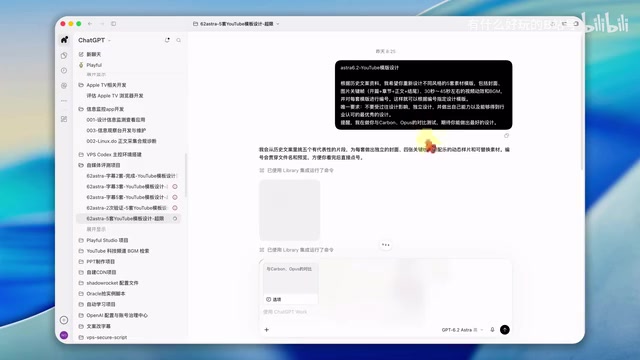
Three-model comparison: GPT's template generation is context-limited, but direct cover output wins back a point through long-term cultivation
A Bilibili creator compared Gemini Carbon, Claude Opus 5.5, and GPT 6.2 Astra using the same subtitles and prompts to generate video templates and YouTube covers. Carbon and Opus could stably produce five to nine template sets, while GPT hit context limits at five sets and could only complete two. In template design, Opus had the best BGM-visual harmony, Carbon's layouts were repetitive and overstuffed with no negative space, and GPT had content-text mismatches. But in pure cover direct output, GPT was actually best—provided it had accumulated channel style preferences through multiple rounds of prior cultivation. The creator judged that 6.2 Astra showed notable speed improvements but no qualitative change in graphic design or video generation compared to 6.0, more like patching than a major version update. The core conclusion: task-model matching matters more than model rankings.
Title
One-Sentence Cover Generation: Gemini vs. Claude vs. GPT Showdown
Meta Description
A Bilibili creator compares Gemini Carbon, Claude Opus 5.5, and GPT 6.2 Astra on one-sentence video template and cover generation: GPT hits context limits but wins on direct cover output; Carbon overstuffs with no negative space; Opus shows more thoughtful motion and BGM choices.
Article Content
When AI image generation evolved from "enter a prompt and wait half an hour" to "one sentence, ready-to-use assets," the gap between models is no longer about whether they can draw—it's about whether they understand what you want. Recently, a Bilibili creator ran a genuinely practical comparison, feeding the same subtitle script and the same prompts to Gemini Carbon, Claude Opus 5.5, and GPT 6.2 Astra to generate video templates and YouTube covers. The results revealed a fascinating divergence: GPT doesn't excel at graphic design, yet it claws back a win in the direct cover output round.
Three Models, One Task: Setup and First Impressions
The core goal of this test was crystal clear—not to produce professional-grade design work, but to use AI to fill efficiency gaps in everyday video production. The creator's needs were simple: based on historical scripts or finalized subtitles, generate multiple sets of video templates containing covers, key frames, openings, chapters, body content, endings, and 30–45 second motion+BGM sequences, with accompanying codes for later reference by number.
All three models received the same subtitle file. Carbon and Opus 5.5 both successfully completed output of five, seven, and even nine template sets without hitting context bottlenecks. GPT 6.2 Astra's performance was surprising: five template sets immediately exceeded context limits, dropping to three still exceeded limits, and only two could barely be completed. The creator remarked bluntly in the video that it "just dropped a massive turd," emphasizing this wasn't a one-off—three verification attempts, prompt adjustments, and reduced reference retrieval scope all failed to circumvent the limitation.
This detail is worth pondering. In model capability evaluations, context window is often treated as just a number on a spec sheet, but in real workflows, it directly determines "how much can be delivered in a single conversation." For users who need batch template production, this is nearly fatal.
Context Window is the total token limit a large model can process in a single conversation, including user input, internal reasoning, and all generated output. It's essentially a "working memory" capacity: once accumulated content approaches this limit, the model either truncates earlier information or aborts generation with an error. In this article, GPT triggering limits at five or even three template sets indicates that video template tasks—where each set includes covers, key frames, chapters, body content, endings, and motion descriptions—consume far more tokens than ordinary Q&A. By contrast, Carbon and Opus producing nine consecutive sets means their window headroom or output management strategy is more generous. For creators needing one-shot batch delivery, context window isn't a paper spec—it's a hard constraint determining "how many finished products you get per conversation round." Tasks should be split into batches in advance.
Template Generation Test: Carbon Overstuffs, Opus Has Ideas, GPT Mismatches Content
Moving to the actual output comparison, the stylistic differences between the three models quickly became apparent.
For GPT's first template set, the creator's assessment was "even using it as a PowerPoint gives me a headache"—key frames, chapter images, and body images all showed crude information density and layout handling. The second set looked "decent" in isolation, but the problem was content-script disconnect: the subtitles discussed a three-model comparison, yet the generated assets had nothing to do with the topic. The creator's conclusion was direct: "content doesn't match the text." Graphic design genuinely isn't GPT's strength.

On Carbon's side, the two selected templates from nine sets had different styles but nearly identical layout skeletons. The core issue the creator identified was "too much content stuffed in, as if trying to fill every inch of the frame with no negative space at all." This is actually a common problem with AI-generated design—models tend to cram information into every pixel without understanding that breathing room itself is part of the design language.
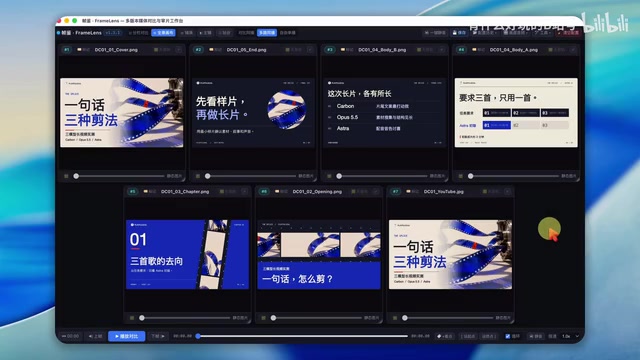
Opus 5.5's two template sets received the most praise. One pop-art style piece had BGM and overall visual presentation in high harmony—"unlike the other sets where basically one BGM plays from start to finish, this one has its own ideas in it." Another design highlighting key points with keywords also aligned with the creator's philosophy that "a lot of content works fine as voiceover; there's no need to put everything on screen." This understanding of information hierarchy is precisely the part of template design that's hardest to describe clearly through prompts.
It's worth noting that the creator repeatedly emphasized this was a "one-sentence generation" comparison and doesn't represent the models' upper limits. Both Carbon and Opus can produce beautiful templates after manual fine-tuning; what's being tested is the models' default aesthetics and comprehension under zero fine-tuning conditions.
Negative Space refers to the empty areas in a layout not occupied by text, images, or decoration. It's not "unfilled" but deliberately designed visual breathing room. Negative space serves three purposes: first, establishing information hierarchy so core elements stand out against surrounding emptiness; second, reducing visual noise so viewers aren't forced to process too many stimuli on one screen; third, conveying stylistic character—high-end, restrained designs often rely on large areas of negative space. A common problem in AI-generated design is the "filling tendency"—models tend to assign content to every region because training data contains a high proportion of information-dense samples, and "giving more" is probabilistically safer. Carbon templates being criticized for "trying to fill every inch" is a typical manifestation of this tendency; Opus earning the "has ideas" evaluation is, to some extent, because it's closer to human designers' judgment about breathing room in information取舍 (trade-offs).
Plot Twist: In Pure Cover Design, GPT Actually Wins
If the article ended here, the conclusion would be that GPT is comprehensively behind in graphic design. But the creator added a final test—designing YouTube covers separately, with each model producing three images.

The results were clear at a glance: GPT's three covers were noticeably superior. Moreover, these cover styles were highly consistent with the visual language the creator's channel has used long-term. The key was the operational approach—the creator simply opened a new conversation, sent the channel logo and finalized subtitles, and asked to "generate covers based on the subtitles and add the logo and name." GPT directly output three styles to choose from.
Of course, this result has caveats. The creator admitted that achieving this effect was possible because "many rounds of adjustment were done before"—the model had already recorded his requirements and habits. Early generated images were similarly overstuffed with information and stylistically off-track, only converging to the current state after being rejected round after round. In other words, a considerable portion of GPT's cover advantage comes from the context dividend accumulated through long-term cultivation, not from crushing one-shot zero-sample capability.
This also serves as a reminder to users: the same model can perform completely opposite on different tasks, and "using it well" and "the model being strong" are two different things.
Context Dividend (长期调教积累) refers to the phenomenon where a model accumulates user preferences, style constraints, and negative feedback through sustained multi-round interactions, then automatically applies these implicit rules in subsequent tasks. It differs from fine-tuning: model weights don't change; what changes is the instruction information carried by conversation history. In this article, the creator's early generated covers were also overstuffed and stylistically off-track, only converging to match the channel's visual language after round after round of rejection—indicating that a considerable portion of GPT's cover advantage comes from this batch of historical conversations, where the model "remembers" which directions were rejected. This also explains why the same model can perform completely opposite on different tasks: the template task is one-shot zero-sample generation with no dividend available; the cover task stands on the shoulders of long-term cultivation. The takeaway for users is that "using it well" depends on accumulating continuous feedback—switching to a new conversation or new model resets this dividend to zero.
Is 6.2 Astra Really a Major Version Update?
The creator's overall assessment of GPT 6.2 Astra was quite restrained. Speed has indeed improved noticeably over 6.0 and 6 Astra—the same content generates faster, thinking time is significantly reduced, and there were pleasant surprises when designing 3D character models. But in the two directions of graphic design and video generation, it's "improved over 6.0 but without qualitative change," and video capability is "unwatchable."
His conclusion: 6.2 Astra is more like patching on top of the 6 model rather than a major version leap. This assessment isn't out of place given current model iteration rhythms—vendors increasingly tend to carry incremental optimizations under small version numbers, with true architectural changes often hidden behind larger version numbers.
For content creators, the practical value of this comparison lies in providing a clear task-model matching reference: for batch template generation, prioritize Carbon or Opus; for pure cover direct output with existing long-term cultivation accumulation, continue using GPT; and for scenarios requiring long-context batch delivery, GPT's current limitations need to be planned around in advance.
The point of model comparisons was never ranking—it's helping people avoid detours. All three flagships have shortcomings and comfort zones; choosing the right task matters more than choosing the right model.
One-line Summary
Three-model comparison: GPT's template generation is context-limited, but direct cover output wins back a point through long-term cultivation
Paragraph Summary
A Bilibili creator compared Gemini Carbon, Claude Opus 5.5, and GPT 6.2 Astra using the same subtitles and prompts to generate video templates and YouTube covers. Carbon and Opus could stably produce five to nine template sets, while GPT hit context limits at five sets and could only complete two. In template design, Opus had the best BGM-visual harmony, Carbon's layouts were repetitive and overstuffed with no negative space, and GPT had content-text mismatches. But in pure cover direct output, GPT was actually best—provided it had accumulated channel style preferences through multiple rounds of prior cultivation. The creator judged that 6.2 Astra showed notable speed improvements but no qualitative change in graphic design or video generation compared to 6.0, more like patching than a major version update. The core conclusion: task-model matching matters more than model rankings.
Related articles
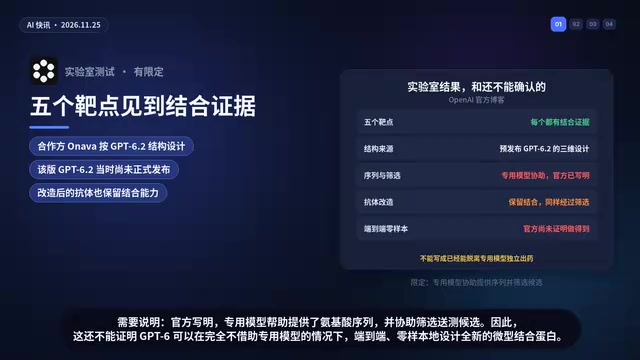
GPT-6 Designs Proteins, Claude Creations Become Apps with One Click, DeepMind Releases New Benchmark
OpenAI says GPT-6 can design protein 3D structures, Anthropic lets Claude creations install as desktop apps, DeepMind's HIP benchmark tests stability on simple questions, Google Workspace opens agent MCP interfaces.
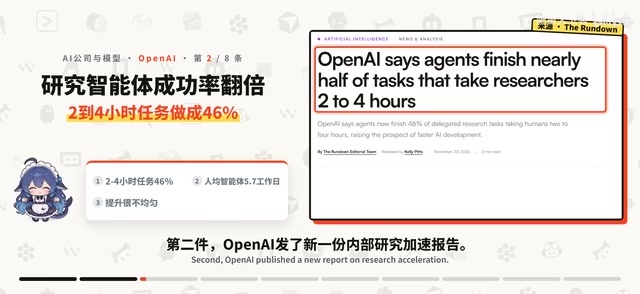
OpenAI Weekly Roundup: GPT-6.2 Rolls Out to ChatGPT, GPT-6 Designs Proteins
OpenAI's week: GPT-6.2 rolls out to ChatGPT, GPT-6 claims independent protein design, agent research share surges, perplexity proposed as a shared metric, and internal safety concerns surface.

Is the Crypto Industry About to "Turn Blue"? The Truth Behind Tech and Politics' Shifting Allegiances
Vergecast discusses whether the crypto industry will shift from the right to the Democrats, revealing the pragmatic nature of tech's politics and the costs of a crypto pivot.