One-Shot Generative Flows: Existence of Straight Flows and Topological Obstructions

Rigorous analysis of when straight flows exist in generative models and what makes them impossible.
This work translates the engineering goal of "one function evaluation per sample" into a rigorous mathematical question. Using the flow matching and stochastic interpolant frameworks, it characterizes straightness via the inviscid Burgers equation, and provides an explicit construction with covariance matrix square root noise that achieves straight flows between Gaussian pairs. More strikingly, it proves that for target distributions on the real line with disconnected support — or even merely ε-disconnected multimodal structure — no continuous-path stochastic process can induce a straight flow. The proofs exploit a contradiction between endpoint independence and the intermediate value theorem, revealing multimodality as a fundamental topological obstruction to straight flows.
Starting from Dynamic Measure Transport
One of the central tasks in generative modeling is transforming a simple, easy-to-sample distribution (such as a Gaussian or uniform distribution) into a complex target distribution that is difficult to sample directly. This work, drawn from an academic presentation, revolves around "dynamic measure transport" and addresses a question that appears engineering-focused but is mathematically profound: can we construct a stochastic process whose induced flow is exactly straight (i.e., a straight line)?
The standard construction goes like this: take a stochastic process indexed by the unit interval $[0,1]$, requiring that its marginal distributions at times 0 and 1 match two given measures $P_0$ and $P_1$ respectively. Then compute the conditional velocity field — that is, the conditional expectation of the time derivative given the process's current position. With this velocity field, one can integrate an ODE to obtain a flow map that transports samples from $P_0$ to $P_1$. This is the shared backbone of modern generative methods such as flow matching and stochastic interpolants.
Why Pursue "Straight Flows"?
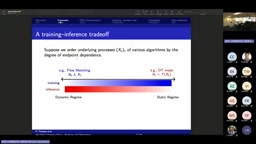
The presenter offers a very practical cost-based perspective: the expense of sampling is approximately equal to the number of velocity field evaluations required to integrate the ODE. If the velocity field induces a straight flow — meaning the second time derivative of the flow map is everywhere zero, with no curvature — then the ODE can be integrated analytically, requiring only a single function evaluation for an exact result.
This is clearly the dream scenario for generative models: after training the velocity field, inference becomes nearly zero-cost. The problem is then precisely formulated as a "design question": given a target measure $P_1$, can we find a stochastic process whose induced flow has straight-line geometry? When is this possible? And when it isn't, what is the obstruction?
Independent Endpoints and Computable Processes
The presentation borrows the stochastic interpolant framework and introduces the concept of a "generalizable interpolant": a process that can be expressed as a deterministic function of time, $X_0$, $X_1$, and some exogenous noise $Z$. The key assumption is that $X_0$, $X_1$, and $Z$ are mutually independent — drawn from a triple product distribution.
This independence assumption is not arbitrary. The presenter arranges various generative algorithms along a spectrum according to their "degree of endpoint dependence": at the far left are flow matching and stochastic interpolants with independent endpoints, which require no pre-computed coupling and are easy to train but may require multi-step integration at inference time; at the far right is full optimal transport (OT), where once the transport map is obtained, straightness is trivial, but training is difficult. The middle ground — pre-computing or estimating some form of coupling — is both interesting and hard. The presenter chooses to start from the leftmost end: independent endpoints, the "zero extra information" regime.
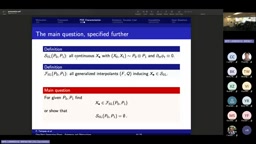
Mathematically, the presentation defines two classes of processes: SSL is the full collection of processes with continuous sample paths, independent endpoints, and curvature-free flows; FSL is the subset of SSL that can be represented as generalizable interpolants — the "computable" portion. The central question then becomes: given a measure, either exhibit a process in SSL/FSL satisfying straightness, or prove that no such process exists anywhere in the "universe" SSL.
PDE Characterization of Straightness
A key transformation is that the curvature-free condition on the flow is equivalent to the velocity field satisfying a particular partial differential equation — known in fluid mechanics as the inviscid Burgers equation (expressed via the material derivative operator). This allows one to bypass the flow itself when discussing straightness, and instead simply check whether this PDE holds — effectively moving from a Lagrangian perspective to an Eulerian one.
One can further derive a second-order form: the Burgers equation is equivalent to a "balance flow" equation relating conditional covariance and conditional acceleration, resembling a momentum conservation law in form. These reformulations provide not only physical intuition but also concrete conclusions. For affine interpolation (the standard flow matching construction), the balance flow equation holds only when the endpoint coupling is a deterministic map — that is, within the restricted affine framework, the only viable case is precisely the trivial end of the spectrum (where a map $X_1 = T(X_0)$ exists). Any non-trivial intermediate case fails. This reveals a fundamental tension: if the process form is too simple, only the rightmost end of the spectrum works.
Positive Results in the Gaussian Case
When the process is allowed to take arbitrary form, and $P_0$ is taken to be the standard Gaussian while $P_1$ is another Gaussian (sharing the same eigenbasis), the presentation establishes an existence result: a generalizable interpolant satisfying the straightness condition does indeed exist. It is composed of the deterministic interpolation part from flow matching, plus a Brownian bridge-like "square root perturbation" term — notably, the noise $Z$ is multiplied by the matrix square root of the product of covariance matrices, not the covariances themselves.
What is intuitively surprising is that the sample paths of this process are themselves curved, yet once one computes the conditional expectation to obtain the velocity field and integrates to get the flow, the flow is straight. That is, the locally curved average velocities in spacetime cancel each other out in a statistically precise way, inducing a rigid zero-curvature constraint. Why is the key the "square root of the covariance" — making the second derivative vanish — rather than the covariance itself? The presenter admits there is no clear geometric explanation, and it can only be verified algebraically (Gaussian conditional expectations have closed forms, which can be substituted directly into the Burgers equation).
This Brownian bridge-like correction term has another interesting property: it is continuous in time, but its derivative is singular at 0 and 1 — as if injecting a large amount of noise at the endpoints, erasing information connecting inputs to outputs, and forcibly creating a kind of "memorylessness" that drives the endpoint covariance to zero.
Topological and Analytic Obstructions in One Dimension
Beyond the positive results, the more illuminating part concerns the "obstructions." The presentation first proves that if a measure on the real line has disconnected support (i.e., the support consists of two separated sets), then no SSL process exists that connects that measure to itself.
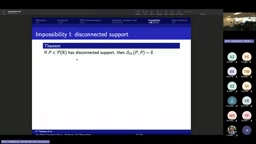
The proof is an elegant argument by contradiction. Suppose such a straight flow exists; by the well-posedness of the ODE, flow lines cannot intersect. In one dimension, two separated modes are each closed: flow lines starting in $S_0$ remain in $S_0$, and those starting in $S_1$ remain in $S_1$. This creates a "no-go zone" in spacetime — a parallelogram-shaped region that mass can never enter, meaning the stochastic process driving the flow also never enters this region. But endpoint independence requires that with positive probability $P(S_0) \cdot P(S_1)$, the process must have one endpoint below and one above; by the continuity of sample paths (intermediate value theorem), any path connecting these two points must pass through the no-go zone. The contradiction follows. The presenter calls this a "topological obstruction": spacetime becomes disconnected as a result.
From Topology to Quantitative: $\epsilon$-Disconnectedness
One might object that disconnected support is overly pathological — in practice, source distributions are often well-behaved. To address this, the presentation provides a stronger quantitative version: the source measure is taken to be the standard Gaussian (perfectly well-behaved), and the target measure only needs to be "$\epsilon$-disconnected" — meaning $1-\epsilon$ of the mass is concentrated in two well-separated modes, with only an infinitesimal $\epsilon$ mass bridging them (as in a bimodal distribution with two narrow peaks far apart). The conclusion still holds: no process with continuous sample paths satisfying the straightness condition exists.
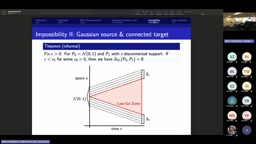
The proof is a quantitative sharpening of the previous argument. The no-go zone becomes a triangular region containing only $\epsilon$ mass, which still disconnects spacetime into two components. Combined with Lipschitz/modulus-of-continuity control on the process (which, with high probability, does not move at extremely high speed), a union bound shows that the probability of entering this region must fall below a threshold $\epsilon_0$, while endpoint independence requires that this probability be positive and exceed the threshold — again a contradiction. Crucially, this threshold $\epsilon_0$ is explicitly computable in terms of the problem parameters: below it, non-existence holds; above it, the conclusion is undetermined. This is a "negative result" showing that quantitative multimodality is itself a fundamental obstruction to straight flows.
Open Problems
The presenter honestly lists directions that remain unsolved. First, the non-existence theorem for $\epsilon$-disconnectedness has not been extended to higher dimensions (dimension greater than 1) — in higher dimensions, paths can go around each other, the technique of tracking extreme rays fails, and neither modal $m$-separation nor second-order control has sufficed. Second, there is the goal of extending the existence results by finding more examples of processes with straight-line behavior; since multimodality is the obstruction, a natural starting point is unimodal measures (such as log-concave distributions), where the PDE framework may prove useful. Third, there is the question of exploring the middle ground of the spectrum: allowing some non-deterministic dependence between endpoints, and thinking about how to quantify the degree of such dependence (mutual information?).
Summary
This work translates the engineering vision of "sampling with a single function evaluation" into a rigorous mathematical question about the existence of stochastic processes. It characterizes straightness via the Burgers/balance flow PDE, provides an explicit construction with matrix square root noise between Gaussian pairs, and uses topological and quantitative analysis to prove that for disconnected or $\epsilon$-disconnected multimodal targets, straight flows simply cannot exist in one dimension. This provides a clear and profound theoretical framework for understanding the intrinsic limits on sampling costs in generative models.
Related articles

DeepCell: One-Click AI Generation of Documents, Spreadsheets, and Slides
DeepCell tops Product Hunt with one-click generation of documents, spreadsheets, and slides, using the .deepcell format for linked updates, designed for System 2 tasks like modeling and sales reviews.

Doneas: 15-Minute Daily Accountability Calls That Keep Indie Developers From Procrastinating
Doneas is a daily accountability tool for indie developers: plan tasks on Monday, join a 15-minute call with five builders each day, and log deliveries on a public progress page. This article analyzes its core mechanics, effectiveness, and potential issues around retention and matching.

Fastlane 2.0: Fully Automated AI Ad Campaigns, From Creative to Optimization
Fastlane 2.0 is an AI ad automation tool: enter your website and it learns your brand, generates video and image ads, and runs and optimizes them on Meta, TikTok, Instagram, and YouTube.