One-Shot Hierarchical Federated Clustering: Tackling Distributed Non-IID Biomedical Data
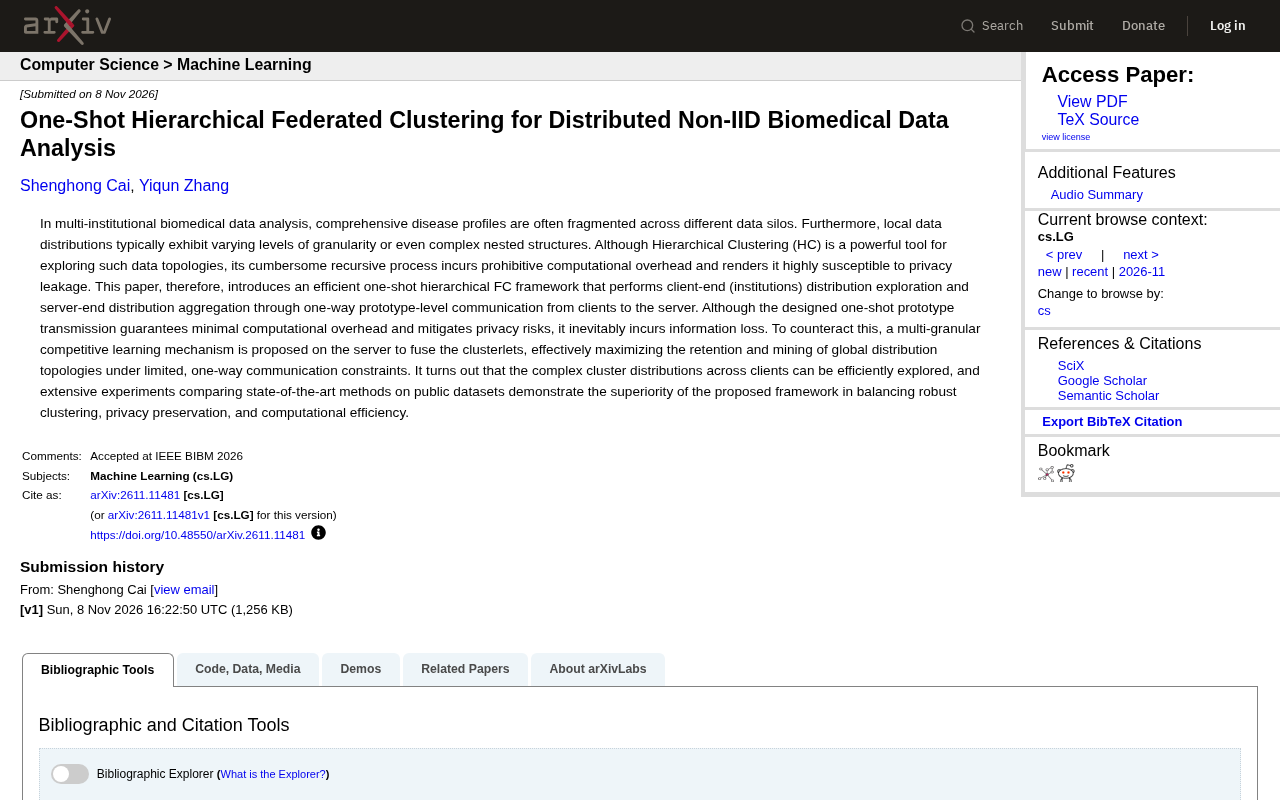
One-shot federated hierarchical clustering balances quality, privacy, and efficiency via single-round prototype transfer and server-side multi-granularity fusion.
The article presents a one-shot hierarchical federated clustering framework from an arXiv paper, addressing the structural tension in multi-institutional biomedical data analysis: complete disease profiles are scattered across silos, local distributions are non-IID with granularity differences and nested structures, and traditional hierarchical clustering is costly and privacy-risky. Clients extract prototypes locally and send them one-way in a single round, minimizing communication and privacy exposure; the server fuses clusterlets via multi-granularity competitive learning to compensate for information loss and infer cross-institutional hierarchies. Experiments on public datasets show a good balance among robustness, privacy, and efficiency.
Multi-institutional biomedical data analysis has long faced a structural tension: complete disease profiles are scattered across different data silos, while each institution's local data distribution exhibits granularity differences and even complex nested structures. Hierarchical clustering (HC) is a powerful tool for exploring such topologies, but its recursive process is computationally expensive and prone to privacy leakage. A paper from arXiv proposes a one-shot hierarchical federated clustering framework that seeks a new balance among clustering quality, privacy protection, and computational efficiency.

Background: When Hierarchical Clustering Meets the Federated Setting
In biomedical research, a single institution often holds only a fragment of patient data. Only by combining data from multiple hospitals can a relatively complete disease map be assembled, yet data sharing faces dual constraints from regulations and ethics. Federated learning offers a middle path—data stays local, and only model parameters or prototype information are exchanged.
The problem is that each institution's data distribution is non-independent and identically distributed (Non-IID), and this Non-IID is not merely simple label skew but also manifests as granularity differences and nested structures at different levels. Traditional hierarchical clustering requires repeated recursive computation on the client side, involving many communication rounds and heavy computational burden, with each round of interaction increasing the risk of privacy exposure. The authors point out that the computational overhead of this recursive process has reached an "unbearable" level.
Hierarchical Clustering (HC) is a class of algorithms that build tree-like clustering structures either bottom-up or top-down. Taking the agglomerative approach as an example: each sample initially forms its own cluster, and then the two closest clusters are iteratively merged until a stopping condition is met. This recursive merging process produces a dendrogram that can simultaneously present clustering results at different granularities. The problem is that each merging step requires recalculating inter-cluster distances, and the time complexity is typically O(n² log n) or even higher; in the federated setting, if each round of merging requires synchronizing intermediate cluster states across clients, the number of communication rounds and the privacy exposure surface grow linearly with recursion depth. This is precisely the technical root of what the original text describes as "the recursive process being computationally expensive and prone to privacy leakage."
Core Idea: One-Way Prototype Transmission + Server-Side Multi-Granularity Competitive Learning
The framework's design can be broken down into two key actions.
Client Side: One-Shot Prototype Extraction
Each institution performs local distribution exploration on its data, extracts prototype-level information, and then sends it one-way to the server. The entire process involves only one communication round, does not involve uploading raw data, and does not require the server to broadcast intermediate results downstream. This design minimizes computational overhead while significantly reducing the possibility of privacy leakage—after all, one-way, single-round, prototype-level transmission exposes far less than multi-round model synchronization.
Prototype in clustering and federated learning typically refers to using a small number of representative vectors to summarize the characteristics of a data subset, such as cluster centers, density peak points, or typical samples. Compared with uploading full model gradients, prototypes are a higher-level, more condensed form of information: they do not expose individual samples or leak details of model parameters, and thus have a smaller privacy exposure surface. But the cost of prototypes is information loss—a cluster is represented by only one or a few vectors, and details such as the variance, skewness, and multimodality of the local distribution are lost. The original text's emphasis that "one-shot transmission, though efficient, inevitably incurs information loss" refers precisely to this inherent trade-off caused by prototype compression, and it is also the reason the server must introduce a multi-granularity fusion mechanism to compensate.
Server Side: Multi-Granularity Competitive Learning Fusion
Although one-shot transmission is efficient, information loss is inevitable. The compressed prototypes from clients cannot fully reconstruct local distribution details. To compensate, the paper introduces a multi-granularity competitive learning mechanism on the server side to fuse the clustering clusterlets from various clients. The role of this mechanism is to preserve and mine the global distribution topology as much as possible under the constraints of limited, one-way communication. In other words, the server does not simply stitch prototypes together but instead creates a competitive relationship among clusters at different granularities, thereby inferring the cross-institutional hierarchical structure.
Clusterlets is a key term used in the original text, referring to the small-scale, fine-grained cluster structures that clients obtain locally through distribution exploration, rather than single prototype points. Each client may produce multiple clusterlets, which carry local topological information of the local data. The meaning of "multi-granularity competitive learning" on the server side is that clusterlets from different clients and different granularity levels are not simply concatenated or averaged; rather, through some competitive mechanism (for example, screening and merging based on inter-cluster distances, density, or consistency scores), it determines which small clusters should be assigned to the same upper-level cluster. This competitive fusion can infer the cross-institutional hierarchical structure under the condition of only one-way, single-round information, thereby compensating to a considerable extent for the information loss caused by prototype compression.
Experimental Performance and the Three-Way Balance
The paper conducts comparative experiments with various existing methods on public datasets. The results show that the framework can effectively explore complex cluster distributions across clients and achieve a good balance across three dimensions: clustering robustness, degree of privacy protection, and computational efficiency.
The phrase "three-way balance" is worth noting. Much work in the federated learning field tends to trade off between efficiency and accuracy, while hierarchical clustering additionally introduces the difficulty of structural reconstruction. The framework's approach is to shift complexity from the communication stage to the server-side fusion algorithm—using one communication round to gain computational simplicity, and then using intelligent server-side fusion to compensate for information loss.
Implications for Biomedical Data Collaboration
A real-world dilemma in multi-institutional biomedical research is that data cannot leave the hospital, yet research requires a global view. This type of one-shot federated clustering method provides a pragmatic technical route—not pursuing multi-round fine-grained optimization, but maximizing information utilization under the constraint of single-round communication. For scenarios with many participating institutions, uneven network conditions, and strict privacy requirements, this design approach has direct reference value.
Of course, the inherent limitations of one-shot communication also mean that this method is more suitable for analysis tasks with relatively stable distribution structures and low real-time requirements. The paper currently validates clustering performance on public datasets; issues in real biomedical data such as missing values, modality differences, and悬殊 sample sizes across institutions remain directions for further verification.
Key Takeaways
- The Non-IID distribution of multi-institutional biomedical data has granularity differences and nested structures, and traditional hierarchical clustering has high recursive overhead and high privacy risk.
- The framework adopts one-shot prototype transmission from clients to the server, minimizing communication rounds.
- The server fuses clustering clusterlets through multi-granularity competitive learning to compensate for information loss caused by one-way communication.
- Experiments show that the method achieves a good balance among clustering robustness, privacy protection, and computational efficiency.
One-line Summary
A one-shot federated hierarchical clustering framework balances clustering quality, privacy, and efficiency through single-round prototype transmission plus server-side multi-granularity fusion.
Paragraph Summary
The article introduces a one-shot hierarchical federated clustering framework proposed in an arXiv paper, aimed at resolving the structural tension in multi-institutional biomedical data analysis: complete disease profiles are scattered across data silos, each institution's data distribution is non-IID and exhibits granularity differences and nested structures, and traditional hierarchical clustering has high recursive computational overhead and high privacy risk. The framework extracts prototypes locally on clients and sends them one-way, in a single round, to the server, minimizing communication and privacy exposure; on the server side, a multi-granularity competitive learning mechanism fuses clustering clusterlets from each client, compensating for information loss caused by one-way communication and inferring cross-institutional hierarchical structures. Experiments on public datasets show that the method achieves a good balance among clustering robustness, privacy protection, and computational efficiency, providing a pragmatic technical route for biomedical collaboration where data cannot leave institutions.
Related articles

Bilibili Creator Teases Fireworks Vlog: A New Trend in AI Tech Content Creation?
A Bilibili creator posts an Urdu dialogue clip teasing an upcoming fireworks vlog. The material lacks substantive AI tech content; this article honestly analyzes its informational limits and explores content creation teaser strategies.
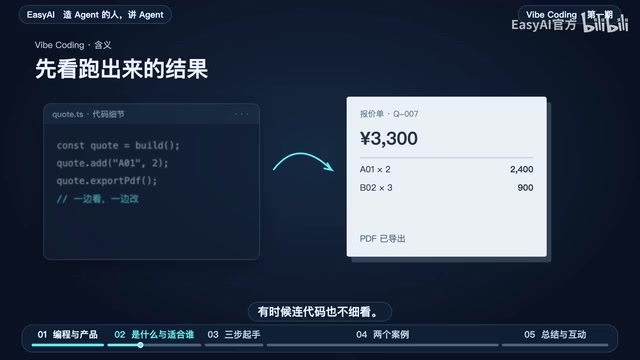
Nobody Uses What Vibe Coding Builds? Coding Is Easy, Products Are Hard
Vibe Coding makes AI coding easy, but a working demo isn't a usable product. From quote tools to one-handed Agent Hub operation, here's why coding is easy and products are hard—plus a three-step method for building usable tools without technical skills.
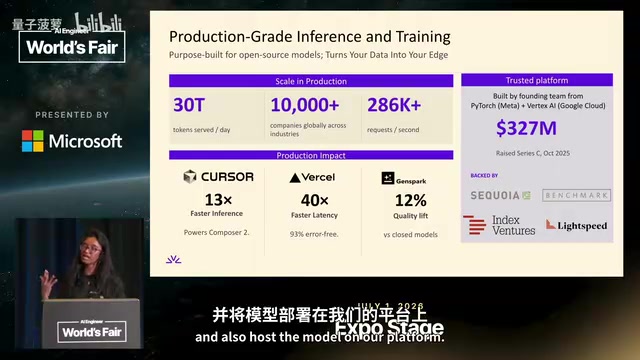
Fireworks AI: How Open-Source Models Rival Closed-Source Through a Training-Deployment Flywheel
Fireworks AI's Jet explains how open-source models rival closed-source via a custom inference engine, three training modes, and a same-platform data flywheel.