One Tweet, One Debate: Is Devin's Problem the Product or the Sales Process?

Is Devin's controversy a product flaw or a sales expectation mismatch? One tweet opens a broader debate.
A short tweet about AI coding assistant Devin prompted a broader discussion: is market skepticism toward Devin a sign of fundamental product failure, or a symptom of poor sales enablement? The article explores the critical difference between diagnosing a technical flaw versus a go-to-market misalignment, noting that for AI tools with fuzzy capability boundaries, precise expectation-setting during sales is especially vital. The author cautions against conflating individual user experience with overall product quality.
The Debate Behind One Tweet
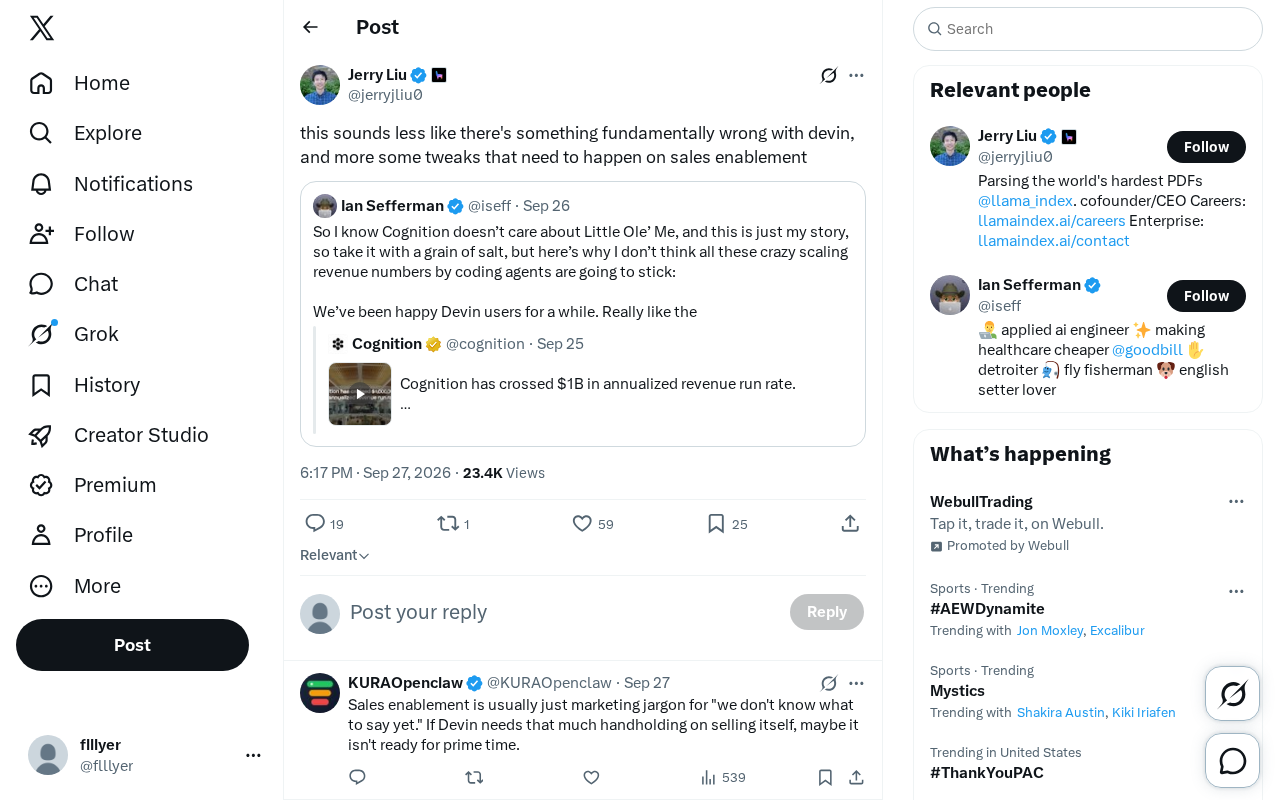
Recently, a tweet about the AI coding assistant Devin sparked discussion among industry observers. The original comment was concise: "This doesn't sound like a fundamental flaw in Devin itself — it sounds more like something that needs to be addressed in the sales enablement process."
Brief as it was, the remark cut to a highly representative issue in the commercialization of AI tools today: when an AI product faces market skepticism, does the root cause lie in the technology itself, or in how it is positioned, sold, and delivered to customers?
Product Flaw vs. Sales Execution
The tweet's author leaned toward the latter. "Sales enablement" refers to the content, tools, processes, and training that companies provide to their sales teams to help them communicate product value more effectively. When a tool is perceived as "broken," it's often not that the functionality fails to deliver — it's that a mismatch has formed between customer expectations and actual capabilities.
For a product like Devin, which is positioned as an "AI software engineer," this kind of mismatch is especially prone to occurring. If marketing emphasizes the ability to independently complete complex engineering tasks, while real-world use requires substantial human oversight and correction, the gap users experience gets amplified — and the blame gets attributed to the product itself. From the perspective of this tweet, what may actually need fixing is how use cases are defined, how expectations are set, and how customer needs are precisely matched during the sales process.
Devin was launched by startup Cognition AI in March 2024, billed as the world's first "fully autonomous AI software engineer" capable of independently completing end-to-end software development tasks — including writing code, debugging, deploying, and interacting with external APIs. Its initial demo video generated widespread attention in the industry, but it was soon followed by reports from independent testers noting gaps between the marketed claims and actual performance. This backdrop makes the tension between "the limits of technical capability" and "market expectation management" especially pronounced — the more aggressive a product's positioning, the greater the risk of a gap between customer expectations and lived experience, and the more critical precise communication becomes during the sales process.
Why This Distinction Matters
Distinguishing between a "fundamental product flaw" and a "sales execution problem" has real implications for how a company should respond.
If the problem is technical, it means committing significant R&D resources to rebuilding core capabilities — a long, high-risk endeavor. But if the problem is primarily one of positioning and delivery, adjustments like refining the target customer profile, optimizing demo workflows, and clarifying the product's applicable boundaries can often improve market reception in far less time.
This is also why many AI startups in their early stages repeatedly emphasize that "finding the right use case" matters more than blindly stacking features. A technically strong product that gets sold to the wrong customers — or that promises capabilities it can't deliver — will still accumulate negative word of mouth.
In product management and business analysis, distinguishing between a "Product-Market Fit" problem and a "Go-to-Market Strategy" problem is a fundamental skill. The former means the product's core capabilities genuinely cannot address the target user's pain points, requiring a fundamental redesign. The latter means the product capabilities are sufficient, but the target customer segment is wrong, the value proposition is unclear, or the sales process has committed to functionality beyond what the product actually delivers. For AI tools, this distinction is especially complex — the capability boundaries of AI systems are typically fuzzy and context-dependent, making them far harder to define with a clear feature checklist than traditional software. This creates an inherent challenge for the accuracy of sales messaging.
A Note on Evaluating AI Tools
The value of this tweet lies largely in its reminder to observers to stay measured when judging an AI product. Online criticism of AI coding tools often tends to be emotional and sweeping, conflating "I didn't use it well" with "the product doesn't work."
In reality, a tool's market performance is the combined result of technical capability, pricing strategy, sales messaging, and customer fit. A single negative case doesn't necessarily speak to the fundamental quality of a product — and conversely, overly optimistic marketing can mask genuine capability limits.
It's worth noting that the source material for this article is a single short tweet, with no specific usage data, customer feedback, or internal company information about Devin provided. The analysis above is therefore an extended discussion of the issues the tweet raises, not a definitive verdict on the Devin product itself.
Conclusion
Whether an AI tool "works" rarely has the black-and-white answer it might appear to on the surface. A product flaw and a sales mismatch are two separate problems that need to be diagnosed separately. For practitioners focused on AI tool adoption, learning to tell the difference may be more meaningful than simply picking a side — booster or skeptic.
Related articles

Gmod TTT: Boba's Winning Streak and Game Design Insights
An in-depth analysis of Gmod TTT's role system, creative items, and social gameplay mechanics, exploring the relationship between randomness design and game balance through Boba's winning streak phenomenon.

FlexBudget: Fair Comparison of KV Cache Eviction Strategies Under a Unified Compute Budget
AMD engineer proposes FlexBudget at PyTorch Conference: a training-free fair comparison method for KV cache eviction rules using fixed kernels and memory budgets, all in core PyTorch.
