One Weekend, One AI Agent, One Money-Making App: From Code to Business Model

One creator used AI agents to build and monetize a student learning app in a single weekend.
This article documents how a content creator used AI agents (built on Abacus AI and the Augment SDK) to build a student learning management app and a business model in a single weekend. The app's standout feature is zero-friction data entry — drag in messy files, type one prompt, and the AI generates course structures, calendar entries, and progress trackers automatically. The creator used a brief-driven approach, letting the agent ask clarifying questions to produce precise specs. The business model combines lifetime and subscription pricing with a 50% revenue share that turns student users into distribution partners. The core argument: AI is shifting the startup barrier from coding ability to clarity of problem-thinking and business strategy.
One Weekend Experiment: AI Is More Than Just Writing Code
The hardest part of building a startup was never writing code. This content creator spent a single weekend, with the help of an AI agent, shipping a learning management app for students — and turning it into a business that could actually run. His core thesis is clear: today, anyone with AI can build something impressive. What truly sets products apart is polish, distribution, and business model.
The app isn't about managing students — it's about helping students manage their own learning. It features a built-in agent that fully understands the app's logic, functioning more like a "manager": not doing homework for students, but helping them organize materials and stay on top of coursework. The dashboard surfaces weekend schedules, course progress, and a calendar view so students can see their study rhythm at a glance.
Zero-Friction Data Entry
The most compelling moment in the entire demo is something the creator kept coming back to: "zero friction." He dragged a pile of messy files — a math spreadsheet, a syllabi outline, instructor emails — directly into the app, typed "help me organize the important information," and the agent automatically read, interpreted, and structured everything.
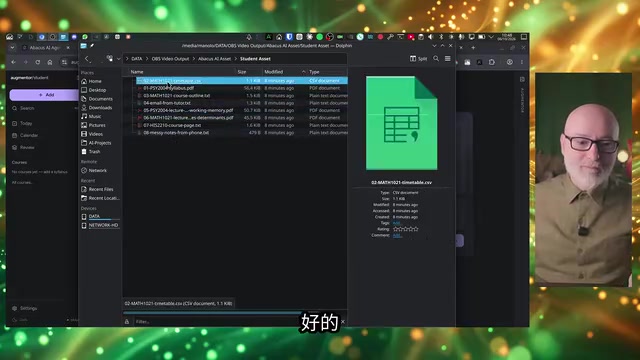
The results were striking: the system automatically added two courses, 35 topics, 80 calendar entries, and 7 materials — and synced everything to the calendar and progress tracker. The manual data entry step, historically the most painful part of any productivity tool, was essentially eliminated. The creator argues this friction is often what determines whether a tool actually gets adopted.

The modular design also makes the app flexible — course modules like math, cognitive psychology, and modern European history can be toggled on or off, each with its own topics, deadlines, exam schedule, and weekly lesson plan.
Brief-Driven Development: Let the AI Write the Spec
The creator shared his build process, which is particularly useful for anyone who wants to try this themselves. Rather than writing code directly, he started with a brief — asking the agent to build a student app on top of the Augment app SDK, but intentionally leaving out details. The goal was to let the agent ask clarifying questions and generate its own spec.

After reading the brief, the agent proactively suggested what to build and produced a detailed "Student App Specification" document — a long-form writeup explaining step by step how the app works internally. The creator noted this was already the third version, refined through multiple rounds of back-and-forth with the document to clarify "what I actually want." His take: the process is remarkably simple, yet produces a highly precise spec. This reveals a key insight about AI-collaborative development — rather than front-loading a vague requirement, let the agent's questions force your thinking into focus.
The Augment app SDK is the core framework underlying this student app. An SDK (Software Development Kit) typically provides a set of pre-packaged functional modules, API interfaces, and development conventions, so developers don't have to build foundational logic from scratch. In this case, the Augment SDK defines the agent's operational boundaries within the app — things like reading files, updating the calendar, and managing course modules. The creator deliberately kept the brief sparse because he wanted to leverage the agent's existing understanding of the SDK to reverse-engineer feature design, rather than issuing direct commands. This approach — letting the AI first understand the tool's boundaries before asking questions — effectively transfers part of the requirements-clarification responsibility to the agent. The developer only needs to make decisions in conversation, without writing a complete technical spec upfront.
The Business Model Is the Real Moat
The creator is emphatic: a great app that nobody uses is worthless. In an era where AI has dramatically lowered the barrier to building, a good product alone is no longer enough. He outlines three "extra key steps": build something genuinely great, give it a website that looks the part, and set the right price for a student audience.

On pricing, he designed two tiers: a $9.99 lifetime purchase and a $1.99/month subscription, with Stripe handling payments. But the most interesting element is the distribution mechanic: a 50% revenue share with every student who sells the app. Students aren't just users — they're also sales partners who can learn entrepreneurship and earn money in the process. This design of turning users into distributors cleverly solves the hardest part of reaching a student audience: customer acquisition.
The 50% revenue share model described here is essentially a hybrid of affiliate marketing and user-as-distributor. It makes particular sense for student audiences: students have limited spending power, but dense social networks and high peer-to-peer trust — making word-of-mouth far more efficient than paid ads. By making students both users and sellers, the founder converts customer acquisition cost from a fixed expenditure into a variable commission paid only on completed sales, with almost no upfront marketing spend in the early stage. Stripe, as the payment infrastructure, supports automated commission payouts, keeping the whole mechanism technically lean. That said, this type of referral structure needs to meet legal compliance requirements in each market (e.g., whether it constitutes multi-level marketing), so real-world implementation warrants careful evaluation.
From Web to Mobile: Run the Agent Again
At the end of the demo, the creator showed how to quickly extend the web app into a mobile app. He created a project in Abacus, selected the most powerful available model, and typed: "Turn the Augment Student app into a mobile application." Again, the agent didn't execute blindly — it pushed back with questions: Which platform, iOS or Android? Which features do you need?
This "agent proactively asks clarifying questions" interaction pattern runs throughout the entire build process. The creator's advice: use the process to talk through your ideas until everything is clear, then let the agent generate a complete mobile app spec.
Final Thoughts: Building a Startup Has Never Been More Accessible
The creator admits it probably won't actually take just one weekend — but the process is "not complicated at all." He believes the key isn't technical skill; it's having a vision, knowing clearly what problem you're solving, and genuinely asking potential customers what they need.
This demo carries an obvious promotional angle — Abacus AI and the Augment SDK are featured throughout — and the "make money" framing is more of a product demo concept than a market-validated revenue stream. But setting aside the marketing, the underlying idea is worth sitting with: AI is shifting the barrier to building a startup from "can you write code" to "do you have clear problem awareness and business thinking." For everyday people, this may be the best time to start building.
Related articles

ChatGPT Space Launches: Team Collaboration and New Pages Features Explained
ChatGPT Space is OpenAI's new team collaboration feature with Pages, real-time collaboration, and Slack/Google Drive sync. We break down its privacy design, multi-platform integration, and the full workflow from conversation to document.

Migrating Apache Spark UDFs to GPU Acceleration with AI Agents
NVIDIA developer blog explains how AI Agents rewrite Apache Spark UDFs for GPU acceleration, covering migration criteria, agent rewriting and verification workflows, plus pitfalls like result consistency and CPU-GPU transfer overhead.

Zed Editor v0.40.4-rc2 Released: Usage Credits Now Available Without Upgrading
Zed editor releases v0.40.4-rc2, allowing users to use usage credits for AI features without upgrading to a paid plan, lowering the trial barrier.