One Year After the EU AI Act: Why Are Compliance Statements on Hugging Face All Talk and Little Action?
Study of 5M+ Hugging Face records finds AI Act references rare and compliance largely limited to responsibility statements.
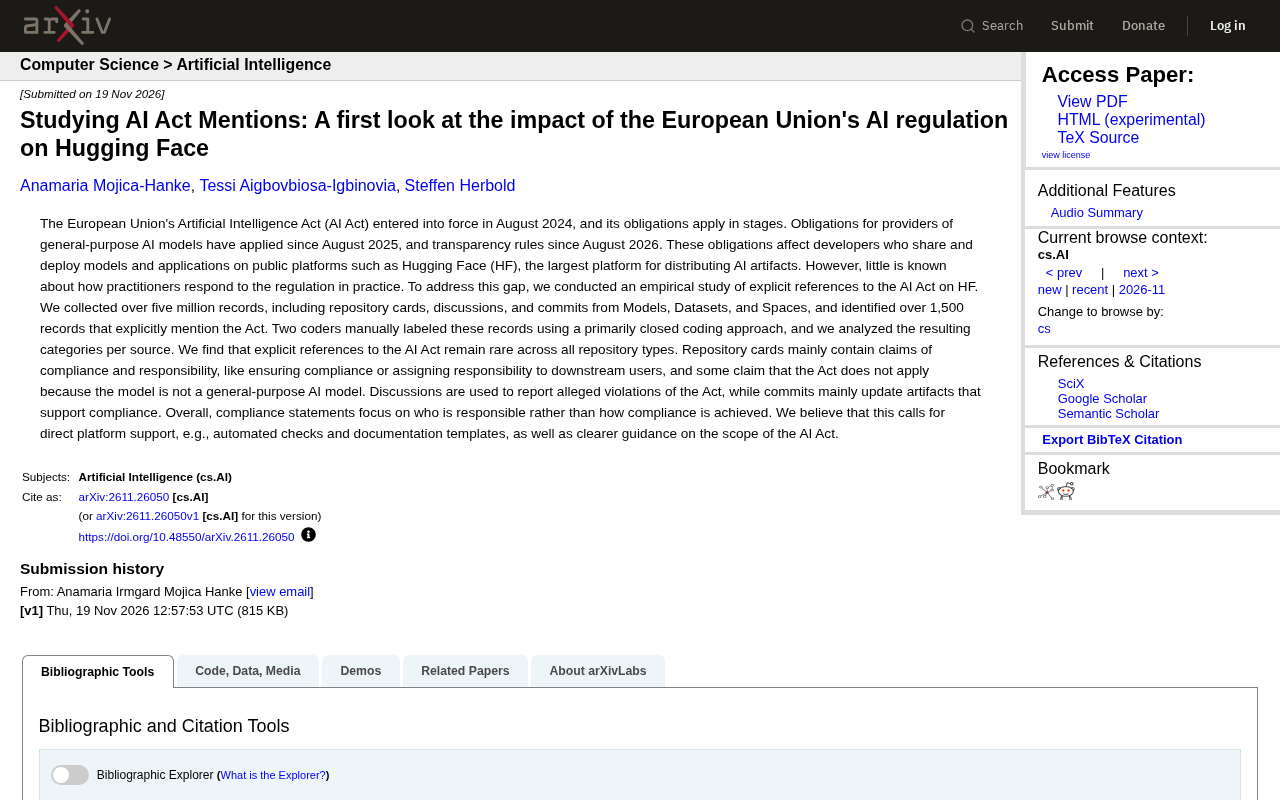
An empirical study collected over 5 million Hugging Face records (repository cards, discussions, and commits for models, datasets, and Spaces) and identified 1,500+ items explicitly mentioning the EU AI Act, analyzing them by source using closed coding. Key findings: explicit AI Act references are rare overall; compliance statements in repository cards focus on responsibility allocation and exemption claims rather than concrete implementation; discussions report suspected violations, and commits update compliance artifacts. The study recommends platform-provided automated checks and documentation templates, plus clearer scope guidance for general-purpose AI models, noting compliance remains at the "statement stage."
Title
One Year After the EU AI Act: Why Are Compliance Statements on Hugging Face All Talk and Little Action?
Meta Description
An empirical study of over 5 million Hugging Face records finds only about 1,500 explicitly mention the EU AI Act, with compliance statements focusing on responsibility allocation rather than implementation paths, calling for automated checks and documentation templates.
Article Content
Since the EU AI Act took effect in August 2024, it has imposed obligations on general-purpose AI model providers in phases: responsibilities related to general-purpose models apply from August 2025, and transparency rules officially take effect in August 2026. As the world's largest AI model distribution platform, how developers on Hugging Face (HF) respond to this regulatory framework has lacked systematic observation. A recent empirical study fills this gap—researchers collected over 5 million records on HF (covering repository cards, discussions, and commits for models, datasets, and Spaces) and identified more than 1,500 items that explicitly mention the AI Act.
1. Research Method: Extracting "Compliance Signals" from Massive Records
The study used a primarily closed coding method, with two coders manually annotating the filtered records and analyzing them by source (repository cards, discussions, commits). This design allows researchers to distinguish differences in compliance discourse across different interaction contexts, rather than broadly counting keyword frequencies.
You may not have noticed that despite the massive sample base (5 million+), only just over 1,500 records explicitly mention the AI Act—an extremely low proportion. The study thus draws its first core conclusion: Across all repository types, explicit references to the AI Act remain rare.
General-Purpose AI Models (GPAI) is a key classification in the EU AI Act. According to the Act's definition, GPAI models are AI models trained on large amounts of data that can perform a variety of different tasks and possess a certain degree of generality, typically including large language models (such as the GPT series and Llama series) and image generation models (such as Stable Diffusion). The Act imposes additional transparency, copyright compliance, and risk assessment obligations on GPAI providers, with tiered management based on the model's compute scale and degree of systemic risk. This classification matters because it determines whether developers bear the additional responsibilities stipulated by the Act—the "exemption claims" mentioned in the article are precisely developers asserting that their models are not GPAI and therefore not subject to the relevant provisions. Because the criteria for defining GPAI remain technically ambiguous (e.g., how to quantify "generality"), platforms and regulators need to provide clearer determination guidance.
Repository Cards are the core documentation mechanism on the Hugging Face platform, similar to a model's "manual" or "README file." Each card typically includes a description of the model's or dataset's purpose, training data sources, performance metrics, limitations, and usage license. In the context of AI Act compliance, repository cards have become the primary vehicle for developers to demonstrate their compliance posture—they can declare model purposes, label risk levels, or transfer responsibility in the cards. However, cards are unstructured text written autonomously by developers, and the platform does not mandate specific compliance templates or fields, which explains why the study observed that compliance statements in cards mostly remain at the level of "responsibility allocation" without verifiable technical details.
Closed Coding is a standardized annotation technique in content analysis. Researchers pre-define a relatively fixed coding framework (such as categories like "compliance statements," "exemption claims," and "violation reports"), and then multiple coders manually classify and annotate the text according to that framework. Unlike open coding, closed coding requires coders to choose among established categories rather than freely inducing new ones, making it more suitable for confirmatory research. This study used two coders annotating independently, and typically also calculates inter-coder reliability to ensure annotation quality. The advantage of this method is that it allows systematic comparison of compliance discourse differences across sources (cards, discussions, commits), but its limitation is that it may miss emerging compliance expressions outside the preset framework.
2. Repository Cards: Many Compliance Statements, but Few "How-Tos"
Repository Cards are the documentation for models, datasets, and Spaces, and also the main window through which developers communicate their compliance posture externally. The study found that AI Act-related statements in cards mainly fall into two categories:
- Compliance statements and responsibility allocation: For example, committing to ensure compliance, or transferring compliance responsibility to downstream users.
- Exemption claims: Some developers claim the Act does not apply, on the grounds that the models they publish are not general-purpose AI models.
A key finding is that these compliance statements focus on "who is responsible" rather than "how to achieve compliance." In other words, developers prefer to delineate responsibility boundaries in documentation but rarely disclose specific compliance technical measures or processes. This pattern of "responsibility first, methods absent" reflects the current lack of actionable compliance guidance at the platform level.
3. Discussions and Commits: Violation Reports and Compliance Tool Updates
The study also revealed the different uses of two other contexts:
- Discussions: Developers use discussions to report suspected violations of the AI Act, forming a kind of community oversight mechanism.
- Commits: Commits are mainly used to update compliance-supporting artifacts, such as supplementing documentation or adjusting model card content.
The comparison of these three sources shows that compliance practices on HF are fragmented: cards are used for declarations, discussions for reporting, and commits for patching, but there is a lack of systematic integration among them.
4. The Absence of Platform Support and the Urgency of Regulatory Guidance
Based on the above findings, the researchers make two recommendations:
- Direct platform support: For example, providing automated checks and documentation templates to reduce developers' compliance operational costs.
- Clearer guidance on the AI Act's scope: Especially regarding the definition of "general-purpose AI models," to reduce situations where developers choose exemption claims due to uncertainty.
The significance of this study lies in the fact that it is the first to present, with large-scale empirical data, the actual penetration rate of the regulatory framework within the developer community. Compliance statements concentrating on responsibility allocation rather than implementation paths indicates that the current implementation of the AI Act is still at the "statement stage," with a distance remaining before verifiable compliance practices. For platforms and regulators, this is both a challenge and an opportunity to optimize tools and guidance.
One-line Summary
A study analyzing over 5 million Hugging Face records finds explicit references to the AI Act are rare and compliance mostly amounts to statements of responsibility.
Paragraph Summary
An empirical study collected over 5 million records on Hugging Face (covering repository cards, discussions, and commits for models, datasets, and Spaces), identified more than 1,500 items explicitly mentioning the EU AI Act, and used closed coding to analyze them by source. The core findings are: explicit references to the AI Act are rare overall; compliance statements in repository cards mainly focus on responsibility allocation and exemption claims rather than specific compliance implementation methods; discussions are used to report suspected violations, and commits to update compliance artifacts. The study accordingly recommends that the platform provide automated checks and documentation templates and clarify the Act's scope for general-purpose AI models. The study is the first to present, with large-scale data, the actual penetration rate of the regulatory framework within the developer community, noting that current compliance remains at the "statement stage."
Related articles

Michael Nielsen Takes Down His Classic Neural Network Textbook, Sparking Community Discussion
Michael Nielsen's classic free textbook Neural Networks and Deep Learning has been taken offline, sparking discussion on Hacker News about the reasons and impact.

Inside the AI Training Data Market: The Trade-off Between Exclusivity and Discounts
G2i founder Gabe Greenberg reveals the dual-track pricing of the AI training data market: labs pay a premium for exclusive data or accept discounts that allow others to buy it.

SessionGraph: Unifying All Coding Agent Sessions in One Interactive Graph
SessionGraph aggregates coding agent sessions into an interactive graph, helping developers review, debug, and manage AI coding workflows across sessions. This article examines its positioning, value, and open questions.