Onlook: Open-Source AI Visual React Design Tool — Cursor for Designers

Onlook is an open-source AI visual design tool enabling WYSIWYG editing directly on React code.
Onlook is an open-source AI-First design tool dubbed "Cursor for Designers," with 25,700+ GitHub Stars. By letting designers perform visual operations directly on real React code, it bridges the gap between design and development. Users can generate and modify UI components through natural language, with AI automatically converting intent into React code. As an open-source alternative in a sector dominated by commercial products like v0 and Bolt, it represents a key evolution in AI-driven visual code editing.
Overview
Onlook is an open-source AI-First design tool built for designers, dubbed "Cursor for Designers" by the community. It allows users to visually build, style, and edit React applications while deeply integrating AI capabilities. The project has earned over 25,700 Stars on GitHub with nearly 2,000 Forks, is developed in TypeScript, and is rapidly becoming one of the most watched open-source projects in the frontend design and development space.
Why Onlook Deserves Your Attention
Bridging the Gap Between Design and Development
For a long time, there has been an almost insurmountable gap between designers and developers. Interfaces meticulously crafted by designers in Figma often need to be reimplemented from scratch by developers, inevitably leading to fidelity issues.
The root cause lies in structural flaws of traditional workflows. Designers use tools like Sketch and Figma to produce static design specs (typically pixel-level visual specifications), then pass spacing, color, typography, and other information to developers through annotation tools (like Zeplin). Developers then manually write HTML/CSS/JS code based on these specifications. Significant information loss occurs during this process: responsive adaptation logic, interaction states, animation details, and more often cannot be fully expressed in static design mockups. According to industry research, frontend developers spend an average of 30-50% of their time on UI implementation, while designers must repeatedly conduct Visual QA to ensure fidelity.
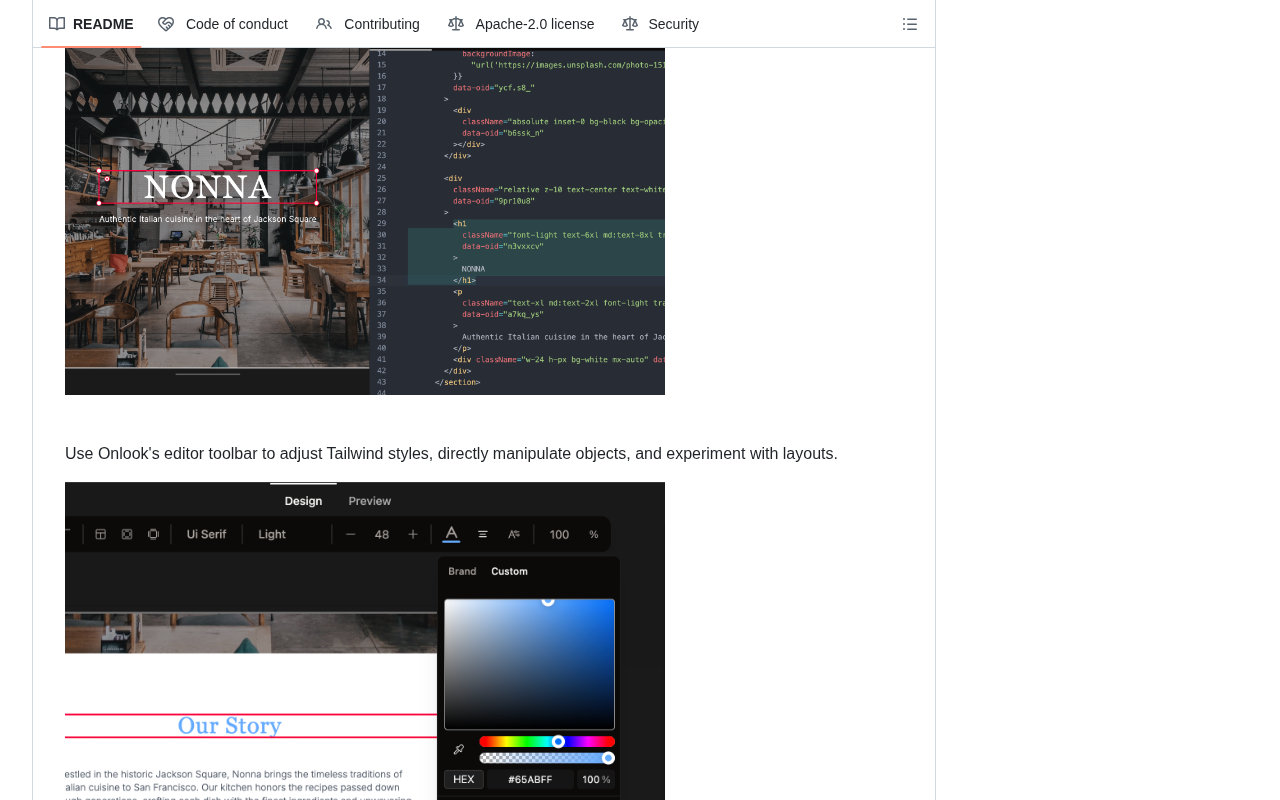
Onlook's core philosophy is: let designers perform visual operations directly on real React code — what you see is what you get, design is code.
This means designers no longer need to "hand off" design specs to developers. Instead, they can make visual adjustments directly in the project's codebase. Every drag, every color change is directly reflected in the actual React component code. This is made possible by React's Component-Based Architecture — React splits the UI into independent, reusable components, each encapsulating its own structure (JSX), styles, and logic. This declarative programming paradigm enables tools to establish bidirectional mapping between visual elements and code nodes: when a user selects a button on the canvas, the tool can precisely locate the corresponding React component source code; conversely, code changes are reflected in real-time on the visual canvas. This bidirectional binding mechanism is what distinguishes Onlook from traditional WYSIWYG editors (like early Dreamweaver) — the latter generates hard-to-maintain flat HTML, while Onlook operates on a structured component tree.
AI-First Design Philosophy
Onlook positions itself as an AI-First tool, and this is more than just a marketing label. Similar to how Cursor revolutionized the code editing experience with AI, Onlook aims to revolutionize the design experience with AI.
It's worth explaining the paradigmatic significance of Cursor here. Cursor is an AI code editor developed by Anysphere, built on VS Code, that achieves code completion, multi-file editing, and natural language programming through deep integration with large language models like GPT-4 and Claude. Its core innovation lies in upgrading AI from a "chat assistant" to an "editing partner" — AI can not only answer questions but also directly modify code within the editor while understanding the entire project's context. Onlook is called "Cursor for Designers" precisely because it extends this deeply integrated AI editing experience from the pure coding domain into the visual design domain.
Users can generate and modify UI components through natural language descriptions, with AI automatically translating design intent into corresponding React code and styles. From a technical implementation perspective, when a user inputs a natural language instruction (e.g., "make this card rounded, add a shadow, and change the background to gradient blue"), the system needs to complete several key steps: first, Intent Parsing — understanding the target element the user wants to modify and the desired effect; second, Context Awareness — understanding the current component's code structure, existing styles, and design system constraints; finally, Code Generation — producing React/CSS code that conforms to project specifications. Unlike pure code editors, Onlook additionally needs to handle real-time visual rendering feedback, ensuring that generated code immediately displays the correct visual effect on the canvas.
This approach dramatically lowers the barrier for designers to participate in frontend development — you don't need to master JSX syntax or CSS properties; you just need to describe the effect you want, and AI will implement it for you.
Advantages of the Open-Source Ecosystem
As a fully open-source project, Onlook offers the following advantages:
- Transparent and controllable: Code is completely public; enterprises can audit and deploy on their own
- Community-driven: Nearly 2,000 Forks indicate active community contributions
- Extensibility: Developers can customize features according to their needs
- No vendor lock-in: No dependency on any specific commercial platform
Technical Architecture and Tool Comparison
How Onlook Differs from Mainstream Design-Development Tools
| Tool | Positioning | AI Capability | Code Output | Open Source |
|---|---|---|---|---|
| Figma | Design collaboration | Plugin support | Requires conversion | No |
| Cursor | AI code editor | Deep integration | Native code | No |
| v0 (Vercel) | AI UI generation | Core feature | React code | No |
| Onlook | Visual design + coding | Core feature | React code | Yes |
Onlook's uniqueness lies in simultaneously occupying the "visual design" and "real code editing" positions while being fully open source. It doesn't aim to replace Figma or Cursor but rather fills the gap between them.
Regarding the competitors in the table, further explanation is warranted. v0 is an AI UI generation tool launched by Vercel (the company behind Next.js), where users can generate React component code based on shadcn/ui and Tailwind CSS through text descriptions or image inputs. Bolt (launched by StackBlitz) goes further, generating complete full-stack applications. Lovable (formerly GPT Engineer) focuses on converting natural language into deployable web applications. These tools collectively form the commercial ecosystem of AI UI generation, but most of them are closed-source SaaS products where users lack control over generation logic and data processing. Onlook's open-source positioning gives it a unique advantage in enterprise scenarios, particularly for teams with strict requirements around data security and code ownership.
TypeScript Tech Stack
The project is developed in TypeScript, which aligns highly with the React ecosystem. TypeScript is a superset of JavaScript developed by Microsoft that catches errors at compile time through a static type system. In tools like Onlook that need to parse and manipulate ASTs (Abstract Syntax Trees), TypeScript's type system is crucial: it ensures type safety when traversing component trees, modifying property values, and inserting new nodes.
Furthermore, TypeScript has become the de facto standard in the React ecosystem — according to the 2024 State of JS survey, over 80% of React projects use TypeScript. This means Onlook's target user projects are very likely TypeScript projects as well. Having the tool and target code share the same type system enables more precise code analysis and generation, and makes it easier for community contributors to participate in development.
Industry Trends and Impact
The AI Design Tool Sector Explosion
In 2024-2025, the AI design tool sector is experiencing explosive growth. From Vercel's v0 to Bolt, Lovable, and other products, AI-generated UI has moved from proof of concept to actual production use. Onlook's emergence represents the open-source direction of this trend — while commercial products continue to proliferate, the open-source community is building equally capable or even superior alternatives.
The Evolution of the Designer's Role
As AI tools mature, the designer's role is transforming from "pixel pusher" to "product experience architect." Tools like Onlook accelerate this transformation: when designers can directly manipulate code-level UI, their influence extends from design mockups to the final product.
The Market Signal Behind 25,000+ GitHub Stars
An open-source project gaining over 25,000 Stars in a short period is itself a strong market signal. In the open-source ecosystem, GitHub Star count is an important metric for measuring project attention (though it doesn't equate to actual usage). For reference, Penpot (Figma's open-source alternative) has about 35,000 Stars, VS Code has about 165,000 Stars, and Next.js has about 128,000 Stars. Onlook reaching 25,700 Stars in a relatively short time shows growth comparable to early-stage phenomenal projects like Tailwind CSS and shadcn/ui. This growth pattern typically indicates the project has hit a pent-up market demand, with community enthusiasm reflecting practitioners' strong resonance with existing toolchain pain points.
It indicates:
- Real market demand exists: A large number of designers and developers crave better design-development collaboration tools
- The AI + visual editing combination is validated: The community has voted with their feet, endorsing this product direction
- Open-source solutions are competitive: In a sector filled with commercial products, open-source solutions can still attract significant attention
Conclusion
Onlook represents an important evolutionary direction in the frontend development toolchain: AI-driven visual code editing. It's not a simple drag-and-drop page builder, nor a pure AI code generator, but rather an organic combination of both, offered to the community in an open-source manner. For practitioners interested in frontend toolchain evolution, design engineering, and AI application implementation, Onlook is a project worth following and trying.
Key Takeaways
- Onlook is an open-source AI-First design tool, dubbed "Cursor for Designers," supporting visual building and editing of React applications
- The project has earned over 25,700 Stars and nearly 2,000 Forks on GitHub, is developed in TypeScript, and has extremely high community activity
- Its core value lies in bridging the design-development gap, allowing designers to perform visual operations directly on real React code
- Deep AI integration enables users to generate and modify UI components through natural language descriptions, dramatically lowering the barrier for designers to participate in frontend development
- As an open-source solution, it provides a transparent and controllable alternative in a sector dominated by commercial AI design tools (v0, Bolt, etc.)
Related articles
 Product Reviews
The Programmer's Desk Setup Guide: Building a Workspace That Feels Like Home
Discover how programmers build productive, comfortable workspaces. From multi-monitor setups to ergonomic design, explore the desk philosophy that drives focus and flow.
 Product Reviews
Qoder vs Cursor Real-World Comparison: Which $20/Month AI IDE Is Better?
Hands-on comparison of Qoder vs Cursor AI IDEs: Agent autonomy, human interaction count, and architecture decisions. Qoder needed only 2 interactions vs Cursor's 8.
 Product Reviews
Cursor Cloud Agent Demo: Eliminating Bottlenecks Across the Entire Software Development Lifecycle
Deep analysis of Cursor's Cloud Agent demo showing how cloud VMs, automated test artifacts, and a full-chain control plane systematically eliminate human bottlenecks across the software development lifecycle.