Only $20K! Open-Source Text-to-Image Model Releases Apache 2.0 Weights
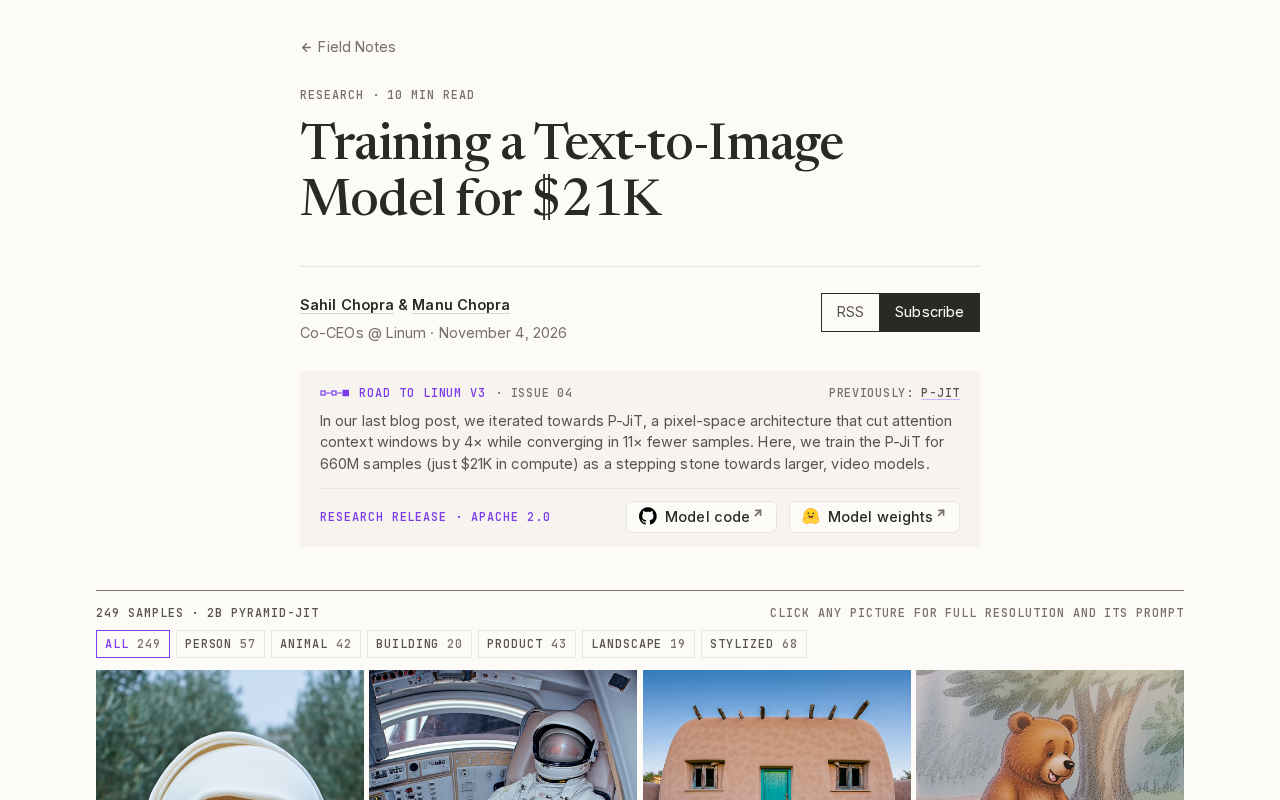
Author trained a text-to-image model for ~$20K and open-sourced weights under Apache 2.0, lowering the barrier but leaving performance to be verified.
The article introduces a low-cost text-to-image model project showcased on Hacker News. The author claims to have trained a "decent" model for about $20,000 and released the weights under the Apache 2.0 license. It analyzes possible strategies behind the $20K cost, such as small parameter counts, small datasets, efficient training techniques, and cheap compute; discusses the commercial friendliness of Apache 2.0 while noting that releasing only weights may limit community reproduction and improvement; assesses the market positioning of a "decent" model as suitable for cost-sensitive prototyping but unlikely to match top models; and concludes that the project reflects the trend of open-source AI lowering barriers, though its real impact and long-term value still depend on community participation.
Introduction
In the "Show HN" section of Hacker News, a project titled "A decent text-to-image model trained for ~$20K" has drawn attention. The author claims to have trained a "decent" text-to-image model at a cost of about $20,000 and released the model weights under the Apache 2.0 license. For developers interested in AI art and the open-source ecosystem, this is undoubtedly a case worth discussing.
Low-Cost Text-to-Image Model Training: What Does $20K Mean?
Current mainstream text-to-image models, such as the Stable Diffusion series, typically cost hundreds of thousands to millions of dollars to train. A training cost of $20,000 is extremely low by industry standards. This raises a key question: how can a "usable" model be trained on a limited budget?
The author did not disclose specific technical details, but based on the cost, one or a combination of the following strategies may have been used:
- Using a smaller parameter count (compared to large models with billions of parameters)
- Training on a relatively small dataset, or fine-tuning an existing pre-trained model
- Employing efficient training techniques such as mixed precision, gradient accumulation, and distributed training optimization
- Possibly using spot instances on cloud platforms or community compute resources to reduce costs
A training cost of $20,000 gives small and medium-sized teams, and even individual developers, a chance to try training their own text-to-image models, lowering the barrier to entry in the AI image generation field to some extent.
Cost Structure of Training a Text-to-Image Model
The cost of training a text-to-image model mainly comes from compute consumption, which depends on model parameter count, training data scale, number of training steps, and hardware efficiency. Take Stable Diffusion as an example: its training involves billions of image-text pairs and a large number of GPU hours, with costs reaching hundreds of thousands to millions of dollars. Cost estimates are usually based on GPU rental prices (e.g., about $1–3 per hour for an A100) multiplied by total training time. Ways to reduce costs include: reducing parameter count (e.g., from billions to hundreds of millions), using a smaller dataset or a subset of data, adopting parameter-efficient fine-tuning (such as LoRA) instead of training from scratch, using mixed precision training and gradient checkpointing to save GPU memory, and using spot instances or idle compute. A budget of $20,000 may correspond to hundreds to thousands of GPU hours, requiring the author to make careful trade-offs between model scale and training efficiency.
Apache 2.0 Weights: A Boon for the Open-Source Ecosystem
The project releases model weights under the Apache 2.0 license, a very permissive open-source license that allows commercial use, modification, and redistribution, requiring only that copyright notices and disclaimers be retained. For developers, this means the model can be freely integrated into their own products, or even further developed.
Compared with models under restrictive licenses (such as research-only use), Apache 2.0 clears the way for commercial applications. This may attract more developers to innovate based on the model, thereby enriching the application ecosystem in the text-to-image field.
However, it is important to note that open-sourcing model weights does not equal open-sourcing training code and datasets. If only the weights are released, the community will find it difficult to reproduce the training process or make in-depth improvements. The author did not state in the post whether the training code is open-sourced, which may affect its long-term value.
Key Terms of the Apache 2.0 License
Apache 2.0 is a permissive open-source license developed by the Apache Software Foundation. It allows users to freely use, modify, and distribute the software, including for commercial purposes, and does not require derivative works to use the same license (non-copyleft). Its core obligations include: retaining copyright notices, the license text, and a NOTICE file (if any), and noting changes in modified files. In addition, the license contains explicit patent grant terms, granting users a perpetual, worldwide, royalty-free license to use contributors' patents, while requiring contributors not to revoke the grant due to patent litigation. Unlike copyleft licenses such as GPL, Apache 2.0 does not force derivative works to be open-sourced, making it very friendly for commercial integration. Note, however, that the license covers only the code or weights themselves, not the training data or trademarks.
Market Positioning and Challenges of a "Decent" Model
The author describes the model as "decent," a relatively modest characterization. In the text-to-image field, model quality is usually measured by dimensions such as the realism and diversity of generated images and the ability to understand prompts. A "decent" model may perform well in some scenarios but may fall short of top commercial models on complex prompts or high-resolution generation.
For developers, such a model may be suitable for cost-sensitive scenarios that do not demand extreme quality, such as rapid prototyping, internal tools, and educational demos. But for commercial-grade products, its actual generation quality may still need to be evaluated.
The text-to-image field is highly competitive today: closed-source models such as DALL·E and Midjourney continue to iterate, and the open-source camp also has strong projects such as Stable Diffusion. For a new low-cost model to gain attention, it needs to demonstrate unique value in usability, community support, and other aspects beyond cost advantages.
Dimensions for Evaluating Text-to-Image Model Quality
Evaluating the quality of a text-to-image model usually involves multiple dimensions: image realism (e.g., FID score measuring the gap between generated and real distributions), image-text alignment (e.g., CLIP score measuring semantic matching between generated images and prompts), diversity (the degree of variation in outputs under the same prompt), resolution support, inference speed, and robustness (response to complex or rare prompts). In addition, subjective ratings in user studies (such as aesthetic quality and compositional rationality) are also important. A "decent" model may reach a moderate level on these metrics—for example, generating reasonable images in simple scenarios but underperforming on multiple objects, fine attribute binding, or high-resolution output. For developers, whether it is applicable depends on the tolerance of the specific application scenario.
Implications for the Open-Source AI Community
This project reflects a trend in the open-source AI community: lowering the barrier to model development by optimizing training pipelines and leveraging limited resources. Although $20,000 is still a significant investment for individual developers, it is an order-of-magnitude reduction compared with the investments of large companies. This encourages more experimentation and innovation.
At the same time, the release of Apache 2.0 weights also embodies the open-source spirit and helps promote the democratization of technology. However, whether such a project can develop sustainably depends on whether the author continues to maintain it and whether the community actively participates. Currently, the post has only 9 upvotes and 0 comments on Hacker News, so attention is not high, and its actual impact remains to be seen.
Conclusion
"Training a text-to-image model for $20K" is an eye-catching headline, and behind it is the exploration of low-cost AI model training. The open-sourcing of Apache 2.0 weights provides developers with a new option, but the model's actual performance and ecosystem building still need time to be tested. For readers interested in AI art and open-source technology, this is a project worth keeping an eye on.
Related articles
 Tech Frontiers
Gemini Omni 1.2 Flash: AI Video Moves Toward Draft-Style Editing
Google's Gemini Omni 1.2 Flash update enables conversational, draft-style editing of the same video—swap scenes while keeping products, adjust lighting while keeping characters. Clips up to 15s, 720p costs 30% less than the previous Flash—ideal for e-commerce ads, previs, and short-asset production.

Codex Tutorial: One-Command Install and Run Your First Task
Codex tutorial: one-command install and run your first task. Covers the four Codex forms, sandbox and approval guardrails, AGENTS.md and MCP configs, cloud network policy, and the iron rule of human review—everything you need to get started with this autonomous coding agent.
 Tech Frontiers
Localix: An Open-Source Agentic Development Environment with Multi-Model and Local AI Integration
Localix is an MIT open-source Agentic Development Environment (ADE) supporting seamless Claude Code plugin loading, multi-model cloud and local execution, Mini Apps extensions, and agent context management—an open AI collaboration workbench for developers.