Only 40% of Statistics Cited by AI Are Traceable: A Credibility Crisis Emerges

Only 40% of statistics cited by AI are traceable; 60% have unknown sources, so beware of numerical distortion and build verification habits.
The article centers on the signal from a Hacker News discussion that "only 40% of statistics cited by AI can be traced to specific studies," and analyzes why statistics are most easily distorted in AI generation: numbers carry an illusion of authority, models aim to generate plausible text, leading to "number drift," and citation chains break through multiple layers of retelling. It points out that content creators cannot equate fluent AI expression with fact-checking, and ordinary users should pay attention to whether AI distinguishes general consensus from specific research conclusions. To reduce risk, the article recommends requiring source labeling, cross-verification, prioritizing internet retrieval tools, and building a default verification habit of asking "where does this number come from." The conclusion emphasizes that traceability will become an important dimension for evaluating AI products, just like accuracy.
A Troubling Number: 40%
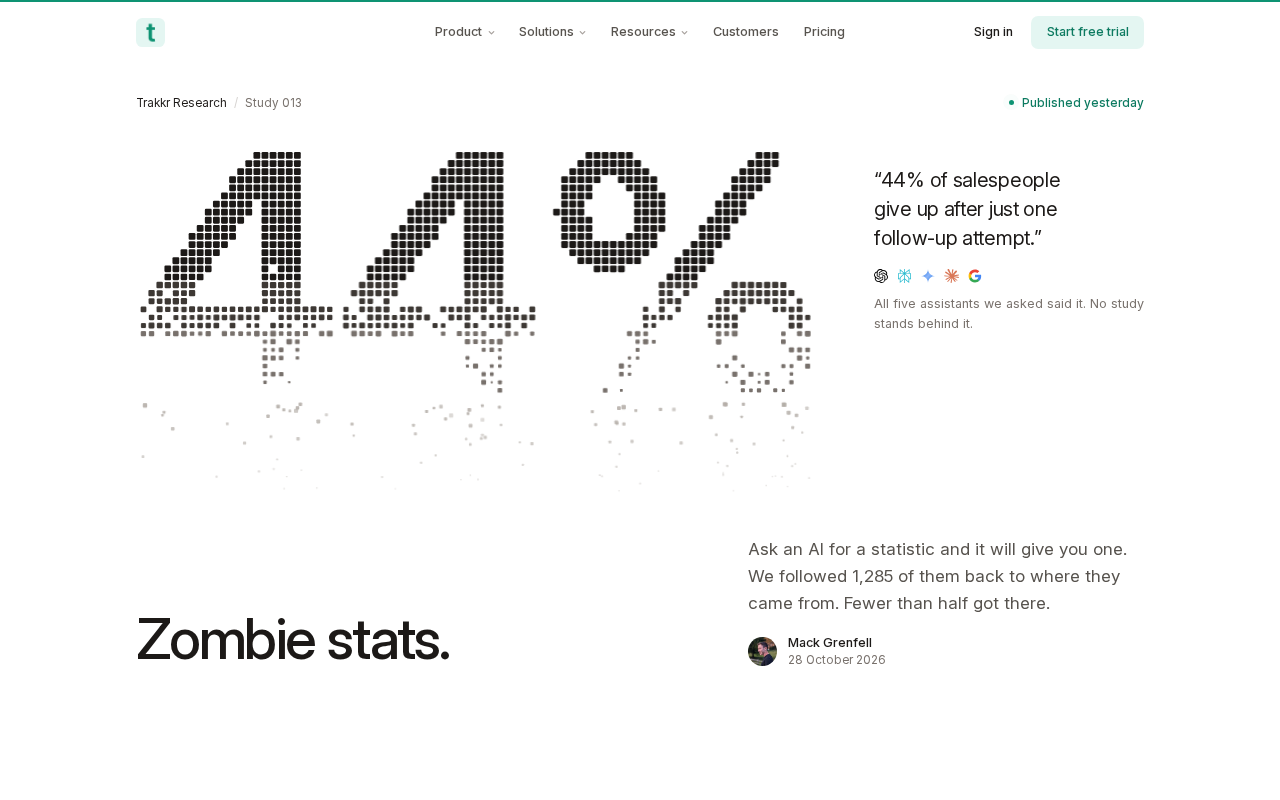
When an AI assistant cites a statistic in its answer, do you assume it can be verified? A discussion on Hacker News offers a rather pessimistic answer: only 40% of the statistics cited by AI can be traced back to a specific study. This means the sources of the other 60% are unknown, unverifiable, or possibly "pieced together" during the model's generation process.
This number deserves attention because AI is becoming the entry point through which more and more people obtain information. When users treat AI answers as factual evidence to forward, cite, or even base decisions on, statistics are the type of content most easily trusted—they look precise, objective, and persuasive. Yet it is precisely this type of content whose traceability rate is so low.
Why Statistics Are Most Easily "Distorted"
The Illusion of Authority in Numbers
Statistics carry an inherent sense of authority. A sentence containing a percentage is more convincing than a qualitative description. This psychological effect was widely exploited in the traditional media era, and in the AI era it has been magnified by an order of magnitude—because AI can generate large volumes of seemingly rigorous numerical statements at extremely low cost and with extremely high fluency.
"Number Drift" in Model Training
The learning objective of large language models is to generate plausible text, not to memorize facts verbatim. Statistical figures in the training corpus often exist inside the model as fuzzy associations, and may be "plausibly but incorrectly" reassembled during generation. The result is that a number may point in the right direction and be close in magnitude, but the specific value, year, and sample size do not match the original study.
"Number drift" is not a strict academic term but a summary of a class of phenomena: during pretraining, large language models learn statistical associations from massive corpora, but they do not store the original text verbatim; instead, they compress information into probability distributions and parameter weights. When the model generates content, it predicts "the most likely next word" based on context rather than retrieving exact values from memory. Therefore, even if the training corpus contains a precise statement such as "a certain study shows X%," the model may output a number with the same direction and a similar magnitude but a shifted value when reproducing it. This phenomenon is related to the model's temperature parameter (a setting that controls generation randomness): the higher the temperature, the more diverse the output and the greater the probability of number drift. In addition, the training data cutoff (knowledge cutoff date) may also cause the model to cite outdated statistics, further aggravating the difficulty of traceability.
The Broken Citation Chain
Even statistics that "have a source" are not necessarily reliable. The research itself may have limitations, the sample may not be representative, or the conclusion may be simplified and distorted in dissemination. When AI presents a secondhand or thirdhand number as a research conclusion, traceability becomes even more difficult.
Secondhand citation is very common in academic communication, but every retelling may introduce error. "Under specific samples and conditions, approximately 37% of participants were observed to exhibit a certain characteristic" in the original study may be simplified by media reports to "nearly 40% of people have a certain characteristic," and after being absorbed by AI into the training corpus, it may be mixed with other similar statements, ultimately generating a number that looks precise but is detached from the original context. This kind of information decay already existed in the traditional media era, but AI's large-scale generation capability causes low-quality citations to be copied and amplified in large quantities, forming a "numerical echo chamber"—an erroneous or vague statistic, after being cited repeatedly, appears even more credible. Understanding this helps users realize that even if AI provides a seemingly specific source, they still need to check whether that source is original research or a secondhand retelling.
Practical Impact on Content Creators and Users
For content workers who rely on AI-assisted writing, this 40% is a reminder: numerical statements given by AI must be verified one by one. Fluent expression from AI cannot be equated with fact-checking. A practical approach is to require AI to provide clickable sources for every sentence involving specific statistics, proportions, or research conclusions, or to search and verify them yourself.
For ordinary users, to judge whether an AI answer is credible, they can see whether it distinguishes between "general consensus" and "specific research conclusions." The latter should have a clear source. If AI is vague about the source of a statistic, that itself is a signal to be vigilant.
How to Reduce Risk: Actionable Approaches
- Require source labeling: Explicitly ask AI in the prompt to label each statistic with the study name or link, and to clearly state when content cannot be traced.
- Cross-verification: Check important data through at least two independent channels to avoid relying on a single source.
- Distinguish generation from retrieval: Prioritize tools with internet retrieval capabilities to obtain statistics with sources, rather than relying on the model's internal knowledge.
- Build a verification habit: Make "where does this number come from" the default question when reading AI output.
Conclusion: Credibility Is the Infrastructure of AI Applications
The number 40% itself comes from a discussion on Hacker News; the sample and statistical method were not elaborated in the original material, so it is better viewed as a directional signal than a precise industry benchmark. But the problem it points to is real: AI's traceability on statistical information is far from reassuring.
As AI participates more deeply in information production, traceability will become an important dimension for evaluating models and products, just like accuracy. For users, maintaining caution toward numbers is the most cost-effective cognitive habit at this stage.
Background Supplement
Retrieval-augmented generation (RAG) is currently a key technical path for reducing the risk of statistical traceability. Its core idea is: before answering, the model first retrieves relevant documents from an external knowledge base or the internet in real time, then generates an answer based on the retrieved content and attaches source links. Compared with relying solely on the model's internal parametric knowledge, RAG can significantly reduce the probability of "fabricating" statistics, because every number can be traced back to the retrieved original text. However, RAG is not foolproof: the quality of the retrieval results themselves, bias in the ranking algorithm, and the model's faithfulness to the retrieved content all affect the reliability of the final output. Therefore, when using AI tools with internet retrieval capabilities, users should still click the source links to confirm rather than assuming credibility just because "there is a citation."
Related articles

LangChain Retry Middleware Configuration: Practices and Selection Guide
Based on Reddit community discussion, this article analyzes LangChain ModelRetryMiddleware retry parameter configuration practices, covering the selection logic and alternatives for key options like max_retries, backoff_factor, and jitter.

Texas Senate Race in Trouble: Why Are Republicans Nervous?
Texas Senate race stirs Republican anxiety. Based on street interviews, this article analyzes the Democratic offensive in funding, organization, and running everywhere, and how Republicans are defending "Texas, Texas" amid the political pendulum effect.

Gemini Chat Now Generates and Edits Google Docs Directly, a New Breakthrough in Office Productivity
Google Gemini's chat interface now generates and edits PDF, Google Docs, Sheets, Slides, Markdown, TXT, and code files. Available to all users; web supports all formats, mobile only PDF for now.