Only Two Paths in the LLM Job Market: Engineering & Deployment vs. Algorithm Research

LLM careers split into two paths: engineering deployment (accessible) vs. algorithm research (elite but in-demand).
A Bilibili creator simplifies the LLM job market into two paths: Engineering & Deployment and Algorithm Research. The engineering path is accessible to bachelor's-degree holders and covers Agent development, RAG, and fine-tuning, but may face oversaturation in 5–10 years. The research path demands a 985 master's, CS/math background, and top-conference publications — yet is paradoxically the easiest to get hired in due to scarce supply. A key warning: even the engineering path requires real algorithmic knowledge. Continuous learning is the non-negotiable survival rule for both directions.
Two Career Directions in the LLM Job Market
When it comes to career planning for large model (LLM) related roles, a Bilibili content creator recently proposed a remarkably clean framework in their latest job market analysis: setting aside the common three-way split, the LLM job market essentially boils down to just two paths — LLM Engineering & Deployment and LLM Algorithm Research. According to this creator, every LLM-related role you might work in will fall into one of these two categories.
This binary framing may seem overly reductive, but for computer science students feeling lost or professionals considering a career pivot, it provides a clear coordinate system. The two directions differ significantly in educational requirements, skill demands, job availability, and career prospects — choosing the right path early can save you a lot of wasted effort.
Engineering & Deployment: The Realistic Choice for Most People
The LLM Engineering & Deployment direction is, as the name suggests, focused on application development and applied training on top of existing foundation models. This includes directly calling production-ready models like DeepSeekAd or OpenAI APIs to build intelligent agents (Agents), RAG (Retrieval-Augmented Generation) systems, or to perform model fine-tuning. The core logic is integrating business needs with large model capabilities — turning model capabilities into real, deployable product features.
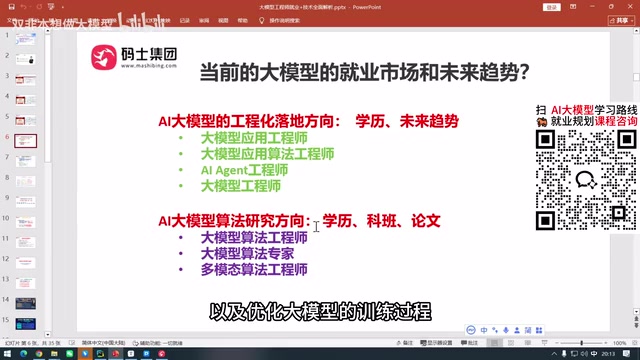
This direction covers a wide range of roles, including LLM Application Engineer, LLM Applied Algorithm Engineer, Agent Engineer, and LLM Engineer. The work spans Agent development, RAG development, and model fine-tuning, and may also involve traditional machine learning techniques — for instance, combining knowledge graphs with large models, or building Graph RAG by pairing knowledge graphs with RAG, or even using models like YOLO for image processing. All of this falls under the engineering and deployment umbrella.
The educational bar is relatively accessible: a bachelor's degree is the minimum requirement. This is precisely why the creator considers this path suitable for the majority of candidates.
RAG (Retrieval-Augmented Generation) is one of the most common technical architectures in engineering deployments today. The core idea is: when a user asks a question, relevant document snippets are first retrieved from an external knowledge base, then fed into the large model along with the question — enabling the model to generate responses grounded in real, up-to-date information. This addresses the problems of knowledge cutoff dates and hallucinations in LLMs. Graph RAG takes this further by incorporating knowledge graphs into the retrieval step, leveraging entity-relationship networks to improve multi-hop reasoning — well-suited for complex business scenarios. Fine-tuning adjusts a pre-trained model's parameters using a small amount of domain-specific data to improve performance on a specific task. Common approaches include full fine-tuning and more compute-efficient parameter-efficient methods like LoRA. Understanding the fundamental principles behind these technologies is the core differentiator that separates strong candidates for engineering roles from those who simply know how to call an API.
Algorithm Research: High Bar, but Easiest to Get Hired
The LLM Algorithm Research direction focuses on foundational research inside companies — writing operators, optimizing the model itself, improving the training process, and refining the inference pipeline. This is work that truly engages with the technical core of large models.
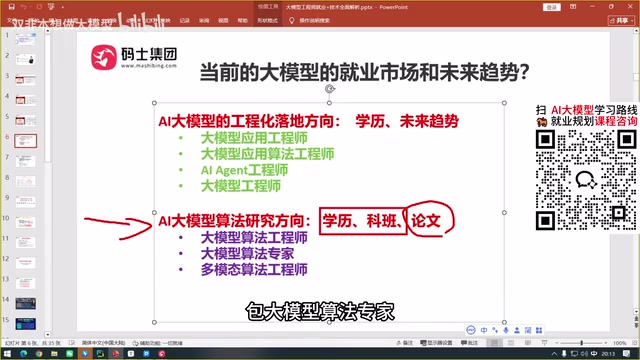
The requirements for this direction are quite demanding. The creator laid out several hard prerequisites: the minimum educational requirement is a master's degree from a 985 university; your major must be computer science or mathematics (a formal academic background in one of these two fields); and you must have publications — specifically, only top-tier conference papers count. Roles in this direction include LLM Algorithm Engineer, LLM Algorithm Expert, and Multimodal Algorithm Engineer.
Here's the counterintuitive part: despite the high bar, this direction is currently the easiest to land a job in. The creator's analysis points to a simple supply-and-demand dynamic — the pool of candidates who actually meet all these hard requirements is extremely small, creating a shortage that makes these roles highly competitive from the employer side. The high barrier itself becomes a moat.
Top-tier conferences (顶会) in the AI/ML field refer to internationally recognized, high-prestige academic venues. Representative conferences include NeurIPS, ICML, and ICLR (machine learning); ACL and EMNLP (natural language processing); and CVPR and ICCV (computer vision). Publishing at these venues means your work has passed rigorous double-blind peer review, making it far more credible than papers at ordinary journals or workshops. Top domestic tech companies and leading AI labs treat "first-author paper at a top conference" as a hard resume filter for algorithm research roles — because it directly demonstrates the candidate's ability to independently conceive a novel approach and drive it through to validated results. "Writing operators" refers to hand-coding high-performance compute kernels in low-level frameworks like CUDA, which demands exceptional mathematical and systems programming skills. This is perhaps the clearest technical dividing line between algorithm research roles and applied algorithm roles.
A Commonly Overlooked Misconception
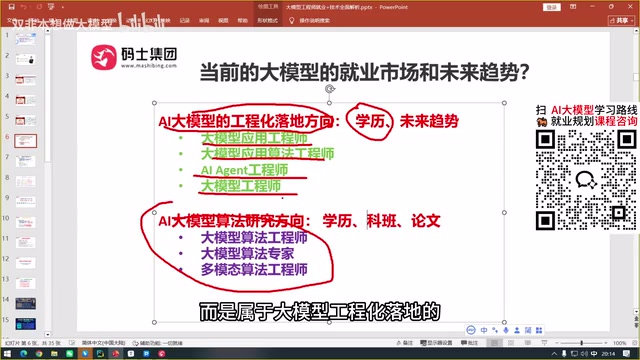
While laying out these two directions, the creator specifically called out a common misconception: never assume that the Engineering & Deployment path requires no knowledge of algorithms whatsoever. That belief is simply wrong. Even in application development, understanding the underlying algorithmic principles remains essential — without it, you'll struggle to build competitive products or handle the tuning demands of complex business scenarios. In other words, the difference between the two paths is one of depth and emphasis, not a binary of "one needs algorithms, the other doesn't."
Future Trends and the Specter of Oversaturation
In terms of sheer job volume, the Engineering & Deployment direction unquestionably leads — and that number will only grow. But the creator also offered an honest warning: because the number of people flooding into this direction is growing just as fast, the field will very likely become oversaturated in roughly five to ten years.
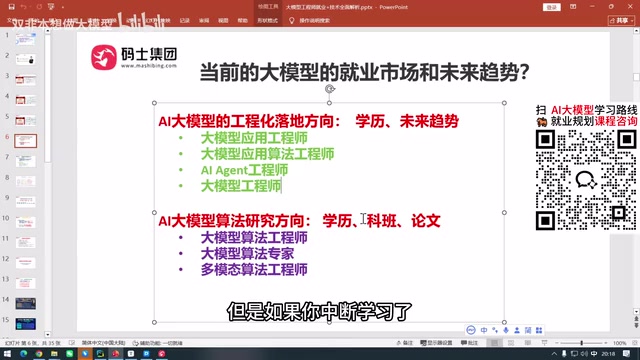
On the question of oversaturation, the creator offered a blunt piece of advice: being a software developer means learning for as long as you're working. You can learn from others or teach yourself from books, but if you stop learning for around three years, you'll likely be left behind by the industry. This isn't specific to any one direction in LLMs — it's the underlying reality of the entire software development field.
The Algorithm Research direction isn't static either. Current work is largely centered on AIGC (Generative AI), but future hot topics could easily shift toward embodied intelligence, world models, and other emerging areas. The reassuring fact, however, is that despite AI's shifting trends and hot topics over the past decade or two, the foundational core of machine learning and deep learning algorithms hasn't undergone fundamental change. This means that solid algorithmic foundations carry long-term value.
Embodied AI and World Models are two of the most closely watched emerging directions in algorithm research today. Embodied AI studies how AI systems can learn and make decisions through physical interaction with the real world — humanoid robots are the representative application. World Models aim to give AI systems an internal simulation of how the physical world operates, enabling planning and reasoning in virtual environments; Yann LeCun's JEPA architecture is a representative research effort in this space. Both directions are seen as important pathways beyond today's language-centric AIGC paradigm toward artificial general intelligence. The reason foundational machine learning and deep learning concepts (gradient descent, attention mechanisms, probabilistic graphical models, etc.) retain value across technology cycles is precisely that these new directions are all built on the same mathematical foundations.
Practical Advice for Job Seekers
Pulling together the key takeaways from this career analysis: if you hold a master's degree from a 985 university, have a formal background in computer science or mathematics, and have published at top-tier conferences, the Algorithm Research path offers high barriers to entry but low competition — making it the stronger option for you. If you have a bachelor's degree or want to enter the industry quickly, the Engineering & Deployment path offers more opportunities and a broader range of entry points.
Whichever path you choose, continuous learning is an unavoidable survival rule. AI technology keeps moving forward, change is inevitable, and once you stop learning, both directions can become dead ends. For computer science students and career changers alike, rather than agonizing over which direction to pick, the better move is to build a solid foundation in algorithms first and develop a habit of continuous learning — that is the fundamental capability for navigating the industry across multiple technology cycles.
Related articles

How Big Can Stars Really Get? The Physical Limits of the Largest Stars
Red supergiants are the largest stars by volume, with radii up to 2,000 times the Sun, engulfing the inner solar system. But there is no precise upper limit on stellar size—models predict up to 15,000 solar radii. The most massive blue stars are far smaller than red supergiants—biggest and heaviest are two different things.

Apple HomeView Smart Display Full Feature Breakdown: Wall-Mount or Desktop, $299
Apple launches HomeView, a $299 smart display with wall-mount and desktop options, 12MP camera for facial recognition, smart home control, music playback, and recipe step-by-step cooking. Full breakdown of watch faces, apps, privacy, and cooking integration.

Where Did the Promised New Studio Go? Craft Computing Answers After Five Years
Craft Computing's host responds to viewer questions: the new studio promised five years ago was shelved as construction costs soared from $30,000 to $75,000, and was replaced by a 168-square-foot garage conversion.