Oogwai Beacon: An AEO Audit Tool That Actually Asks the AI Engines

Oogwai Beacon audits AI answer engine visibility by actually querying ChatGPT, Gemini, and Claude — not just scoring your HTML.
AEO (Answer Engine Optimization) is SEO's evolution for the AI era: as users turn to ChatGPT, Gemini, and Claude for direct answers, appearing in those answers becomes a critical new channel. Oogwai Beacon audits this visibility by actually submitting unbranded buyer questions to AI engines — not just grading HTML — and returns data on mention frequency, competitor displacement, and trusted sources, with a fix recommendation for every gap found. It ranked #12 on Product Hunt.
As search shifts from keyword rankings to AI-generated answers, the logic behind traditional SEO is being rewritten. Answer engines like ChatGPT, Gemini, and Claude are becoming the new primary gateway for information — and with that comes a new concept: AEO (Answer Engine Optimization). Oogwai Beacon, which launched on Product Hunt and ranked #12, is an audit tool built precisely around this trend.
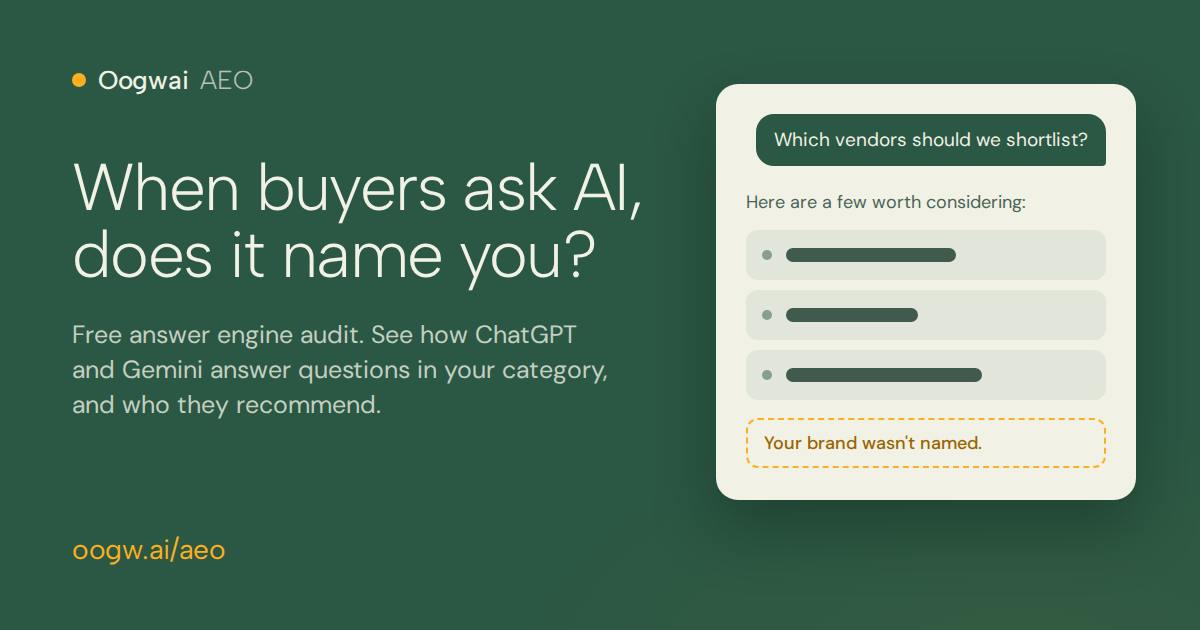
Most AEO Tools Are Just Guessing — Beacon Actually Asks
Oogwai Beacon opens with a pointed critique: most AEO tools on the market simply score your HTML and call it your "AI visibility." But how well-structured your HTML is doesn't actually tell you whether an AI engine will mention your brand in its answers.
Beacon's differentiator is that it actually goes and asks the engines. It submits a set of unbranded buyer questions to ChatGPT and Gemini (with the full audit also including Claude), then observes how these engines actually respond — a method that much more closely mirrors what real end users experience.
What are "unbranded buyer questions"? These are broad, category-level queries that users make before settling on a specific brand — for example, "What are the best project management tools right now?" or "CRM recommendations for small teams." These questions best reveal an AI engine's genuine, unprompted preferences, and they represent the core battleground for brands competing to occupy that mental entry point. By contrast, branded questions (like "Which is better, Notion or Asana?") already assume a competitive frame, making them far less useful for measuring an AI's native recommendation tendencies. By centering its tests on unbranded questions, Beacon produces audit results that much more closely reflect the experience of real potential customers.
Two Core Questions, Two Separate Answers
Beacon breaks the audit into two distinct but equally important dimensions:
1. Can AI Crawlers Actually Read Your Site?
The first question is technical: can AI crawlers properly access and parse your site's content? This check is instant and requires no sign-up, lowering the barrier to entry. If AI crawlers can't even read your pages, no amount of optimization further down the line will matter.
2. Will the Engine Actually Recommend You?
The second question gets closer to the business reality: when a user asks an AI engine about your category, does it recommend you? Beacon surfaces three key data points:
- How often you're mentioned: how frequently your brand appears in answers to relevant questions
- Who's taking your place: which competitors show up in answers more often than you do
- Which sources the engine trusts: the references and information sources AI relies on when generating its answers
The value of this combination is that it doesn't just tell you where you rank — it reveals why it's someone else instead of you, and where the information shaping that conclusion comes from.
Every Gap Comes With a Fix
An AEO audit that only surfaces problems offers limited real-world value. Beacon emphasizes that "every gap comes with the fix" — for every issue it identifies, it provides actionable remediation guidance. This pushes the tool from a pure diagnostic instrument to a "diagnosis + prescription" model, letting marketing and SEO teams act directly on findings rather than staring at a dashboard full of scores with no clear next step.
Why AEO Deserves Attention
The rise of AEO reflects a broader shift: users are increasingly turning to AI assistants for direct answers instead of clicking through search result pages. For brands, this means that appearing in an AI's answer is becoming an entirely new form of traffic and mindshare.
Traditional SEO focuses on search engine rankings; AEO focuses on AI engine citations and recommendations. The underlying logic shares common ground — quality content and technically accessible sites matter in both worlds — but the way performance is measured is fundamentally different. Beacon's approach of "just asking the engine directly" is a pragmatic response to exactly this change.
How AEO differs from traditional SEO at a fundamental level: Traditional SEO aims to get your page into Google or Bing's list of blue links, where users still choose to click. AEO operates in a different scenario: a user asks ChatGPT a question and receives a synthesized answer directly — only the brands cited or recommended in that answer actually enter the user's field of view. Brands that go unmentioned are effectively invisible. This mechanism resembles an extreme version of zero-click search, with the key difference being that AI-generated answers don't just skip the click — they actively endorse certain brands or sources.
The factors influencing whether an AI engine cites a given brand are not publicly defined, but industry consensus points to training data coverage, citation density from authoritative sources, the parseability of structured content, and brand exposure in high-credibility media. This is precisely why checking HTML structure alone is insufficient for measuring AI visibility — the underlying logic has expanded from "page optimization" to "information ecosystem building."
Summary
Oogwai Beacon targets a rapidly forming niche. Compared to tools that simply score HTML, it delivers a more realistic assessment of AI visibility by actually submitting unbranded queries to ChatGPT, Gemini, and Claude. The ability to check crawler accessibility without signing up — combined with actionable fix recommendations for every finding — lowers the trial barrier while increasing practical utility.
For marketers and growth teams asking "Will my brand even be seen in the age of AI?", tools like this offer a meaningful starting point. That said, the accuracy and long-term value of its audit results will ultimately be proven through real-world usage and feedback over time.
Related articles

JobRunner MCP Server: AI Agents Can Now Fix Failed Java Jobs
JobRunner launches an open-source MCP server enabling AI agents to view cluster status, diagnose failures, and recover Java jobs—incident response from any cloud coding environment or existing agent.

MLAI Digital Launches 9 Security Agents: MCP Server Safeguards the Full Lifecycle of Agentic AI
MLAI Digital launches Security MCP Server with nine built-in specialized security agents covering vulnerability discovery, attack simulation, prompt injection detection, API and infrastructure assessment, and accelerated remediation—embedding security validation across the full Agentic AI lifecycle from development to production.

Running Isaac Lab on H100 GPUs: Exploring Better Approaches
Exploring optimization methods for running Isaac Lab on NVIDIA H100 GPUs, including MIG configuration, mixed precision, TensorRT acceleration, and community experience to improve robotics simulation and reinforcement learning efficiency.