Opal: A Designer Built an AI Pet Assistant on Raspberry Pi Using OpenClaw

A Microsoft designer built a Raspberry Pi AI rabbit using OpenClaw, Claude, and browser automation in just a few months.
Microsoft Foundry designer Tua Nguyen created Opal, an AI rabbit assistant running on a Raspberry Pi, using the open-source OpenClaw framework with GPT-4o for transcription and Claude for reasoning. Opal can browse the web, find recipes, summarize podcasts, push content to Discord, and even commit code to its own GitHub account — demonstrating that complex Agent systems are now within reach of individual developers.
An AI Rabbit Living Inside a Raspberry Pi
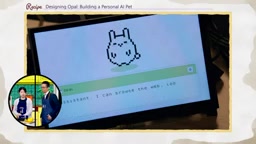
On Microsoft's Cozy AI Kitchen show, Microsoft Foundry product designer Tua Nguyen demonstrated her personal project Opal — an AI rabbit assistant running on a small Raspberry Pi screen. This virtual pet isn't just decorative: it can browse the web, find recipes, summarize podcasts, control a real browser, and sync results to Discord and GitHub.
What makes it even more impressive is that Tua graduated from college just last June. Working part-time over a few months, she completed a complex project that previously would have required an entire professional team.
"She's a rabbit who lives on the small screen of a Raspberry Pi on my desk," Opal introduced herself in a voice generated by ElevenLabs. "Tua built me from scratch as her personal AI assistant. I can browse the web, retrieve information, find recipes, summarize podcasts, and chat with her about anything."
ElevenLabs and AI Voice Synthesis: ElevenLabs is an AI voice synthesis company founded in 2022, known for its highly realistic text-to-speech (TTS) and voice cloning technology. Its core technology is based on deep learning models capable of generating natural, emotionally expressive synthetic speech in over 30 languages, with the ability to clone specific voices from minimal audio samples. Opal's choice of ElevenLabs over a system-native TTS reflects a broader trend in personal Agent projects — assembling the best available components: ElevenLabs for voice, GPT-4o for transcription, Claude for reasoning, Raspberry Pi for hardware. Each module is replaceable at low cost, all tied together by an open-source framework.
Technical Architecture: Dual-Model Collaboration + Browser Automation
Opal is built on the open-source framework OpenClaw, with two models handling different responsibilities. GPT-4o handles voice transcription — converting spoken commands into text — while Claude handles information retrieval, reasoning, and tool calls.
OpenClaw and Agent Orchestration Frameworks: OpenClaw is an open-source Agent-building framework designed for multi-model collaboration, part of a rapidly growing ecosystem of "Agent orchestration" tools. This layer bridges the gap between raw model capabilities and real-world application engineering. Similar frameworks include LangChain, AutoGen, and CrewAI. Their core value lies in abstracting tool-calling interfaces, managing multi-turn conversation context, coordinating multiple models, and handling async tasks and error retries. For individual developers, using a mature framework means not having to implement low-level Agent scheduling logic from scratch — freeing them to focus on application-layer design.
This division of labor reflects a typical modern Agent system design philosophy: let different models do what they do best, rather than relying on a single model to do everything. The entire system runs on a small Raspberry Pi — a lightweight edge device paired with cloud-based models, forming a deployable personal AI agent that is itself a noteworthy engineering achievement.
Raspberry Pi and Edge-Cloud Collaborative Architecture: Raspberry Pi is a single-board computer developed by the Raspberry Pi Foundation in the UK. Since its launch in 2012, over 50 million units have been sold at just $35–80 each. As AI applications have grown, Raspberry Pi has become emblematic of an "edge-cloud collaboration" architecture: the local device handles sensory input and UI rendering, while compute-intensive model inference is offloaded to cloud APIs. This approach reduces hardware costs, protects data privacy (sensitive interactions can be preprocessed locally), and avoids the compute limitations of running large models on consumer hardware.

Real Tool-Calling Capabilities
Opal's most essential capability is Tool Use. When Tua says "check what's new on Hacker News," Opal actually opens a browser, scrapes the page, and narrates its progress in real time via voice.
Tool Use Mechanism Explained: Tool Use is the core mechanism that allows large language models to break out of pure text conversation and interact with the outside world. The process works like this: developers declare a set of available tools to the model (e.g., "search the web," "run code," "send a message"). When the model determines it needs a tool, it outputs a structured call instruction. The host application executes the action and returns the result, which the model then uses to generate a final response. This mechanism was first introduced by OpenAI in 2023 as Function Calling, and has since been adopted by Anthropic's Claude, Google's Gemini, and others. It upgrades the model from a "knowledge retriever" to an "action executor" — the foundational building block for Agents that can truly operate a computer.
In the demo, Opal accurately reported the trending topics: "Someone announcing they're leaving tech at 517 points, GTA6 developers forming a union at 320 points, a debt economics theory at 222 points" — then pushed the full list to Discord.
This closes the complete loop of perceive → reason → act, rather than just question-and-answer dialogue.
A Pet with Its Own GitHub Account
Opal has its own independent account ecosystem, including a dedicated GitHub account. This means it can not only read information, but also perform write operations on external systems.
In the browser automation demo, Tua asked Opal to find the highest-rated Japanese cheesecake recipe. Opal opened a browser, navigated through pages, and found a soufflé cheesecake recipe from Just One Cookbook with 937 ratings and a 4.72-star average — then pushed the full recipe to Discord.
Browser Automation Background: Browser automation refers to using code to simulate human interactions with a browser. Popular tools include Playwright, Selenium, and Puppeteer. Unlike traditional API calls, browser automation can handle websites with no public API, significantly expanding the range of information an Agent can access. Recently, browser automation solutions purpose-built for AI Agents — such as Browser Use and Stagehand — have also emerged, with specific optimizations for element recognition and action planning on unstructured pages. Opal's behavior of "navigating through pages" to find a recipe is a perfect snapshot of the emerging "Computer Use" paradigm — letting AI control a computer's graphical interface.

Tua then pushed further: "Add this recipe to my recipe website." Opal used its own GitHub account to create a page and commit the content. From web retrieval and information extraction to message delivery and code commit — the entire workflow executed seamlessly, demonstrating a complete multi-tool capability chain.
Agent-Building from a Designer's Perspective
What makes Opal distinctive is that it came from a designer, not a pure engineering background. Tua hand-drew 8 different sprite expressions so Opal can react to different interactions — a specific animation when clicked, waking up when touched while asleep, and dozing off during long idle periods to "save GPU."

Tua described her motivation: "As a designer working in the Agentic AI space, it felt important to understand how Agents work and how the underlying infrastructure is built." She chose a rabbit character specifically to make the process of building an Agent fun in itself.
Advice for Aspiring Designer-Developers
At the end of the interview, host John asked Tua to share advice for young designers drawn to vibe coding. Her answer was illuminating:
"A lot of the platforms you use today have Agents running behind them. As designers, we're heading toward a world where every interface is Agent-powered — and these are ultimately the things we'll need to design. It's really important to understand how Agents work, how the infrastructure is built, and how complex the configuration can be."
Vibe Coding Background: Vibe Coding is a concept introduced in early 2025 by AI researcher Andrej Karpathy that quickly went viral. It describes a style of programming heavily reliant on AI assistance, driven by intuition and iteration: the developer describes intent in natural language, AI generates code, the developer runs it and observes the result, then describes the next adjustment in natural language — and so on, without necessarily understanding or writing code line by line. This approach dramatically lowers the barrier to programming, enabling non-traditional technical roles like designers and product managers to build working software prototypes. Tua's ability as a designer to complete a complex system like Opal in just a few months is in large part enabled by Vibe Coding. However, the approach is also controversial: critics argue that "vibe programming" without understanding underlying principles accumulates significant technical debt; supporters argue it is redefining what "technical barrier" means in the first place.
Her core advice: Build an Agent yourself — and make it fun. "You don't have to make it boring. It can absolutely be an exciting, joyful project."
The Barrier Is Disappearing: Anyone Can Build an Agent
The deepest significance of the Opal project may not lie in the technology itself, but in the trend it reveals: a complex Agent system that was once nearly impossible for an individual to build can now be happily put together by a recent graduate in a few months of spare time.
Open-source frameworks like OpenClaw, mature multi-model capabilities, browser automation tools, and affordable hardware like Raspberry Pi have collectively brought the barrier to Agent development to an unprecedented low. When a designer can build an intelligent pet that browses the web, writes code, and sends messages, the era of "anyone can build an Agent" has truly arrived.
Key Takeaways
Related articles

The Truth Behind Codex 'Build a Website in 5 Minutes': AI Isn't Creating Sites—It's Helping You Copy Them
Exposing the truth behind viral Codex 5-minute website videos: creators aren't building original sites with AI—they're copying shared prompts or scraping others' work. Learn AI coding tools' real limits.

Getting Started with AI Agent Development: A Complete Guide from Concept to Practice
A comprehensive guide to AI Agent architecture and development, covering automated marketing, intelligent customer service, and investment analysis scenarios with single and multi-agent collaboration.

The Truth Behind Codex 'Build a Website in 5 Minutes': AI Isn't Creating Sites — It's Helping You Copy Them
Exposing the truth behind viral Codex 5-minute website videos: creators aren't building original sites with AI — they're copying shared prompts or scraping others' work.