Open Oscar Server: The Open-Source IM Server Resurrecting AIM and ICQ

An open-source server reviving AIM and ICQ by implementing the classic OSCAR protocol.
Open Oscar Server is an open-source project that implements the OSCAR protocol, enabling original AIM and ICQ clients to connect to self-hosted servers. Built on years of community reverse engineering, it offers protocol-level compatibility, digital artifact preservation, privacy through self-hosting, and a valuable resource for studying real-world protocol design. While limited by client compatibility and feature completeness challenges, it represents a meaningful intersection of nostalgia, open-source spirit, and digital heritage protection.
Reviving an Internet Memory
For those who lived through the golden age of the internet around the year 2000, the names AIM (AOL Instant Messenger) and ICQ carry countless memories of youthful instant messaging. That iconic "ding" notification sound, the classic "Uh-oh!", and the anxious moments spent watching your buddy list for a friend to come online — these are shared memories that an entire generation of internet users can never quite shake.
From a historical perspective, these two applications hold monumental positions in the history of instant messaging. ICQ was launched in 1996 by the Israeli company Mirabilis and was the first internet instant messaging tool to achieve truly massive global popularity. Its name itself is a phonetic play on "I Seek You," and it pioneered paradigms we now take for granted — online status indicators, offline messaging, and more. In 1998, AOL acquired Mirabilis for a staggering $407 million, bringing ICQ under its umbrella alongside its own AIM in a dual-product strategy. AIM's dominance in the North American market was even more impressive — at its peak around 2001, AIM commanded over 50% of the North American instant messaging market with more than 18 million simultaneous online users, making it practically a staple of American teenage social life.
However, AIM officially shut down in 2017, and ICQ ceased service in 2024. These once globally beloved chat applications seemed to have permanently exited the stage of history.
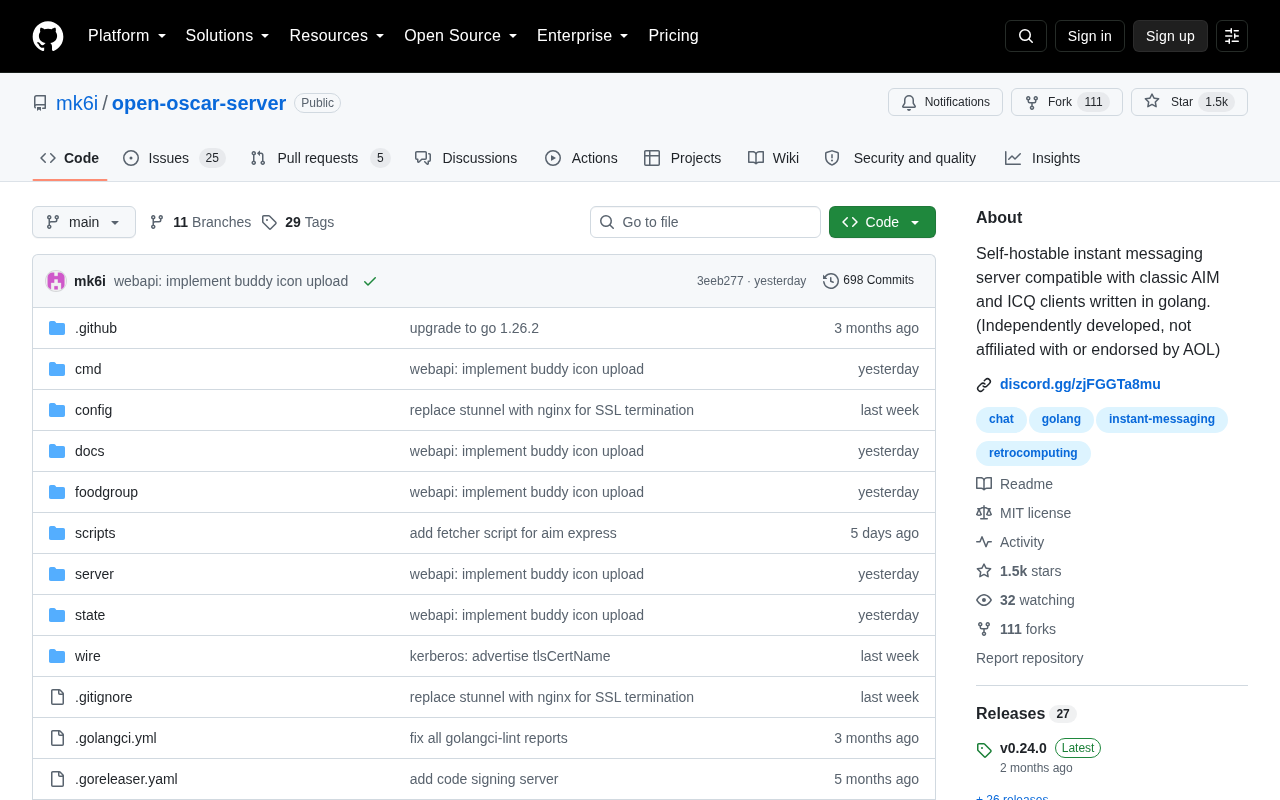
Just when most people thought this chapter was closed for good, an open-source project called Open Oscar Server quietly appeared on Hacker News, catching the eye of a group of nostalgia-driven tech enthusiasts. It's a fully open-source server-side implementation compatible with the original AIM and ICQ clients — in other words, if you still have those old client programs saved somewhere, you can now rebuild that classic chat experience on your own server.
What Is the OSCAR Protocol?
Protocol Background and the Reverse Engineering Journey
To understand the value of Open Oscar Server, you first need to understand the OSCAR (Open System for CommunicAtion in Realtime) protocol it implements. This was the instant messaging protocol developed by AOL specifically for AIM and ICQ. Despite having "Open" in its name, OSCAR was for a very long time a closed, proprietary protocol with no public documentation.
From a technical architecture standpoint, OSCAR is a binary protocol based on TCP connections, forming a stark contrast with the XML-based text protocol XMPP (Extensible Messaging and Presence Protocol) that gained popularity later. OSCAR's core employs a layered communication architecture called SNAC (Simple Network Atomic Communication): each SNAC packet is identified by a family ID and a subtype ID, with different families handling different functional modules — for example, family 0x0001 handles general services, family 0x0002 handles location information, family 0x0003 handles buddy lists, and family 0x0004 handles message delivery. This modular design was quite advanced for its time, but because the entire protocol stack was binary-encoded with no official documentation, external developers who wanted to understand and implement it had no choice but to rely on reverse engineering.
Over the years, the reverse engineering community gradually uncovered the technical details of the OSCAR protocol through packet capture analysis, binary reverse engineering, and other techniques — including the login handshake process, message packet formats, and buddy list synchronization mechanisms. Open-source instant messaging client projects played a crucial role in this process. The most representative was the Gaim project (later renamed Pidgin) and its underlying communication library libpurple — this multi-protocol open-source client accumulated a wealth of empirical knowledge about protocol behavior through its efforts to achieve OSCAR compatibility. Additionally, third-party clients like Miranda IM and Adium each independently reverse-engineered different versions and feature subsets of the OSCAR protocol. It's worth noting that AOL's attitude toward third-party clients evolved from active suppression to tacit tolerance — in the early days, AOL frequently modified protocol details to block third-party clients, even engaging in a rather dramatic "cat-and-mouse game" with the open-source community around 2000. But as AIM's market share gradually declined, this confrontation eventually fizzled out. It was precisely this accumulated work by predecessors over years and even decades that laid the indispensable foundation for projects like Open Oscar Server today.
The Core Significance of Protocol-Level Compatibility
The most fundamental value of Open Oscar Server lies in its protocol-level compatibility. Users don't need to modify or recompile the original AIM/ICQ client software — they simply point the client's server address to their self-hosted Open Oscar Server instance and can log in, add friends, send and receive messages, and more. This "plug-and-play" compatibility dramatically lowers the technical barrier for nostalgic users who want to relive the classic experience.
A comparison helps illustrate its uniqueness: if AOL had originally adopted an open standard protocol like XMPP, the community could have very easily used mature open-source XMPP servers like Ejabberd or Prosody to take over after the official servers shut down. But since OSCAR is a proprietary binary protocol whose server side was never publicly implemented, the developers of Open Oscar Server had to build a complete server-side implementation from scratch, armed only with the community's accumulated reverse engineering knowledge. The engineering effort and technical difficulty involved far exceeds simply "deploying an open-source server."
Technical Value and Use Cases
Living Preservation of Digital Artifacts
From the perspective of technical history and digital cultural preservation, Open Oscar Server holds unique significance. Software has a lifecycle, and when official servers shut down, even if the client program can still launch, it becomes a "brick" because it can't connect to backend services. What Open Oscar Server does is essentially living preservation of digital artifacts — it doesn't seal old software behind museum glass, but makes it operational and interactive once again.
This philosophy of "living preservation" is gaining increasing attention and recognition within the broader digital preservation movement. The Internet Archive has long preserved web snapshots through the Wayback Machine, but for interactive software that requires server-side cooperation to function, static archiving is clearly far from sufficient. On the legal front, the U.S. Copyright Office has discussed the protection of abandoned online services multiple times during its DMCA (Digital Millennium Copyright Act) Section 1201 exemption reviews — one important exemption that the Electronic Frontier Foundation (EFF) and other organizations continue to advocate for allows reverse engineering of discontinued online games and software to enable server emulation. This legal discussion directly affects the legitimacy and future prospects of projects like Open Oscar Server.
Similar open-source revival projects have long been common in the gaming world, where various private server emulators give discontinued online games a second life. For example, after Star Wars Galaxies shut down, the SWGEmu project rebuilt the entire game server through reverse engineering; the community servers for City of Heroes still maintain an active player base to this day. In the instant messaging space, Open Oscar Server fills a relatively blank spot in the puzzle, providing the possibility of continued survival for classic software like AIM and ICQ.
Privacy and Data Sovereignty
Beyond nostalgia value, self-hosting an OSCAR server brings tangible privacy advantages. During AIM and ICQ's heyday, all chat data had to pass through AOL's centralized servers. In fact, AOL's track record on privacy was far from spotless — in the 2006 "AOL search data leak incident," AOL's research division publicly released 20 million search queries from 650,000 users. While this incident primarily involved the search engine rather than instant messaging, it profoundly exposed the potential risks centralized services pose to user data. With Open Oscar Server, users can run their instant messaging service on hardware they fully control, with chat data no longer flowing to any third party.
Of course, in the current self-hosted instant messaging ecosystem, users already have quite a few mature options. The Matrix protocol and its client Element offer a decentralized, end-to-end encrypted modern communication solution; in the XMPP ecosystem, clients like Conversations and Gajim paired with Ejabberd or Prosody servers can similarly achieve fully self-sovereign communication. Compared to these modern solutions, a self-hosted setup based on the OSCAR protocol clearly doesn't compete in terms of security or feature richness — the OSCAR protocol was designed in the 1990s and natively lacks modern security features like end-to-end encryption. But the value of Open Oscar Server doesn't lie in being a "best practice" communication solution — it lies in providing a one-of-a-kind historical experience and cultural connection.
For privacy-conscious tech enthusiasts, small teams, or experimental communities, it offers an alternative private communication option that's both fun and functional.
A Resource for Protocol Study and Network Programming Research
For protocol developers and network programming students, Open Oscar Server is also a rare learning resource. By reading its source code, one can understand how a real-world instant messaging protocol — battle-tested over more than a decade — was designed, covering classic communication system design problems like login authentication, state synchronization, message routing, and buddy list management.
The OSCAR protocol contains many design decisions worthy of in-depth study. For example, its login process employs a challenge-response authentication mechanism: the client first connects to the authentication server (Authorizer), and upon successful verification receives a temporary cookie, which is then used to connect to the actual BOS (Basic OSCAR Service) server. This "two-stage login" design bears a striking resemblance to modern OAuth authentication flows. As another example, OSCAR's buddy list synchronization mechanism (called Server-Side Information, or SSI) involves version number comparison and incremental updates — design concepts that remain widely applicable in today's distributed systems. Compared to purely textbook examples, code from a production environment like this offers far greater reference value.
Nostalgia Culture in the Open-Source Community
Here's a telling detail: Open Oscar Server didn't exactly set Hacker News on fire — it received only single-digit upvotes and a handful of comments. But this actually reflects the true positioning of such projects: it's not a mass-market commercial product, but rather something that serves a highly vertical, deeply passionate niche community.
This is precisely where the charm of the open-source world lies. There are always developers willing to spend enormous amounts of their free time reviving software and services that commercial companies abandoned long ago. Their motivation is rarely profit — it's the pure technical challenge, nostalgic sentiment, or a sense of stewardship over digital heritage. This spirit of "powered by passion" is one of the most moving aspects of the open-source ecosystem. This same spirit thrives in the broader retrocomputing community — from BBS systems running on Raspberry Pis, to the Mini vMac project that emulates early Macintosh computers, to virtual machine images that faithfully recreate the Windows 3.1 experience, a vast and enthusiastic community continues to work at keeping past technologies tangible, usable, and understandable in the present.
Real-World Limitations and Compatibility Challenges
Of course, it's important to take an objective look at the real-world limitations facing such projects:
- Client compatibility issues: Original AIM/ICQ clients may encounter obstacles running on modern operating systems. Old Windows clients may not launch smoothly on Windows 11, and macOS users may face even more problems — since Apple completely removed support for 32-bit applications in macOS Catalina, a huge number of classic programs can no longer run natively on newer systems. Users may need to resort to virtual machines (such as running Windows XP in VirtualBox) or compatibility layers (such as Wine/CrossOver) to run these classic clients. Additionally, some old clients have built-in SSL/TLS certificates that have long since expired, potentially requiring extra configuration at the network connection level.
- Limited user base: Without a large active user base, self-hosted servers serve more as technical demonstrations or tools for small circle internal use — it's very difficult to recreate the bustling scene of hundreds of millions of users simultaneously online.
- Questionable feature completeness: Protocol compatibility achieved through reverse engineering is rarely 100% perfect. Some advanced features (such as file transfer, voice chat, custom emoticons, etc.) may be missing or unstable. The OSCAR protocol went through multiple version iterations over its lifecycle, and clients from different eras may use slightly different protocol variants, further increasing the difficulty of comprehensive compatibility.
These limitations don't diminish the project's value, but users should set reasonable expectations before deploying it.
The Long-Term Value of Technical Nostalgia
Open Oscar Server may never become a hit project, but the significance it represents transcends the software itself. In an era of rapid application turnover where online services can be shut down at any moment, open-source revival projects like this remind us of an easily overlooked truth: technology shouldn't only be about "looking forward." Looking back and preserving the tools and protocols that shaped internet history carries irreplaceable value as well.
For those who still remember staying up all night chatting with friends on AIM, being able to see that familiar login screen again and hear that iconic notification sound is, in itself, the best reward this project could offer. And for the broader tech community, Open Oscar Server serves as a vivid exercise in protocol openness, digital heritage preservation, and the open-source spirit.
Related articles

Chain of Thought Isn't Just for AI: How Humans Can Use CoT to Improve Thinking Quality
Chain of Thought isn't just a prompt trick for large models. Starting from a Hacker News discussion, this article analyzes why CoT works for human thinking too, breaks down actionable ways to transfer it, and highlights the key differences between human CoT and machine CoT.
Cloudflare Teams Up with OpenAI: Closi…
Cloudflare Teams Up with OpenAI: Closing the Loop from Vulnerability Discovery to Defense with AI
Cloudflare uses OpenAI Daybreak to investigate security vulnerabilities and generate reviewable remediation plans, while developers use Codex to boost coding efficiency and quality.

Orca Multi-Agent Orchestration in Practice: A Guide to Parallel Collaboration with Claude and Codex
Orca is Stable AI's free open-source agent workbench supporting 34 agents like Claude Code and Codex in parallel. Learn its Git worktree isolation, multi-model orchestration, and mobile management.