open-slopware: A FOSS Alternatives List for AI-Averse Developers

open-slopware: a curated FOSS alternatives list for developers who want to avoid AI integration entirely.
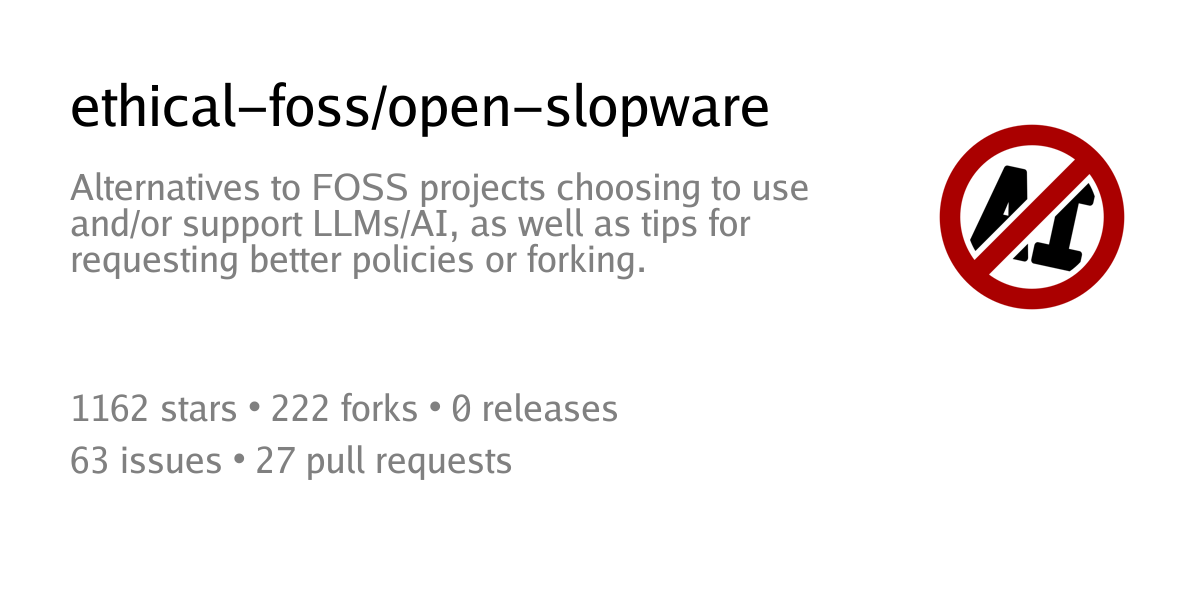
open-slopware is an open source project that appeared on Hacker News, positioning itself as a curated list of "AI-free" open source software for developers and users who don't want LLMs or AI features in their tools. It emerged in response to the growing trend of AI integration across the open source ecosystem — where AI assistants and cloud API calls are being embedded into core features, raising concerns among FOSS users about privacy, data sovereignty, and code quality. The project's name borrows the community term "AI slop" to ironically critique the trend of blindly piling on AI features. As a directory-style project, it reduces users' information-gathering costs but faces challenges around vague inclusion criteria and long-term maintenance. Its emergence reflects a deepening split in the open source community over the AI wave.
A Directory of Alternatives to "AI-ified" Open Source Projects
A project called open-slopware recently surfaced on Hacker News, raising a contentious question: as more and more free and open source software (FOSS) projects begin integrating large language models (LLMs) and AI features, what options do users who want to avoid AI actually have?
The project's core purpose is straightforward — it's an alternatives list that catalogs open source software explicitly refusing to integrate LLMs or AI into their codebase or feature set, giving AI-skeptical developers and users something to turn to. The name itself makes a clear statement: "slopware" is derived from the community term "AI slop," a sardonic label for low-quality AI-generated content. The name open-slopware uses irony to express frustration with the trend of blindly piling AI features into everything.
Why Would Anyone Need "Anti-AI" Software Alternatives?
Over the past stretch of time, a noticeable trend has emerged in the open source ecosystem: projects of all kinds have been rushing to add AI assistants, smart completion, chatbots, and similar features. For a subset of users, these additions are neither wanted nor welcome — and they raise genuine concerns.
One concern is privacy and data security. Many AI features rely on cloud API calls, which means user data may be sent to third-party servers. For the segment of FOSS users who prioritize local-first computing and data sovereignty, this directly conflicts with the original value proposition of open source software.
Another concern is software quality and maintainability. Some developers argue that over-reliance on LLM-generated code or features introduces uncontrollable quality risks, and that projects positioning AI as their core selling point raise questions about long-term sustainability. open-slopware emerged from this context, aiming to serve as an information hub — a kind of safe harbor — for this group of users.
It's worth noting that the FOSS community has always been highly sensitive to software transparency and user control. One of the core principles of the free software movement is that users have the right to inspect, modify, and control the software they run. When an open source project ships with built-in functionality that calls external AI services, even if the code itself is open, the actual data flows at runtime may be completely opaque — user input, behavioral data, and even private file contents could be sent to commercial APIs like OpenAI or Google without the user's knowledge. This directly conflicts with the fundamental goal of "users controlling their own computing environment," which is why this group of users isn't satisfied with simply "turning off the AI feature" — they want software that carries no AI dependencies from the start.
The Project's Value and Its Limitations
With 15 points and 6 comments on Hacker News, this topic clearly touches on a real user need, even if it remains a niche conversation for now. It reflects a growing split within the open source community — not every developer welcomes AI integration with open arms.
As a community-maintained alternatives list, open-slopware's value lies in reducing the information-gathering costs for AI-averse users. Directory-style projects like this are hardly new in the open source world — the awesome-list format has been widely adopted. The real challenge lies in sustained maintenance and objective inclusion criteria: How do you define whether a project "overuses AI"? Should a project that offers AI as an opt-in feature be excluded? These boundary questions will directly affect the list's practical usefulness.
The Double-Edged Nature of Taking a Stance
The project's name carries an obvious attitude, and that's a double-edged sword. On one hand, it can quickly rally like-minded community members and forge a clear identity. On the other hand, an overly adversarial name can push the conversation toward ideological posturing rather than a rational evaluation of AI features in specific use cases.
The awesome-list is a community-driven knowledge curation model that took off on GitHub — typically maintained in Markdown format as a curated collection of links on a given topic, accepting contributions via Pull Requests. These directory projects have low barriers to entry and spread quickly, but they face chronic "zombie" problems: once the initial enthusiasm fades, maintainers often struggle to keep up with reviewing the quality and currency of new submissions. For open-slopware, the challenge is especially acute: a project's degree of AI integration can shift with each new release. A project that's "AI-free" today might introduce related features tomorrow, while a project that once aggressively integrated AI might roll things back in response to user feedback. Keeping the list accurate requires ongoing manual tracking — something community-driven contribution alone is unlikely to sustain reliably over time.
A Signal of a Larger Trend
Setting aside the specifics of this project, the appearance of open-slopware is worth paying attention to as a signal. It demonstrates that amid AI technology's rapid infiltration of software of all kinds, a counter-movement is forming — one that calls for "de-AI-ification" or selective rejection of AI.
This tension isn't necessarily bad for the broader software ecosystem. It serves as a reminder to developers that AI features should be tools that expand user choice, not defaults imposed on everyone. The genuinely user-respecting approach is to keep AI features optional, transparent, and local-first wherever possible, with clear explanations of data flows. Whether users support or oppose AI, everyone ultimately benefits from a more diverse, user-centered open source ecosystem.
For developers following this conversation, open-slopware offers a window into community sentiment — and gives projects committed to an "AI-free" path a chance to be discovered.
The term "AI slop" has grown in popularity in technical communities in recent years, referring specifically to content or code generated in bulk by AI — uneven in quality, lacking human review — including auto-generated documentation riddled with errors, cookie-cutter AI writing, and LLM completions merged into codebases without adequate testing. The term carries a clear negative connotation, reflecting some developers' distaste for the "AI for AI's sake" phenomenon — where project maintainers treat AI features as attention-grabbing gimmicks or fundraising hooks rather than genuine solutions to user needs. open-slopware's name directly invokes this context, taking aim at open source projects perceived as stuffing low-value AI features into their products.
Related articles

JobRunner MCP Server: AI Agents Can Now Fix Failed Java Jobs
JobRunner launches an open-source MCP server enabling AI agents to view cluster status, diagnose failures, and recover Java jobs—incident response from any cloud coding environment or existing agent.

MLAI Digital Launches 9 Security Agents: MCP Server Safeguards the Full Lifecycle of Agentic AI
MLAI Digital launches Security MCP Server with nine built-in specialized security agents covering vulnerability discovery, attack simulation, prompt injection detection, API and infrastructure assessment, and accelerated remediation—embedding security validation across the full Agentic AI lifecycle from development to production.

Running Isaac Lab on H100 GPUs: Exploring Better Approaches
Exploring optimization methods for running Isaac Lab on NVIDIA H100 GPUs, including MIG configuration, mixed precision, TensorRT acceleration, and community experience to improve robotics simulation and reinforcement learning efficiency.