Open-Source 10.5 GHz Phased Array Radar: A New Benchmark for Low-Cost DIY Hardware

An open-source 10.5 GHz phased array radar project is making advanced RF hardware accessible to makers and students.
PLFM_RADAR is a trending GitHub project offering a complete, low-cost 10.5 GHz piecewise linear frequency modulation phased array radar system. With over 24,000 stars, it brings traditionally expensive military-grade phased array technology into the reach of hobbyists, university labs, and RF engineers. The article explores the underlying phased array and PLFM principles, X-band design considerations, and practical guidance for evaluating and reproducing the project.
An Unusual Open-Source Hardware Project
On GitHub, the vast majority of high-star projects are software tools, frameworks, or AI models. But a recent project called PLFM_RADAR breaks the mold — it's a complete, open-source, low-cost 10.5 GHz PLFM (Piecewise Linear Frequency Modulation) phased array radar system. Published by developer NawfalMotii79, the project has accumulated over 24,000 stars in a short time, gaining 204 new stars in a single day, with forks exceeding 5,500 — a clear indicator of its popularity.
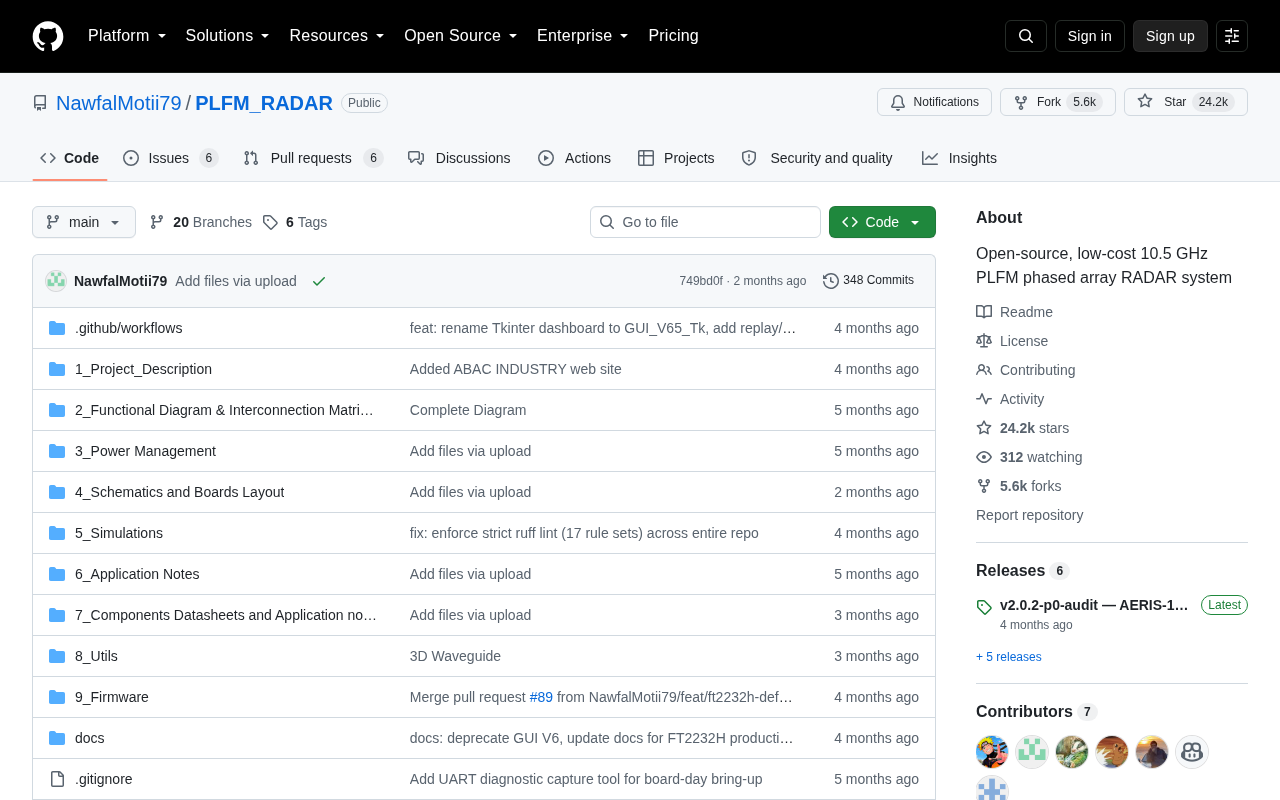
For engineers who have long followed the radar, RF, and signal processing fields, the emergence of such a project is profoundly significant. Phased array radar technology has long been monopolized by defense contractors and high-end commercial equipment manufacturers, with hardware costs easily reaching tens or even hundreds of thousands of dollars. An open-source implementation claiming to be "low-cost" brings this high-barrier technology into the view of hobbyists, university labs, and the maker community.
What Is a PLFM Phased Array Radar?
The Core Value of Phased Array Radar
Traditional mechanically scanned radars rely on physically rotating the antenna to change the beam direction. Phased array radars, by contrast, control the phase differences among multiple antenna elements to electronically steer the beam rapidly and flexibly. This means no moving mechanical parts, faster scanning speeds, and higher reliability — making it the mainstream direction in modern radar technology.
The core principle of phased array radar stems from the interference and superposition of electromagnetic waves. Signals emitted from each antenna element are precisely phase-controlled so that the beam forms constructive interference in a specific direction, thereby achieving beam steering. This technology was first deployed at scale in the 1960s with the U.S. military's AN/FPS-85 radar system, and has since become a cornerstone of military platforms such as the Aegis shipborne system (SPY-1) and the Patriot air defense system. In the civilian domain, Massive MIMO antennas widely used in 5G base stations are essentially an extension of phased array technology — using dozens or even hundreds of antenna elements working cooperatively to achieve precise beamforming toward users. In traditional phased array systems, each antenna element requires an independent phase shifter and transmit/receive module (T/R Module), which is the primary reason costs remain so high — a typical military phased array radar may contain thousands of T/R modules, each costing hundreds to thousands of dollars. This is precisely why a low-cost, open-source implementation is so valuable.
The Significance of PLFM Modulation
The PLFM (Piecewise Linear Frequency Modulation) in the project name refers to a radar signal modulation technique. Compared to traditional continuous wave (CW) or single linear frequency modulation (LFM/Chirp), piecewise linear frequency modulation can switch between multiple frequency slopes, achieving a better balance between range and velocity measurements while helping to suppress range-velocity coupling ambiguity.
To understand PLFM's value, it helps to first understand the limitations of its predecessor — standard LFM (Linear Frequency Modulation). In standard LFM, the transmitted signal's frequency sweeps linearly from a start frequency to a stop frequency within one pulse period. The receiver mixes the echo with the transmitted signal (i.e., dechirp processing) to convert the target's range information into a frequency difference. However, single-slope LFM has an inherent flaw — range and Doppler velocity are coupled: a stationary but distant target may produce the same beat frequency as a closer target with radial velocity, making the system unable to distinguish between the two. PLFM addresses this by using multiple segments of different-slope linear chirps within one pulse repetition interval. By exploiting the differences in range-velocity coupling relationships across different slopes and jointly processing them, it decouples range and velocity information to achieve high-precision estimates of both. This approach has widely used variants in automotive millimeter-wave radars (such as multi-slope chirp sequence designs in 77 GHz FMCW radars).
Operating at 10.5 GHz in the X-band, this is a commonly used frequency range for many weather radars, speed radars, and short-range detection applications, striking a balance between resolution and hardware feasibility. The X-band typically refers to the microwave frequency range of 8–12 GHz, with 10.5 GHz sitting in its center. There are multiple considerations behind choosing this band: first, ISM (Industrial, Scientific, and Medical) band allocations exist near 10.5 GHz, and some regions allow low-power devices to operate license-free, which is critical for an open-source project's regulatory compliance; second, the wavelength at this frequency is approximately 2.86 cm, making antenna dimensions quite compact — a half-wave patch antenna is only about 1.4 cm wide, facilitating the integration of multiple antenna elements into an array within a small area; furthermore, atmospheric attenuation at 10.5 GHz is relatively low (far less than at 60 GHz or millimeter-wave bands), while still providing better angular resolution than S-band or L-band. Many commercial speed radars (such as traffic enforcement radars) and Doppler weather radars also operate in the X-band, generating a wealth of publicly available technical literature and design experience that provides rich reference material for open-source reproduction.
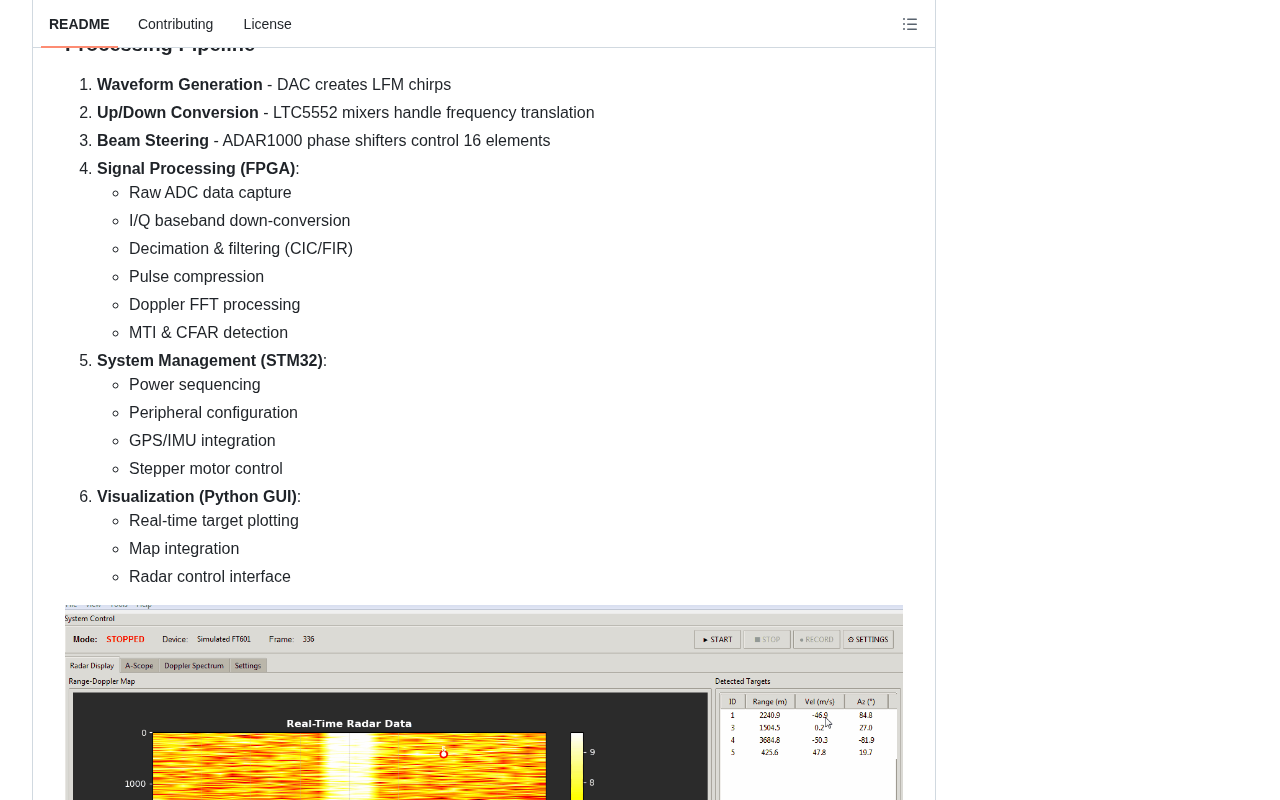
Combining "phased array + PLFM + X-band" within an open-source, low-cost framework is precisely what makes this project so compelling. It consolidates technologies previously scattered across academic papers and expensive commercial equipment into a single reproducible solution.
The Value and Challenges of Open-Source Radar Hardware
Lowering the Barrier to RF Technology
The greatest significance of open-source hardware projects lies in the democratization of knowledge. RF and radar design typically require deep backgrounds in electromagnetics, antenna design, and high-speed signal processing, with an extremely steep learning curve. A complete open-source implementation — including schematics, PCB designs, firmware, and signal processing code — allows learners to start from a "working physical system" and reverse-engineer each module's role, rather than facing abstract theoretical formulas from scratch.
It's worth noting that PLFM_RADAR is not the first pioneer in open-source radar hardware. Several milestone projects have previously paved the way: MIT Lincoln Laboratory published a "Coffee Can Radar" educational design using inexpensive components to build a simple FMCW radar, which has been used for teaching at hundreds of universities worldwide; open-source SDR (Software Defined Radio) platforms like HackRF One (~$300) and LimeSDR have brought the entry cost of RF experimentation down to the hundred-dollar level; and in more specialized directions, the OpenRadar project has attempted to provide an open-source radar platform based on TI's AWR series millimeter-wave chips. However, most of these projects remain limited to single-channel or simple transceiver architectures. Truly open-source implementations involving phased arrays — that is, multi-channel cooperative beamforming — have been extremely rare. This is the core reason PLFM_RADAR has attracted such widespread attention: it fills a gap in the open-source community for multi-channel phased array radar.
Technical Details Worth Noting
One detail worth paying attention to: the project page lists the primary language as PL/SQL, which is clearly inconsistent with the C, C++, Verilog/VHDL, or Python languages that a radar hardware project would typically use. This is very likely a misidentification by GitHub's language detection algorithm (PL/SQL has abbreviation similarity with PLFM, or certain files in the repository were incorrectly classified). This also reminds readers to examine the actual repository contents when evaluating such projects, rather than relying solely on label information.
It's worth explaining GitHub's language detection mechanism here. GitHub uses an open-source library called Linguist to automatically identify programming languages in repositories. It analyzes file extensions, content characteristics, and editor modeline patterns to make its determination, then designates the repository's "primary language" based on the byte proportion of each language's files. This mechanism works well for most software projects, but frequently misidentifies hardware projects — PCB design files (such as KiCad's .kicad_pcb files), FPGA constraint files, or configuration files in specific formats may be incorrectly categorized as some programming language. Developers can manually override detection results by adding a .gitattributes file in the repository root directory using attributes like linguist-language or linguist-vendored, but many hardware project maintainers are unaware of this mechanism, resulting in language tags that frequently don't match actual content.
Rational Assessment of High-Star Projects
Over 20,000 stars is extremely rare for hardware projects. While this reflects the community's strong demand for open-source RF/radar content, it also warrants rational assessment: star counts represent attention and bookmarking intent, and do not fully equate to a project's maturity or actual reproducibility. For engineers planning to build it themselves, the focus should be on documentation completeness, BOM (Bill of Materials) cost, and whether there are records of other users successfully reproducing the project.
When evaluating an open-source hardware project's actual reproducibility, the industry typically focuses on several key dimensions: First, BOM completeness and component availability — whether discontinued components or export-controlled chips are used. This is especially important for RF projects, as many high-performance RF chips (such as high-frequency VCOs, low-noise amplifiers, etc.) are subject to supply chain restrictions. Second, manufacturing process requirements — for RF circuits at 10.5 GHz, PCB substrate selection and trace impedance control are critical. This typically requires high-frequency substrates like Rogers RO4003C or RO4350B rather than standard FR-4 (FR-4's dielectric loss increases significantly above 10 GHz), which directly affects manufacturing cost and fabrication house selection. Third, testing and calibration procedures — phased array systems require precise inter-channel amplitude and phase calibration, which typically requires support from test equipment such as a Vector Network Analyzer (VNA), and a VNA with adequate performance may itself cost thousands to tens of thousands of dollars. Finally, community verification — whether independent third parties have successfully reproduced the project and shared their results. The best practice guidelines published by OSHWA (Open Source Hardware Association) also recommend that open-source hardware projects provide detailed assembly guides, testing procedures, and known issue lists — all important indicators of project maturity.
Who Should Pay Attention to This Open-Source Radar Project
This project is suitable for the following groups:
- RF and Radar Engineers: It serves as a practical reference for learning phased array and PLFM modulation techniques. For engineers working on automotive radar, drone obstacle avoidance, or industrial sensor development, understanding the design tradeoffs in low-cost phased arrays (such as the tradeoff between antenna element count and beamwidth, or the choice between digital and analog beamforming) has direct engineering reference value.
- University Faculty and Students: The low-cost approach makes it highly suitable as a teaching lab platform for communications and radar courses. Students can observe the complete process of beamforming, target detection, and signal processing on real hardware — far more intuitive than pure simulation (e.g., MATLAB/Simulink).
- Hardware Makers and Hobbyists: It provides a rare entry point into the millimeter-wave and microwave DIY domain. However, it's important to note that experiments in the microwave band involve RF safety and spectrum management regulations. Before getting started, you should understand local regulations regarding transmit power limits and usage permits for the 10.5 GHz band.
- Signal Processing Researchers: Real hardware-collected data can be used to validate ranging, velocity measurement, and imaging algorithms. The noise characteristics, multipath effects, and clutter interference present in real data are difficult to fully simulate — which is crucial for publishing high-quality signal processing papers.
Conclusion: Open Source Is Breaking Into Hardcore Hardware
From AI models to development frameworks, the open-source movement has profoundly transformed the software world. The popularity of projects like PLFM_RADAR signals that the open-source spirit is penetrating into higher-barrier hardware domains such as RF and radar. While a low-cost phased array radar can hardly compete with professional equipment in performance, the educational value and technological democratization it embodies far exceed the system itself.
Deeper forces drive this trend: on one hand, the prices of PCB manufacturing and SMT assembly services have dropped dramatically over the past decade (Chinese fabrication houses like JLCPCB and PCBWay have brought small-batch high-frequency board manufacturing costs down to an affordable range), enabling individuals and small teams to afford complex RF circuit fabrication; on the other hand, the prices of high-performance ADCs (Analog-to-Digital Converters) and FPGAs continue to fall, providing the hardware foundation for computationally intensive processing like digital beamforming. Together, these trends form the fertile ground for the flourishing of open-source RF hardware.
For engineers and students eager to understand how radar works but lacking a practical platform, such an open-source system that can be truly built, observed, and debugged is undoubtedly a precious gift. Of course, before diving in, carefully reviewing the project documentation and assessing the actual investment and reproducibility remains an indispensable step.
Related articles

Chain of Thought Isn't Just for AI: How Humans Can Use CoT to Improve Thinking Quality
Chain of Thought isn't just a prompt trick for large models. Starting from a Hacker News discussion, this article analyzes why CoT works for human thinking too, breaks down actionable ways to transfer it, and highlights the key differences between human CoT and machine CoT.
Cloudflare Teams Up with OpenAI: Closi…
Cloudflare Teams Up with OpenAI: Closing the Loop from Vulnerability Discovery to Defense with AI
Cloudflare uses OpenAI Daybreak to investigate security vulnerabilities and generate reviewable remediation plans, while developers use Codex to boost coding efficiency and quality.

Orca Multi-Agent Orchestration in Practice: A Guide to Parallel Collaboration with Claude and Codex
Orca is Stable AI's free open-source agent workbench supporting 34 agents like Claude Code and Codex in parallel. Learn its Git worktree isolation, multi-model orchestration, and mobile management.